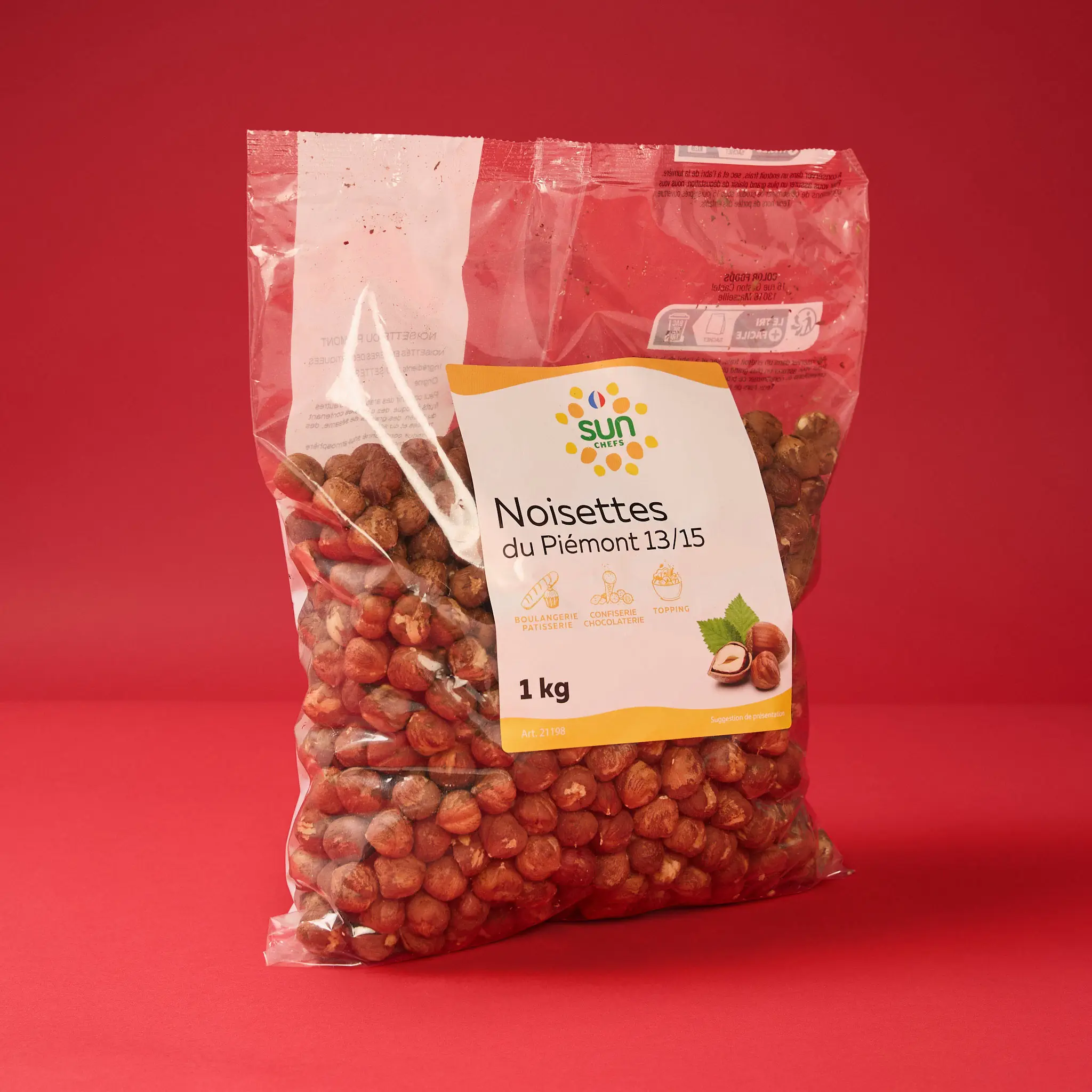



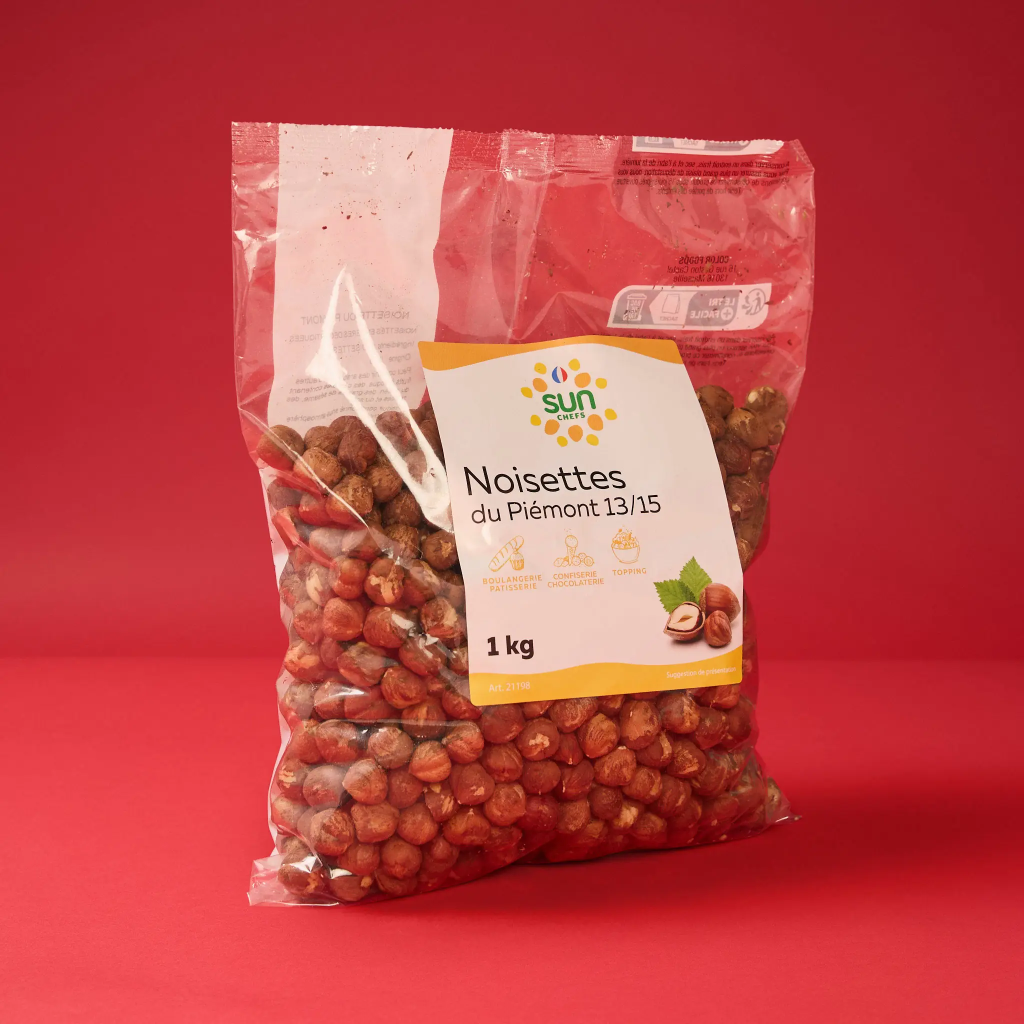

Shelled Piedmont hazelnuts PGI — dried fruit | G. Detou Paris
The Piedmont IGP hazelnut is the gold standard for precision pastry work. The Tonda Gentile delle Langhe variety, grown in the Italian Piedmont, is renowned for its exceptional aromatic yield after roasting: intense toasted-hazelnut aromas, a subtle caramel note, and a lingering finish that surpasses all other varieties.
The IGP (Protected Geographical Indication) guarantees both origin (Piedmont region, Italy) and compliance with traditional production specifications. The 13/15 mm size is the standard eating-grade caliber. The 1 kg bag is a workshop format — the packaging we recommend for regular use in homemade praliné.
\nWhy Piedmont IGP
\nPiedmont is the historical heart of the Italian chocolate industry (Turin, Alba), deeply rooted in the local hazelnut. The Tonda Gentile variety was selected over centuries for its aromatic performance when roasted: it is the hazelnut used in gianduja, in the signature pralinés of Italy's great confectionery houses, and in high-end filled chocolates.
Compared to a French hazelnut from Occitanie, the Piedmont IGP offers a more complex, more persistent aroma and a more pronounced natural sweetness after roasting. That is what justifies its premium price — roughly twice as expensive.
The IGP Tonda Gentile delle Langhe covers the Piedmontese communes of the Langhe zone — a region equally celebrated for its wines (Barolo, Barbaresco) and its Alba white truffles. The hazelnut has been cultivated here since the 18th century, and its quality has established itself as an international benchmark for precision pastry.
\nHow to Use
\nFor a very high-quality praliné: roast for 15 minutes at 150 °C, rub off the skins in a clean kitchen towel, then process in a food processor with a sugar syrup cooked to 117 °C. The result rivals a professionally made chocolatier's praliné.
For homemade gianduja: roast and grind the Piedmont hazelnuts with melted milk chocolate and a little powdered sugar. Store refrigerated. This is the base of several iconic Italian confections (gianduiotti).
As a chocolate cake decoration, a few whole Piedmont hazelnuts, lightly roasted and placed on a ganache, make an elegant visual statement — and an economical one, since just a handful goes a long way.
For a gianduja-inspired revisited Mont-Blanc, make a gianduja with Piedmont hazelnuts and milk chocolate, pipe in spirals over a meringue base, and finish with whipped vanilla cream. This Savoyard-Italian dessert makes the most of the Piedmont IGP's aromatic depth.
For a revisited Paris-Brest with Piedmont hazelnuts (an alternative to the classic almond version), make a homemade praliné with 200 g of roasted Piedmont hazelnuts, fold it into a mousseline cream, and fill a ring-shaped choux pastry. The pairing of Piedmont hazelnuts and choux is a hallmark of contemporary French pastry.
The Piedmont IGP was recognized in 1993 to protect and promote this specific hazelnut production of Italian origin. Today, approximately 2,500 growers cultivate the Tonda Gentile across the Langhe region under a strict set of specifications guaranteeing origin, variety, and traditional methods. It is the world's most prestigious hazelnut IGP.
\nDelivery & Storage
\n1 kg bag, available for in-store pickup in Paris or shipped anywhere in France. Store below 11 °C as indicated on the manufacturer's label — meaning refrigerated in summer, a very cool pantry in winter. The Piedmont hazelnut is rich in aromatic oils that oxidize rapidly when exposed to heat.
For everyday praliné work where a signature flavor profile is not required, the French hazelnut from Occitanie or a blanched Levant hazelnut are more affordable alternatives. The Piedmont IGP is reserved for pastries where the hazelnut aroma needs to take center stage.
We recommend the Piedmont IGP in small-format bags for occasional premium use, rather than in bulk. Consuming it promptly after opening preserves its aromatic potential. For regular workshop use, it can be combined with a less expensive French hazelnut for applications where the aromatic signature is not critical.
\nFrequently Asked Questions
\nWhat is the difference from French hazelnuts?
\nThe Piedmont IGP delivers a more intense, more persistent aroma and a pronounced natural sweetness after roasting. The French hazelnut from Occitanie is more neutral, more affordable, and perfect for everyday use. The Piedmont is reserved for signature pralinés and gianduja.
\nWhy the 13/15 mm size?
\nThis is the standard eating-grade hazelnut caliber. Larger sizes (15/17 or 18/20) are rarer and more expensive. Smaller sizes (10/12) are intended for industrial processing.
\nHow do you remove the brown skins?
\nRoast for 15 minutes at 150 °C, let cool, then rub in a clean kitchen towel. The skins come right off — an essential step for a light amber-colored praliné.
\nIs it suitable for homemade gianduja?
\nIt is, in fact, the reference hazelnut for exactly this use. Traditional Turinese gianduja specifically calls for the Tonda Gentile.
\nHow should it be stored to preserve the hazelnut aroma?
\nTwo to three months refrigerated (below 11 °C). Beyond that, the oil may begin to go rancid and the aroma gradually fades.
\nWhy strictly below 11 °C?
\nThe rich oil in the Piedmont IGP is less stable than that of a standard hazelnut. Prolonged storage above 11 °C accelerates oxidation and diminishes the signature aromas. That is the difference between a fresh IGP hazelnut and one that has been poorly stored.
Price per kg |
30,73 € |
Description
Piedmont hazelnuts 13/15 are superior quality dried fruits, ideal for pastry making, confectionery or snacking.
Characteristics
- Weight: 1.000 kg
- Ingredients: Hazelnuts
- Allergens: May contain peanuts, other tree nuts, gluten, sesame, soy and sulfites.
-
Nutritional values:
Energy (kJ): 2773
Energy (kcal): 672
Total Fat (g): 64
Saturated Fat (g): 4.3
Total Carbohydrate (g): 6.1
Carbohydrate (g): 3.5
Dietary Fiber (g): 14
Protein (g): 8.9
Salt (g): 0.05 - Legal name: Shelled Piedmont hazelnuts PGI
- Storage conditions: Store below 11°C
- Best before date: Refer to the packaging
Nos derniers contenus
Découvrez les nouveautés dans notre entreprise !