


Blanched hazelnuts — dried fruit | G. Detou Paris
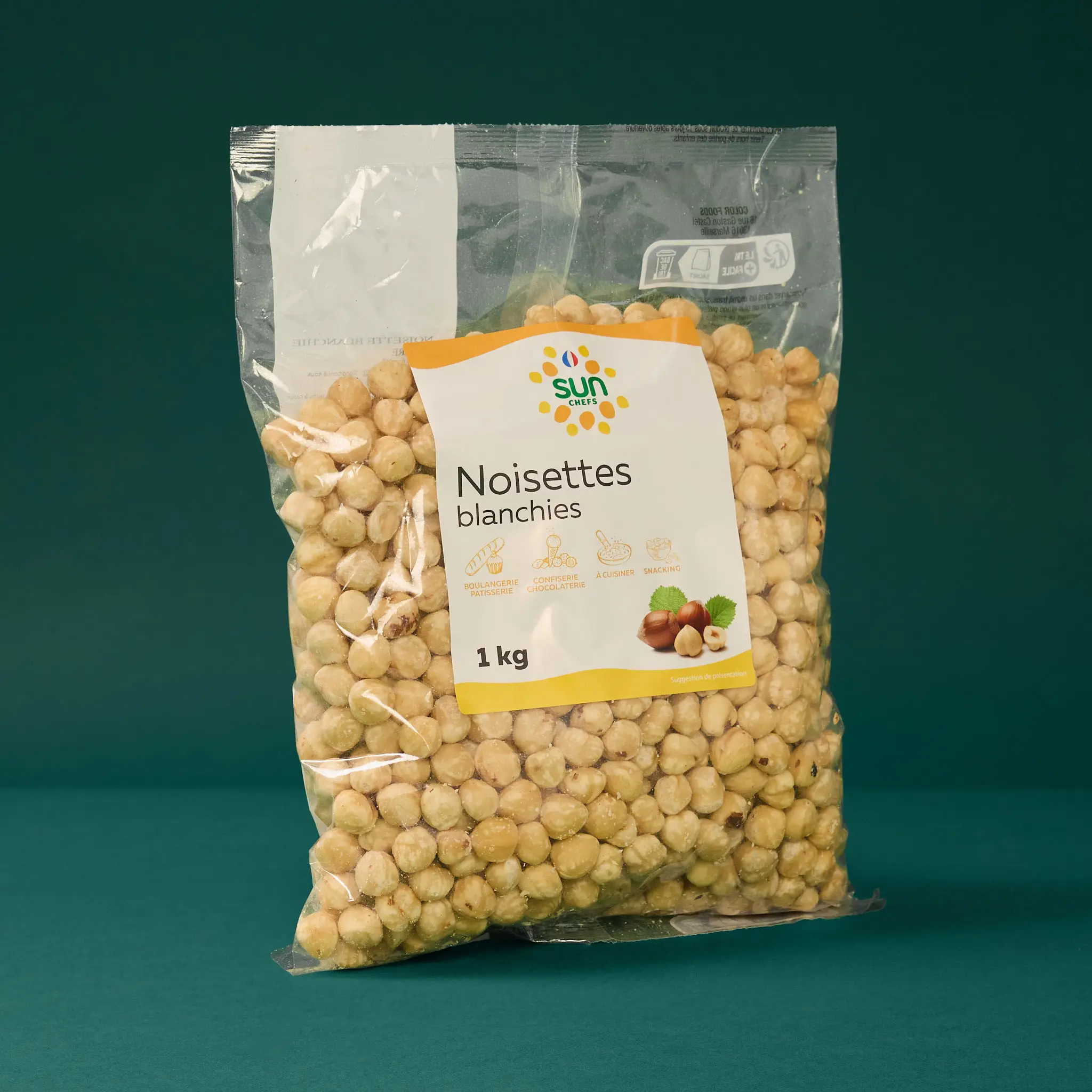
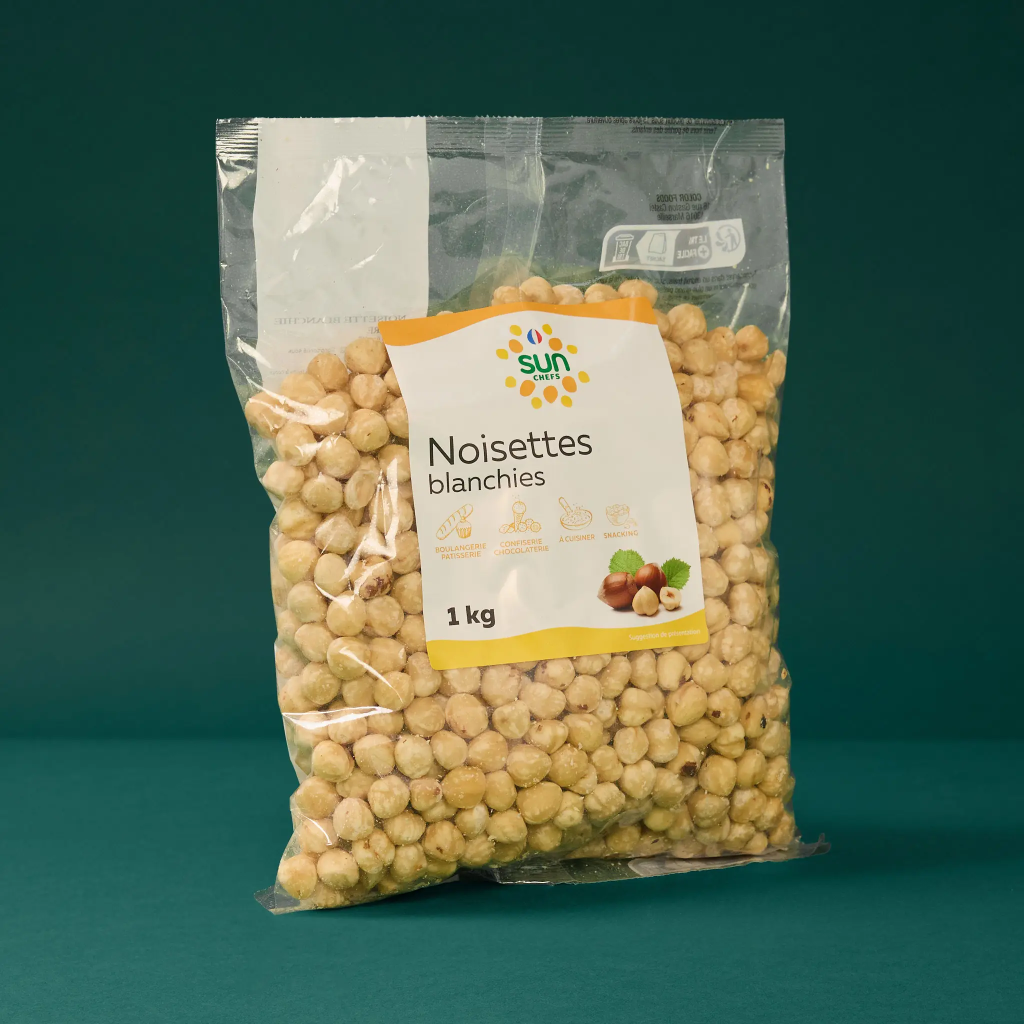
Blanched Levant hazelnuts are the skinless version, used primarily in preparations where a light color matters: white praliné, white gianduja, pale sponge bases. The Levant region — Turkey above all — is the world's top hazelnut producer, delivering consistent quality at a price point generally more accessible than French or Italian hazelnuts.
One hundred percent hazelnuts, nothing added. Blanching process: the brown skin is removed after a brief pass through boiling water, followed by a short heat treatment that lightens the natural color. 1 kg bag, workshop format.
\nBlanched and skinless — what it actually changes
\nThe brown skin of the hazelnut carries tannins and bitterness — that's exactly what gives a classic skin-on hazelnut praliné its bold, distinctive character. Remove the skin, and you get a milder, more neutral hazelnut, ideal for preparations where color and delicacy take precedence over intensity.
The blanching step is a brief heat treatment that lightens the hazelnuts visually without actually cooking them. It's an industrial process that readies the nuts for decorative use or white praliné applications at their best.
Turkey produces roughly 70% of the world's hazelnuts, primarily in the Black Sea region. The cultivated varieties (Tombul, Levant) are harvested in August–September, sun-dried, then mechanically shelled. Blanching and skinning are carried out in specialized facilities for the pastry export market.
\nUsage tips
\nFor homemade white praliné: blend the blanched hazelnuts in a food processor with a sugar syrup cooked to 117 °C. The result is light amber, smooth, and gently sweet — quite different from a classic skin-on hazelnut praliné, which runs darker and more tannic.
For white gianduja, blend finely ground blanched hazelnuts with melted white chocolate and a touch of cocoa butter. Pour into molds. This is a less common take on traditional gianduja, delivering a noticeably softer, creamier finish.
In hazelnut dacquoise biscuits, finely ground blanched hazelnuts folded together with powdered sugar produce a pale base — ideal for modern cakes where natural color is part of the aesthetic.
For individual pale hazelnut dacquoises, combine 100 g finely ground blanched hazelnuts, 100 g powdered sugar, and 4 stiffly beaten egg whites. Spread into discs and bake for 15 minutes at 170 °C. The cream-white discs are perfect for contemporary entremets with a refined presentation.
For modern individual dacquoises, combine 100 g ground blanched hazelnuts + 100 g powdered sugar + 4 stiffly beaten egg whites. Spread into 8 cm discs and bake for 15 minutes at 170 °C. The cream-white discs layer beautifully with creams and ganaches — an elegant base for contemporary entremets.
The Turkish hazelnut industry accounts for roughly 70% of global production, centered on the Black Sea region. Modern processing facilities handle skinning, blanching, and optical sorting to international standards. It's a reliable go-to for regular workshop use where value takes priority over an intensely aromatic profile.
\nPick-up and storage
\n1 kg bag, available for in-store pick-up at the Paris location or for shipping anywhere in France. Store below 11 °C as indicated on the manufacturer's label — ideally refrigerated once opened. Blanched hazelnuts, stripped of their protective skin, oxidize faster than their skin-on counterparts.
We also carry French Occitanie hazelnuts (skin-on, more assertive character) and Piémont IGP hazelnuts (the benchmark for high-end flavor). The blanched Levant 1 kg remains the workshop format of choice whenever light color is the priority.
The industrial blanching process uses a brief steam bath (60–70 °C) followed by mechanical skin removal. It's a clean food-processing step that does not alter the nutritional composition or properties of the hazelnut. Only the color and flavor — slightly softened — change noticeably.
\nFrequently asked questions
\nWhy blanched?
\nTo obtain a hazelnut with a lighter color and more neutral flavor, suited to white praliné, pale dacquoise bases, white gianduja, and any preparation where the natural color of a skin-on hazelnut doesn't fit the brief.
\nLevant or Piémont?
\nLevant for value and everyday use. Piémont IGP when you're after a signature praliné with bold, intense aroma. Each has its place depending on the application.
\nWhat size grade?
\nThe label does not specify an exact caliber for this blanched reference — Levant hazelnuts are generally graded 11/13 or 13/15 depending on the batch.
\nDoes refrigeration matter?
\nStrongly recommended. Without the protective skin, the hazelnut's natural oils oxidize more quickly at room temperature. Refrigerator storage is ideal for preserving the flavor over several months.
\nHow long will blanched hazelnuts keep once opened?
\nUp to two months in an airtight jar kept cool; four to six months when stored strictly in the refrigerator.
\nFor a Mont-Blanc, are these better than skin-on hazelnuts?
\nFor a traditional Mont-Blanc built around chestnut cream vermicelli, not particularly — chestnut is the dominant flavor. For a reinterpreted Mont-Blanc or a pale-toned hazelnut entremet, blanched hazelnuts make a stronger visual impact.
Price per kg |
22,50 € |
Description
Characteristics
- Weight: 1.000 kg
- Ingredients: Hazelnuts
- Allergens: May contain peanuts, other tree nuts, gluten, sesame, soy and sulfites.
-
Nutritional values:
Energy (kJ): 2778
Energy (kcal): 673
Total Fat (g): 62
Saturated Fat (g): 4.5
Total Carbohydrate (g): 8.2
Carbohydrate (g): 4.9
Dietary Fiber (g): 15
Protein (g): 9.4
Salt (g): 0 - Legal name: Blanched hazelnuts
- Storage conditions: Store below 11°C
- Best before date: Refer to the packaging
Nos derniers contenus
Découvrez les nouveautés dans notre entreprise !