



Burgundy mustard seeds 250g fallot
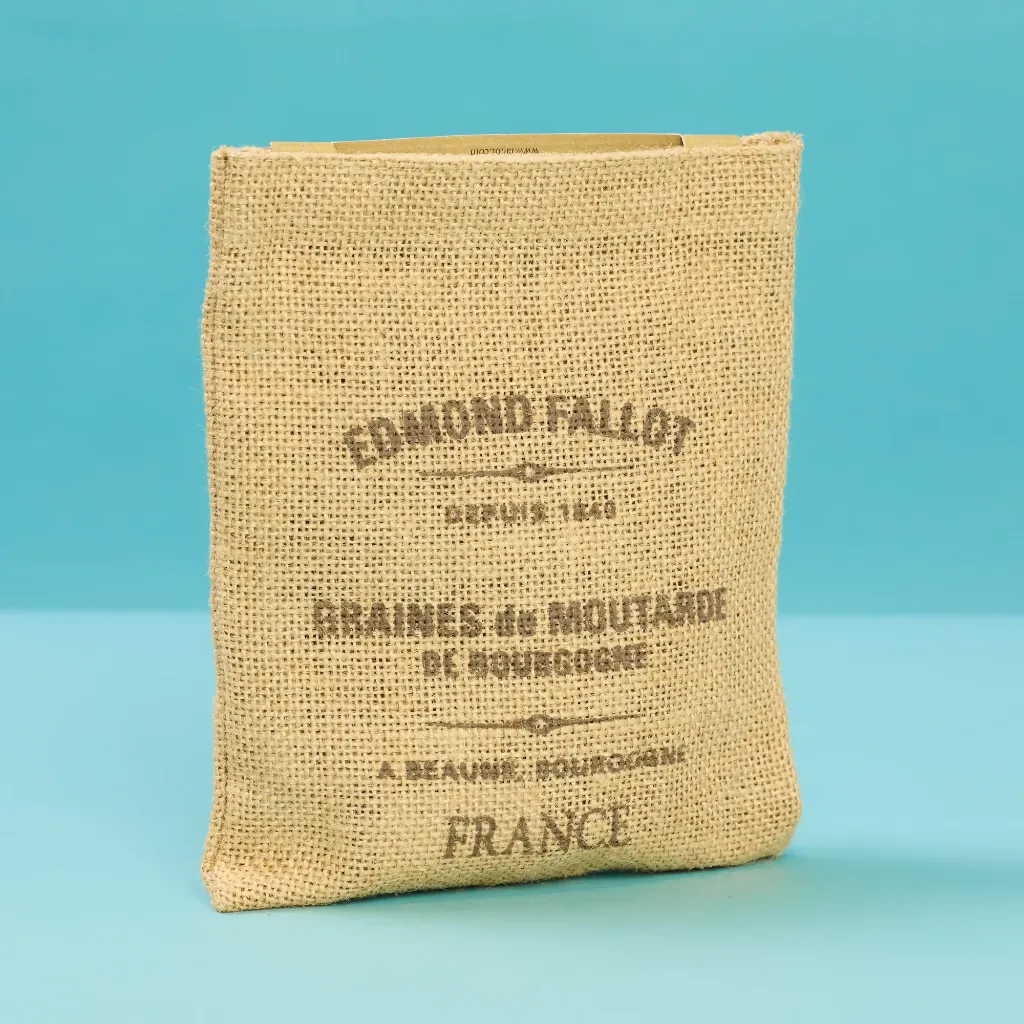
Fallot Burgundy Mustard Seeds, 250 g. Our Paris shop (2nd arrondissement) has carried them since we opened in 1951. These are raw mustard seeds of Burgundy origin — not a ready-to-use condiment but a raw ingredient for pickles, preserves, traditional Indian dishes, and homemade mustard.
\nIngredients: Mustard seeds. Size: 250 g (whole seeds), €6.40 — available for in-store pickup in Paris or shipped anywhere in France.
\nWhy We Carry This at G. Detou
\nMaison Fallot has been based in Beaune since 1840 (founded by Léon Bouley, taken over in 1928 by Edmond Fallot): five generations of mustard makers have kept production firmly in family hands. A rare technical distinction: Fallot still grinds its seeds on stone millstones, a process that protects allyl isothiocyanate — the molecule responsible for mustard's heat.
\nEvery mustard relies on the same fundamental reaction: the sinigrin in the seed is hydrolyzed during wet grinding, releasing the heat molecule. High-heat grinding partially destroys this compound; slow grinding preserves it — that is precisely what sets traditional mustard making apart from fast industrial processes. Burgundy seeds deliver a slightly sharper heat than Canadian seeds, owing to terroir and variety.
\nWe have worked with Fallot for many years: our loyalty to the brand comes from the product's remarkable consistency over time and the seriousness of this family house in Beaune. Our commercial relationship is direct with the mustard mill, with no intermediary — which makes special orders and technical recipe questions straightforward. These whole seeds are a cooking ingredient, not a table condiment. Use them ground in a spice mill (for homemade mustard) or whole (for pickles and Indian dishes).
\nFor their seeds, Fallot favors Burgundy-sourced supply when local harvest yields allow, supplementing with European seeds (Canada, Germany) in leaner years. The IGP Moutarde de Bourgogne designation, which Fallot holds, requires 100% Burgundy seeds across its labeled range.
\nHow to Use Them
\nFor homemade mustard, soak 100 g of seeds in 200 ml of vinegar plus 50 ml of white wine for 24 hours, then blend with salt and honey to taste. Allow to mature in the refrigerator for two weeks.
\nFor cauliflower pickles, add a tablespoon of seeds per jar to your vinegar-water-sugar brine — the heat diffuses slowly during curing.
\nFor an Indian fish curry, pop the seeds dry in hot oil at the start of the recipe — this is tempering, the aromatic base of Keralan cooking.
\nIdeal for pickled vegetables (onion, cucumber, beet), Indian dishes (fish curry, dal, masala), Eastern European cuisine (rollmops, sauerkraut), and homemade mustard.
\nFor wine pairings with mustard-based dishes: crisp whites (Sancerre, Chablis, Petit Chablis) pair beautifully with mustard sauces on poultry and fish, while a light Côtes-du-Rhône rouge or a Bourgogne villages will hold its own against rabbit or red meat in a mustard preparation.
\nOn the color of Fallot mustard: the exact shade depends on the seed variety (yellow or brown), water content, and the wine or vinegar used. There are no colorants — everything comes from the raw ingredients and natural oxidation.
\nA few less obvious uses: folded into a homemade cracker dough (two teaspoons per 200 g of flour), in a smoked tofu marinade, pressed into the base of a savory tart shell to add structure, or stirred into mashed potatoes at the finish for a flavor lift.
\nOn price: at €6.40 for the 250 g format of whole seeds (roughly €25.60/kg), this sits squarely in the traditional French mustard segment — more expensive than a supermarket brand, but entirely in keeping with Fallot's positioning and its family independence.
\nCulturally, mustard holds a place in the French gastronomic heritage on a par with cheese or wine: it appears in Dijon's medieval texts as early as the 13th century and was long a standard table staple across every region of France. Fallot carries that history forward in Beaune.
\nTo preserve that signature nasal heat, close the jar after each use and avoid leaving a spoon submerged in it — oxygen is the number-one enemy of fresh mustard.
\nDelivery and Store
\nAvailable for in-store pickup in Paris or shipped anywhere in France: G. Detou is located at 58 rue Tiquetonne in the 2nd arrondissement, Étienne Marcel metro station. Store in a cool, dry place away from light.
\nAt our shop at 58 rue Tiquetonne, you have access to the full expertise of our team — feel free to ask for advice on how to use a product, wine pairings, or storage. Every day, customers stop by simply to chat about a product or a recipe they're working on, and our team is always happy to engage in those kinds of gourmet conversations.
\nAllergen warning: mustard.
\nFrequently Asked Questions
\nHow do I grind the seeds?
\nUse a mortar and pestle for small quantities, or an electric coffee grinder for larger amounts. Avoid overheating: bitterness increases quickly.
\nIs the Burgundy origin guaranteed?
\nYes, with labeled traceability. Burgundy seeds are recognized for their slightly higher sinigrin content — which translates to a more pronounced heat.
\nIs it truly artisan?
\nYes — Maison Fallot is one of the very few remaining family-owned mustard mills in France. Five generations have succeeded one another in Beaune.
\nHow long do they keep?
\nTwo years in an airtight jar, stored dry and away from light. Whole dry seeds are very stable — this is their natural state after harvest.
\nWhat's the difference between yellow and brown seeds?
\nDijon seeds are yellow (Sinapis alba or hirta), with sharper heat suited to classic mustard. Brown seeds (Brassica juncea) are milder and widely used in Indian cooking.
Price per kg |
25,53 € |
Description
Mustard seeds grown in Burgundy, ideal for making homemade mustard or for flavoring your dishes.
Characteristics
- Weight: 0.250 kg
- Ingredients: Mustard seeds
- Allergens: Mustard
- Legal name: Burgundy Mustard Seeds 250g
- Storage conditions: Store in a cool, dry place, away from light.
Nos derniers contenus
Découvrez les nouveautés dans notre entreprise !