


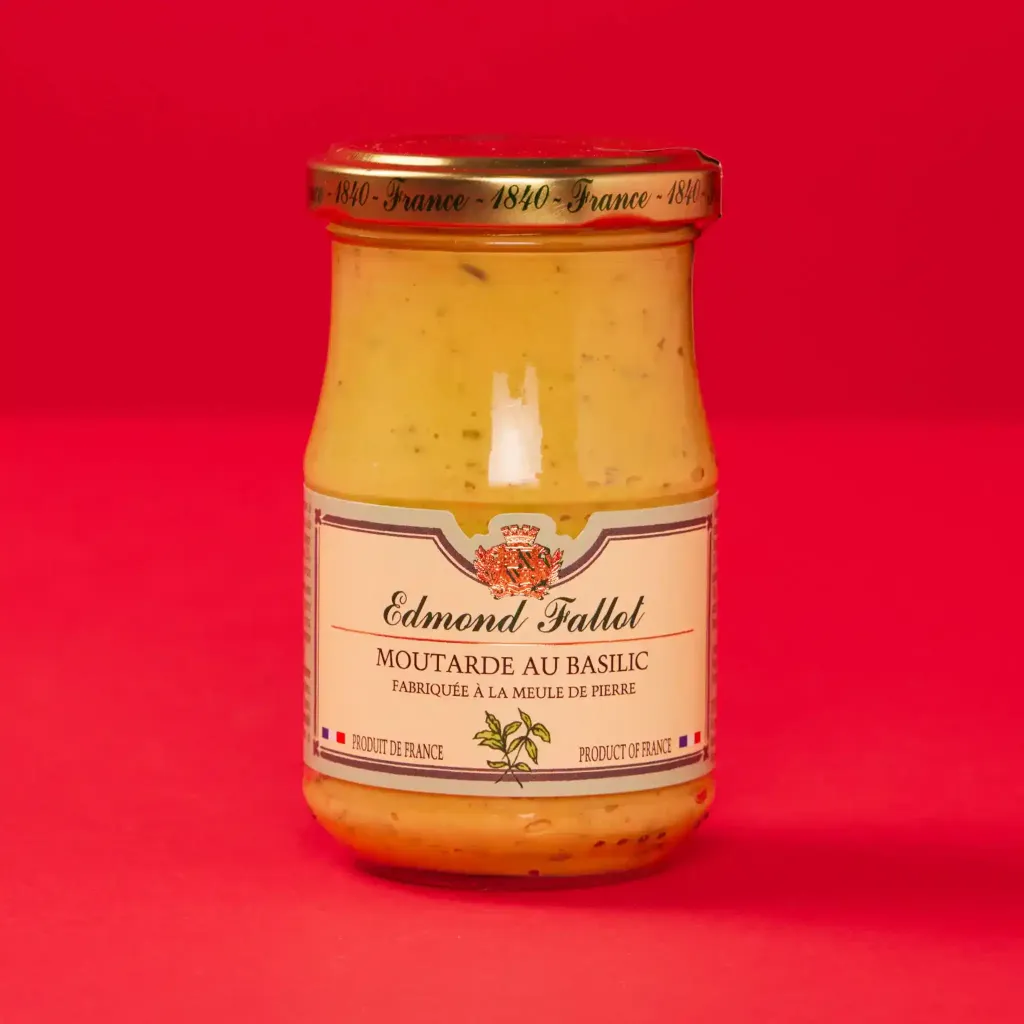

Dijon mustard with basil, 21cl, Fallot
Fallot Dijon Mustard with Basil, 21 cl. One of the staple references we've kept on our shelves for regulars at the Paris store since 1951. A classic Fallot aromatic recipe: Dijon mustard with 1% basil, for a Mediterranean herbal touch.
\nIngredients: Water, mustard seeds, vinegar, salt, basil 1%, antioxidant: potassium disulfite, acidifier: citric acid, spices. 21 cl format, €3.10 in store.
\nWhy We Carry This at G. Detou
\nFounded in Beaune in 1840 by Léon Bouley and taken over in 1928 by Edmond Fallot, the Fallot house is today one of the last two or three independent French mustard makers still in operation. The Fallot method: slow stone-grinding rather than high-speed mechanical milling, so the mustard paste never heats up.
\nMustard's heat comes from a plant enzyme, myrosinase, which releases allyl isothiocyanate upon contact with water the moment the seeds are ground. The entire art of mustard-making lies in preserving this fragile molecule from field to jar — every heat step means a loss. This is the ideal mustard for Mediterranean recipes when you don't have fresh basil on hand.
\nFallot is one of the cornerstone brands in our condiment aisle — we keep it in near-permanent stock because customers who buy one jar come back for more on a regular basis, which validates our decision to carry it. Repeat purchasing is one of the strongest quality indicators for a neighborhood specialty grocer. The 1% basil delivers a clean but understated note — this is a summer mustard, a natural match for Italian-inspired dishes and fresh salads.
\nOn the production side, Fallot's mustard paste undergoes a resting period after grinding (anywhere from a few hours to a few days depending on the recipe) to let the heat stabilize. It's an extra step that industrial producers skip in the name of throughput.
\nHow to Use It
\nFor a caprese salad dressing, whisk the basil mustard with white balsamic vinegar and olive oil — a direct match with tomato and mozzarella.
\nFor oven-baked sea bream en papillote, spread a thin layer of basil mustard over the fish before cooking — the herb perfumes the flesh without overpowering it.
\nFor a quick pesto, blend basil mustard with toasted pine nuts, grated Parmesan, and olive oil: an instant pesto with no chopping of fresh herbs required.
\nTomato-mozzarella, Italian salads, grilled white meat, fish en papillote, summer vinaigrettes. It brings the basil note without the need to chop fresh leaves.
\nOn the drinks side: a top-fermented pale ale — Belgian Saison, Northern French Bière de garde — stands up beautifully alongside mustard-dressed meat. It's the classic pairing of bistros across northern France and Belgium.
\nA tip for the empty jar: don't toss it right away. Once rinsed, it makes a perfectly good container for homemade jam, spices, or seeds — Fallot jars are standard recyclable glass.
\nFor everyday cooking with a twist: a spoonful stirred into homemade pizza dough, a parsley-based revisited pesto, a cheese omelet for added depth, or a reinvented carbonara sauce.
\nOn a per-kilo basis, the 21 cl jar at €3.10 works out to roughly €15.50/kg — a typical price point for Fallot mustards, which sit in the upper-mid segment of the French condiment market.
\nA detail that's often overlooked: mustard is one of the allergens officially listed under European regulation INCO 1169/2011. Its declaration is mandatory in food service and the food industry — it must be clearly identified on menus and labels whenever the condiment is present in a dish.
\nFor a stable emulsion (vinaigrette, mayonnaise), mustard acts as an emulsifier: a quarter teaspoon is enough to bind a two-person vinaigrette.
\nDelivery and Store
\nFree in-store pickup at our Paris location, 58 rue Tiquetonne (Paris 2nd arrondissement, Étienne Marcel metro), or shipping anywhere in France. Keep the jar refrigerated once opened.
\nThe G. Detou store is open Monday through Saturday during the day, closed on Sundays. We're always happy to welcome customers for advice and tastings by appointment — call ahead or stop by to arrange a visit if you're planning a catering project or an event. For large orders, please allow extra lead time to ensure availability.
\nDeclared allergens: mustard, disulfite.
\nFrequently Asked Questions
\nIs 1% basil really enough?
\nYes — the note is clean but not dominant. Basil is a powerful herb; at a higher concentration, it would overwhelm the mustard's heat.
\nReal basil or flavoring?
\nReal basil at 1% according to the label — no artificial flavoring listed.
\nTruly artisanal?
\nWithout a doubt — Fallot is an independent, family-run French mustard house that produces in Beaune using the traditional Burgundian method.
\nHow long does it keep after opening?
\nFour to six months refrigerated. The basil aroma gradually fades — after about four months, it settles back toward a near-plain mustard.
\nWhat does it pair best with?
\nAnything in the Mediterranean pantry: tomato, mozzarella, zucchini, white fish, white meat. Less suited to northern European cuisine or game.
Price per kg |
15,23 € |
Description
Dijon Mustard with Basil – 21 cl
Characteristics
- Weight: 0.200 kg
- Ingredients: Water, MUSTARD seeds, vinegar, salt, basil 1%, antioxidant: potassium disulfite, acidifier: citric acid, spices.
- Allergens: Mustard, disulfite.
-
Nutritional values:
Energy (kJ): 677 kJ
Energy (kcal): 163 kcal
Total Fat (g): 12
Saturated Fat (g): 0.8
Total Carbohydrate (g): 3.7
Carbohydrate (g): 2.5
Protein (g): 7.1
Salt (g): 6.6 - Legal name: Dijon Mustard Basil
- Storage conditions: Keep refrigerated after opening.
Nos derniers contenus
Découvrez les nouveautés dans notre entreprise !