


Dijon mustard e.fallot 1.1kg fallot
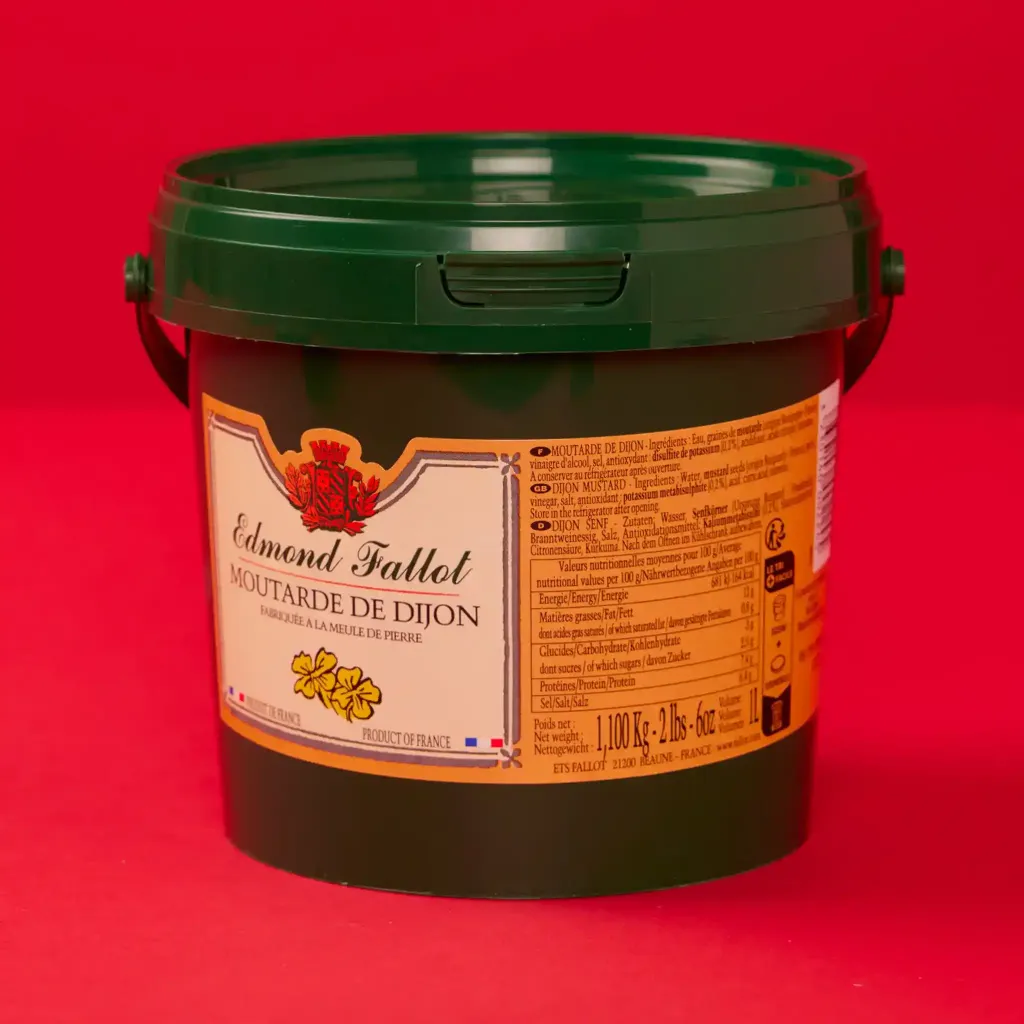
E. Fallot Dijon Mustard, 1.1 kg. You'll find it in our store at 58 rue Tiquetonne, Paris 2nd arrondissement, just as you have since we opened in 1951. A pro-bistro format: the same Fallot Dijon recipe, in a catering-size 1.1 kg jar.
\nLabel ingredients: Water, mustard seeds, vinegar, salt, antioxidant: potassium disulfite, acidifier: citric acid, spices. 1.1 kg format, €7.20 — available in-store in Paris or shipped anywhere in France.
\nWhy We Carry This at G. Detou
\nThe Fallot house has called Beaune home since 1840 (founded by Léon Bouley, taken over by Edmond Fallot in 1928): five generations of mustard makers have followed one another there, keeping production firmly in their own hands. A rare technical distinction: Fallot still grinds its seeds on stone millstones, a process that protects allyl isothiocyanate — the molecule responsible for mustard's heat.
\nEvery mustard is built on the same fundamental reaction: the sinigrin in the seed is hydrolyzed during wet grinding and releases that heat-giving molecule. Hot grinding partially destroys the compound; slow grinding preserves it — that is the entire challenge facing traditional mustard-making in the face of fast industrial processes. The 1.1 kg jar is one of the top sellers in our condiment section among our restaurant clientele.
\nFallot became the obvious choice for the consistency of the product over time — every jar has the same aromatic profile, with very little variation between batches, which is an essential criterion for the neighborhood restaurateurs who anchor their recipes around it. A mustard that shifts from one jar to the next throws a professional kitchen into disarray. This is the format that restaurateurs and personal chefs regularly come to pick up at our Paris store. For an ordinary household, it's too much: the mustard loses its bite before the jar is finished.
\nThe water Fallot uses comes from Burgundian groundwater aquifers — a factor that is often overlooked but that influences the final result, since water hardness affects the texture of the mustard paste.
\nHow to Use It
\nFor a revisited carbonnade flamande, deglaze the browned onions and meat with a dark beer and stir in two tablespoons of Dijon mustard. Simmer for three hours.
\nFor a buffet vinaigrette serving twenty: one hundred grams of mustard, two hundred grams of wine vinegar, six hundred grams of oil, salt, and pepper. Blend to emulsify.
\nFor a classic cream-based dijonnaise sauce, reduce a white stock, add thick crème fraîche, two tablespoons of mustard, and a squeeze of lemon juice. A natural partner for rabbit and pork.
\nIn a restaurant setting, it works across three applications: at the table (in a pot for service), in sauces (deglazed meat jus, dijonnaise), and in marinades (chicken, rabbit, pork).
\nOn the wine pairing side: mustard calls for a crisp white or a light red — never a heavily tannic wine, which would amplify the bitterness. A village-level white Burgundy is the ideal compromise for most mustard-based dishes.
\nOn the pH side: a standard mustard has a pH between 3.2 and 3.8 (acidic), sufficient to inhibit bacterial growth and naturally preserve the product for several months. It is the mustard's own acidity — not a preservative — that ensures its longevity.
\nA few alternative uses that work particularly well: stirred into a revisited hollandaise, blended into a maître d'hôtel butter for grilled meats, used in a Caesar dressing for a peppery kick, or as a marinade for pork tenderloin on the barbecue.
\nIn terms of price per kilogram, this 1.1 kg jar comes to approximately €6.55/kg — a French specialty grocery price that reflects independent production, quality sourcing, and the choice of slow stone grinding.
\nFor those wanting to dig deeper into Dijon vs. Burgundy mustard: the former is a free commercial name (anyone may use it), while the latter holds an IGP designation with strict specifications (100% Burgundian seeds, Aligoté wine). It is an important distinction when you want to be certain of the genuine French origin of what you are eating.
\nOne practical tip: if a skin has dried out on the surface of the mustard, scrape it away with a spoon and stir well — the oxidized layer is not representative of the rest of the jar.
\nDelivery and Store
\nPick up in-store in Paris (58 rue Tiquetonne, Paris 2nd arrondissement) or shipped within metropolitan France. Refrigerate after opening.
\nFor delivery within metropolitan France, we work with a tracked parcel carrier. Orders placed online before 2 p.m. on weekdays generally ship the same day or the next. Standard delivery times are 2 to 4 business days depending on your area — slightly longer for Corsica, the French Antilles, or poorly served rural zones.
\nAllergen labeling: mustard, disulfites.
\nFrequently Asked Questions
\nWho is this for?
\nRestaurateurs, personal chefs, caterers, and large households with heavy usage. For everyday domestic use, the 21 cl or 37 cl jar is a better fit.
\nHow long does it keep after opening?
\nSix months refrigerated in a tightly sealed jar. To preserve the heat, avoid leaving a spoon in the jar and reseal it firmly after each use.
\nWhat's the difference from the 5 kg pail?
\nNone in terms of the recipe: only the packaging changes. The 5 kg is intended for institutional foodservice; the 1.1 kg suits small restaurants and large families.
\nIs Fallot truly artisan-made?
\nYes — Fallot has refused acquisition by multinational groups. Production remains in Beaune using the historic Burgundian stone-grinding method.
\nDoes it contain sulfites?
\nYes, potassium disulfite (E224) is used as an antioxidant. This is standard practice in mustard-making to preserve color and aroma.
Price per kg |
6,23 € |
Description
E. Fallot Dijon Mustard – 1.1 kg.
Characteristics
- Weight: 1.100 kg
- Ingredients: Water, MUSTARD seeds, vinegar, salt, antioxidant: potassium disulfite, acidifier: citric acid, spices.
- Allergens: Mustard, disulfite.
-
Nutritional values:
Energy (kJ): 681 kJ
Energy (kcal): 164 kcal
Total Fat (g): 12
Saturated Fat (g): 0.8
Total Carbohydrate (g): 3
Carbohydrate (sugars) (g): 2.5
Protein (g): 7.4
Salt (g): 6.4 - Legal name: Dijon Mustard
- Storage conditions: Keep refrigerated after opening.
Nos derniers contenus
Découvrez les nouveautés dans notre entreprise !