



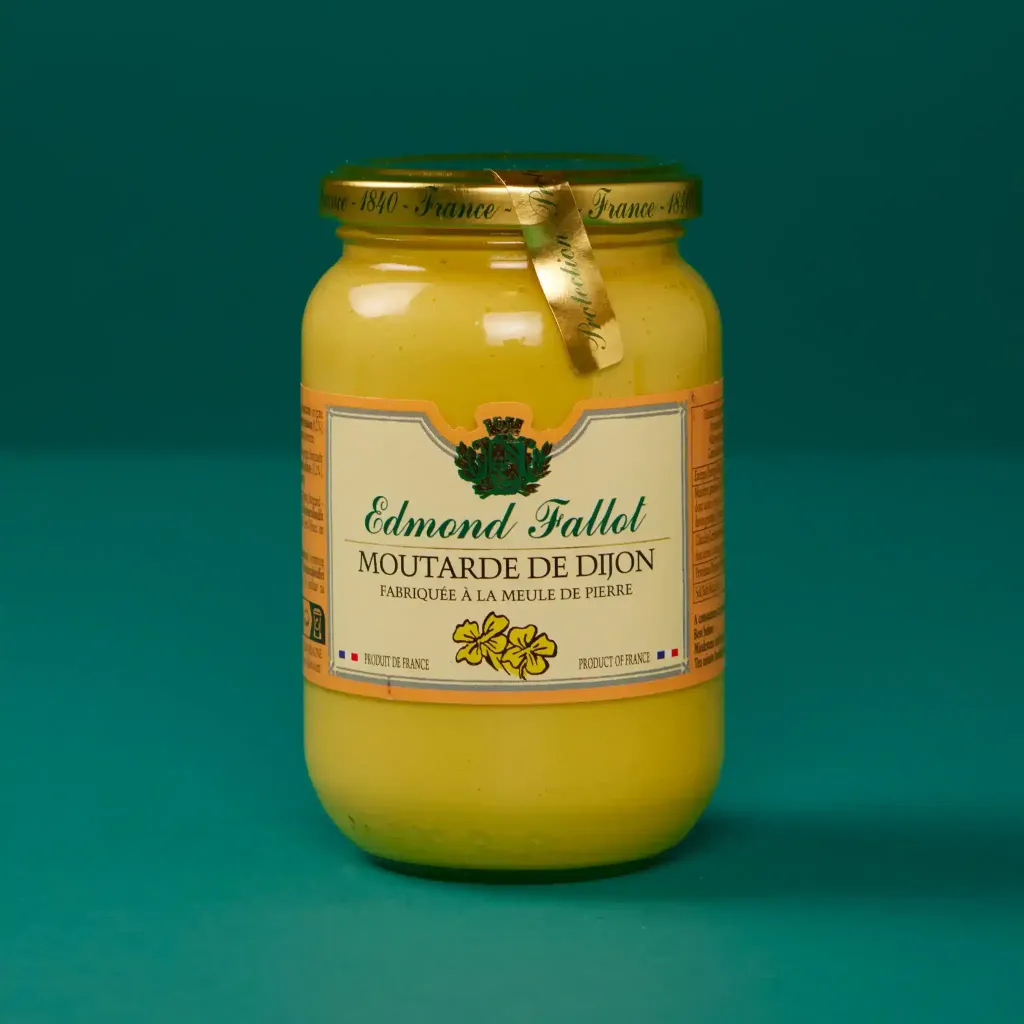

Fallot Dijon Mustard, 37cl Jar
Fallot Dijon Mustard, 37 cl jar. This is one of the staple references we have kept on our shelves for regulars since 1951, available at our Paris store. Classic Dijon recipe: round, sharp, lightly vinegary, with no added aromatics.
\nLabel ingredients: Water, mustard seeds, vinegar, salt, antioxidant: potassium disulfite, acidifier: citric acid, spices. 37 cl jar format, €3.20 — available for in-store pickup in Paris or online order.
\nWhy this product at G. Detou
\nThe house of Fallot has been established in Beaune since 1840 (founded by Léon Bouley, taken over in 1928 by Edmond Fallot) and stands among the last independent family-owned mustard mills in Burgundy. The house retains stone-wheel grinding, a slow method that generates minimal heat and preserves the volatile compounds responsible for nasal heat.
\nThe nasal heat of mustard comes from allyl isothiocyanate, a molecule released through hydrolysis of sinigrin during grinding. The slower and cooler the grind, the longer this molecule is retained in the jar. This chemistry explains the perceptible quality gap between a traditionally made mustard and an industrially accelerated one. The 37 cl format sits between everyday single-household use and the larger 1.1 kg family size.
\nAt G. Detou, we chose Fallot for the consistency of its quality and for its sourcing — the Beaune house has supplied our shop for several decades without any notable change in aromatic profile. That is rare in a food industry in constant flux, and it is what justifies our loyalty. The 37 cl jar suits a household that goes through a jar in four to six weeks. Beyond that timeframe, the 21 cl size is the better choice to keep the heat intact.
\nOn the seed side, Fallot favors Burgundy-sourced seeds when local harvest yields allow, supplementing with European seeds (Canada, Germany) in leaner years. The IGP Moutarde de Bourgogne certification, to which Fallot adheres, requires 100% Burgundy seeds for its labeled range.
\nUsage tips
\nFor a classic vinaigrette: one teaspoon of mustard, two tablespoons of wine vinegar, six tablespoons of oil, salt, and pepper. Whisk to emulsify and use immediately — the mustard acts as the emulsifier.
\nFor rabbit with mustard, coat the pieces in a thick layer of mustard before roasting at 350 °F for one hour and ten minutes. Deglaze with white wine at the end of cooking.
\nFor a homemade mayonnaise, start with one egg yolk at room temperature, a dab of mustard, then drizzle in the oil while whisking. The mustard stabilizes the emulsion.
\nIt pairs naturally with grilled red meat, steak tartare, green salad vinaigrette, and homemade mayonnaise. When cooking, add it at the end of preparation — otherwise the heat dissipates.
\nFor wine pairings with a mustard-based dish: lively whites (Sancerre, Chablis, Petit Chablis) complement mustard sauces on poultry and fish well, while a light red Côtes-du-Rhône or a Bourgogne Villages will stand up to rabbit or red meat prepared with mustard.
\nA small technical note on color: a fresh mustard is pale lemon-yellow; it shifts toward golden yellow and then brownish-yellow over time. This evolution is normal and not a sign of spoilage as long as the aroma remains fresh.
\nA few less obvious uses: in a homemade cracker dough (two teaspoons per 200 g of flour), in a smoked tofu marinade, spread on the base of a savory tart shell to add structure, or stirred into mashed potatoes as a finishing touch to brighten the flavor.
\nA quick note on price: in the 37 cl jar format, this works out to roughly €8.65/kg — a positioning that holds up well for a traditional French mustard compared to industrial varieties available at bargain prices but with far more generic aromatic profiles.
\nFor those who want to explore further, G. Detou's condiments section also carries other traditional mustard references: an English-style mustard in the Coleman's tradition for British applications, a mild American-style mustard for hot dogs, and several flavored mustards beyond the Fallot range to explore regional variations (blackcurrant, honey, truffle, herbs).
\nTo preserve the nasal heat, close the jar after each use and avoid leaving a spoon resting inside — oxygen is a fresh mustard's number one enemy.
\nDelivery and store
\nFree in-store pickup at our Paris location, 58 rue Tiquetonne (Paris 2nd arrondissement, Étienne Marcel metro), or shipping anywhere in mainland France. Refrigerate after opening.
\nThe G. Detou store is open Monday through Saturday during the day, closed on Sundays. We are happy to welcome customers for advice and tastings by appointment — call ahead or stop by to arrange a visit if you have a catering project or event in mind. For large orders, please allow extra lead time to ensure stock availability.
\nAllergens declared on the label: mustard, disulfites.
\nFrequently asked questions
\nIs Fallot truly artisan-made?
\nYes: Fallot is one of the last independent family-owned mustard mills in France, based in Beaune. The slow-grinding method and Burgundy sourcing are maintained.
\nWhat is the difference from the Fallot 21 cl mustard?
\nThere is no difference in recipe: it is exactly the same classic Dijon mustard — only the format changes (210 g vs. 390 g).
\nHow long does it keep after opening?
\nFour to six months in the refrigerator with the jar tightly closed. Beyond that, the mustard remains safe to eat but the nasal heat gradually fades.
\nIs a sulfite-free option available?
\nThis recipe contains potassium disulfite (E224) as an antioxidant. For a sulfite-free version, see the 21 cl Moutarde de Bourgogne, which contains none.
\nWhere do the seeds come from?
\nThe house of Fallot prioritizes Burgundy-grown seeds but also uses seeds of Canadian/European origin depending on the harvest. The label indicates the origin for the current crop year.
Price per kg |
8,65 € |
Description
Fallot Dijon mustard 37cl jar – traditional and tangy taste.
Characteristics
- Weight: 0.370 kg
- Ingredients: Water, MUSTARD seeds, vinegar, salt, antioxidant: potassium diSULFITE, acidifier: citric acid, spice.
- Allergens: Mustard, disulfite.
-
Nutritional values:
Energy (kJ): 681 kJ
Energy (kcal): 164 kcal
Total Fat (g): 12
Saturated Fat (g): 0.8
Total Carbohydrate (g): 3
Carbohydrate (sugars) (g): 2.5
Protein (g): 7.4
Salt (g): 6.4 - Legal name: Dijon Mustard
- Storage conditions: Keep refrigerated after opening.
Nos derniers contenus
Découvrez les nouveautés dans notre entreprise !