



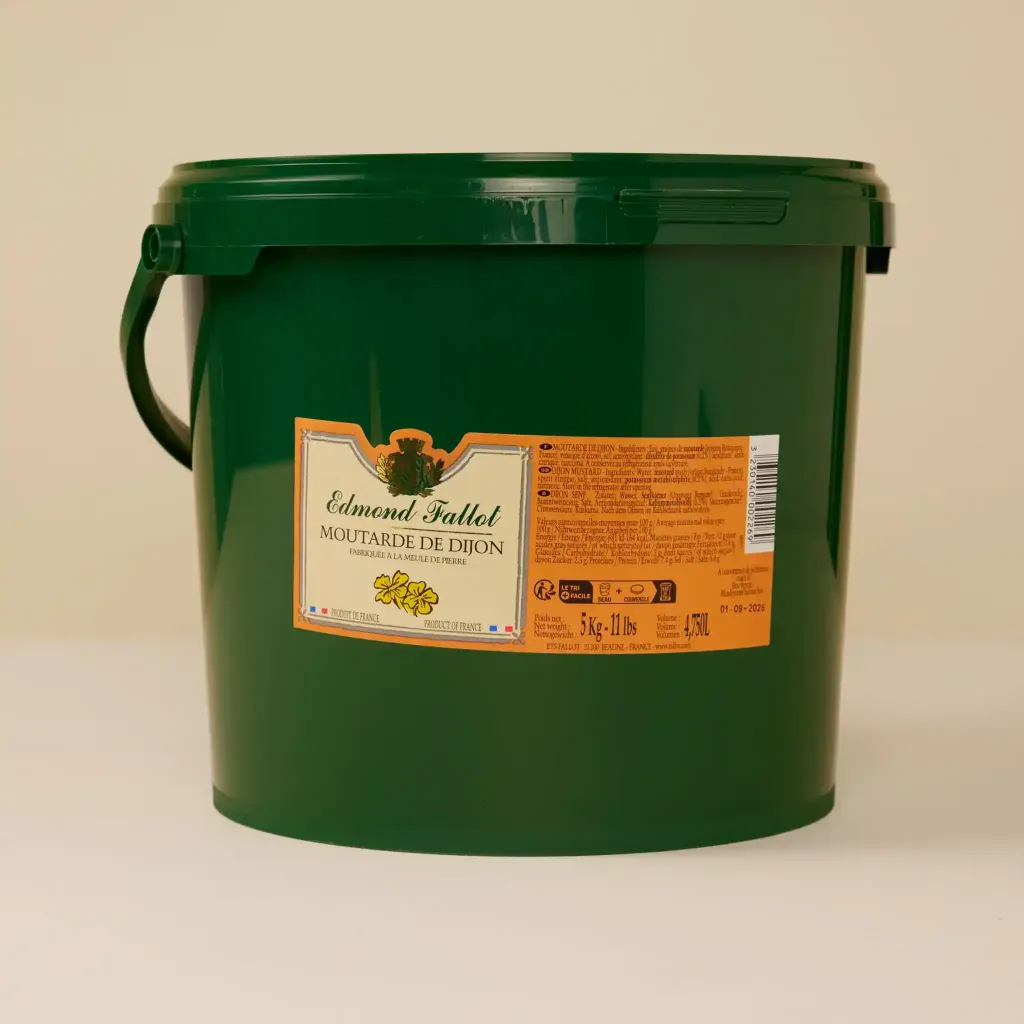
Dijon mustard, 5kg bucket, Fallot
Fallot Dijon Mustard, 5 kg pail. A classic we have carried since 1951. Foodservice and event catering format: classic Fallot Dijon mustard in a food-grade 5 kg plastic pail.
\nIngredients per the manufacturer: Water, mustard seeds, vinegar, salt, antioxidant: potassium disulfite, acidifier: citric acid, spices. 5 kg pail format, €21.00 — available for in-store pickup at our Paris location or for shipping anywhere in France.
\nWhy We Carry This at G. Detou
\nA family-owned house founded in Beaune in 1840, Léon Bouley established the mustard mill (taken over in 1928 by Edmond Fallot) — one that has resisted the successive buyouts that swept through its Burgundian peers. The stone-grinding process, still used at Fallot, yields a smoother texture and a longer-lasting heat on the palate than any industrial mustard can offer.
\nThe sinus-clearing heat is caused by allyl isothiocyanate, a compound released during grinding. This molecule is volatile and fragile — it dissipates with heat and over time, which is precisely why cold stone-grinding matters, and why the pail should be kept tightly sealed and refrigerated after opening. The food-grade 5 kg plastic pail is resealable and stackable, purpose-built for professional kitchen use.
\nWe remain loyal to Fallot because the house stays independent and maintains consistent quality year after year. For a specialty grocer like ours — one that selects suppliers for the long haul — that consistency is essential. It allows us to avoid the formulation shifts that so often follow ownership changes or corporate strategy overhauls. This is our professional format: institutions, school cafeterias, hotels and restaurants, and event caterers setting up buffet stations. Not intended for home use.
\nThe vinegar used by Fallot is primarily wine vinegar or spirit vinegar depending on the recipe. For IGP-certified recipes, the vinegar is also sourced in France. This commitment to consistent sourcing is what sets heritage producers apart from globalized commodity production.
\nServing Suggestions
\nFor a hundred cafeteria-style vinaigrettes: five hundred grams of mustard, one liter of wine vinegar, three liters of neutral oil, salt, and pepper. Blend to achieve a lasting emulsion.
\nFor a cold-buffet ravigote sauce: build a mustard-based mayonnaise, then fold in chopped cornichons, capers, minced shallot, and parsley. A natural match for tête de veau and cold sliced meats.
\nFor a large-batch barbecue marinade: five hundred grams of mustard, one liter of olive oil, herbes de Provence, and garlic. Coat the pieces generously before grilling.
\nIn a professional kitchen, mustard does double duty — as a condiment (ramekins at self-service stations) and as a cooking ingredient (sauces and large-batch marinades). Once opened, the pail should be used within two to three months.
\nFor pairing: favor dishes alongside a Burgundy Aligoté — a regionally coherent match with the mustard's origins. A dry Alsatian Riesling works beautifully as well.
\nA note on origins: Dijon mustard is not an AOC — it is an open commercial term. Any producer anywhere in the world may print "Dijon mustard" on a jar, even if it was made in Poland or the United States. Only the IGP Moutarde de Bourgogne provides a genuine geographic guarantee.
\nFor the adventurous cook: mustard works surprisingly well in a savory ice cream (explored in fine dining), in a cultured butter with fresh herbs, in a cream sauce for pommes dauphines, or in a sauce to accompany grated cheese (with a splash of dark ale).
\nA quick note on price: at the 5 kg pail format, the cost works out to roughly €4.20/kg — a fair price point for a traditional French mustard when measured against industrial alternatives that undercut on price but underdeliver on flavor.
\nOn production schedule: Fallot produces mustard year-round with no particular seasonal constraint (seeds are stored for several months following the August–September harvest). Flavored varieties follow a more targeted release calendar around the holiday season — the pain d'épices mustard and the truffle mustard see sales spike sharply in November and December.
\nDay-to-day dosing: one teaspoon for a vinaigrette (two servings), one tablespoon for a marinade or sauce (four servings). Beyond that, restraint is advised.
\nDelivery and In-Store
\nStore located at 58 rue Tiquetonne, Paris 2nd arrondissement — free in-store pickup at our Paris location, or shipping anywhere in France. Once opened, the pail should be stored cold (ideally 4 to 6 °C).
\nFor professional orders (restaurants, caterers, specialty retailers), we offer volume-based pricing and a dedicated account manager. Contact the store to open a professional account and access rates tailored to your business — G. Detou has long served a wide range of food professionals in the neighborhood, from Michelin-starred chefs to local independent caterers.
\nFrequently Asked Questions
\nWho is this format intended for?
\nInstitutions, school foodservice, hospitality, and event catering. Not suited for private or household use, even for large families.
\nHow long does it keep after opening?
\nTwo to three months in a tightly sealed pail kept refrigerated. Beyond that, the heat and color degrade noticeably.
\nIs the packaging suitable for transport?
\nYes — the stackable food-grade plastic pail is designed for transport and storage in professional cold rooms.
\nIs Fallot truly artisanal?
\nIt genuinely is: Fallot has remained independent since 1840, is based in Beaune, and produces mustard using traditional Burgundian methods.
\nCan the contents be repacked?
\nFor institutional use, the mustard can be transferred into smaller serving pots for tableside or buffet service. Keep service pots refrigerated between uses.
Price per kg |
4,19 € |
Description
FALLOT Dijon Mustard – 5 kg bucket, traditional and tangy taste.
Characteristics
- Weight: 5.000 kg
- Ingredients: Water, MUSTARD seeds, vinegar, salt, antioxidant: potassium diSULFITE, acidifier: citric acid, spice.
-
Nutritional values:
Energy (kJ): 681 kJ
Energy (kcal): 164 kcal
Total Fat (g): 12
Saturated Fat (g): 0.8
Total Carbohydrate (g): 3
Carbohydrate (sugars) (g): 2.5
Protein (g): 7.4
Salt (g): 6.4 - Legal name: Dijon Mustard
- Storage conditions: Keep refrigerated after opening.
Nos derniers contenus
Découvrez les nouveautés dans notre entreprise !