



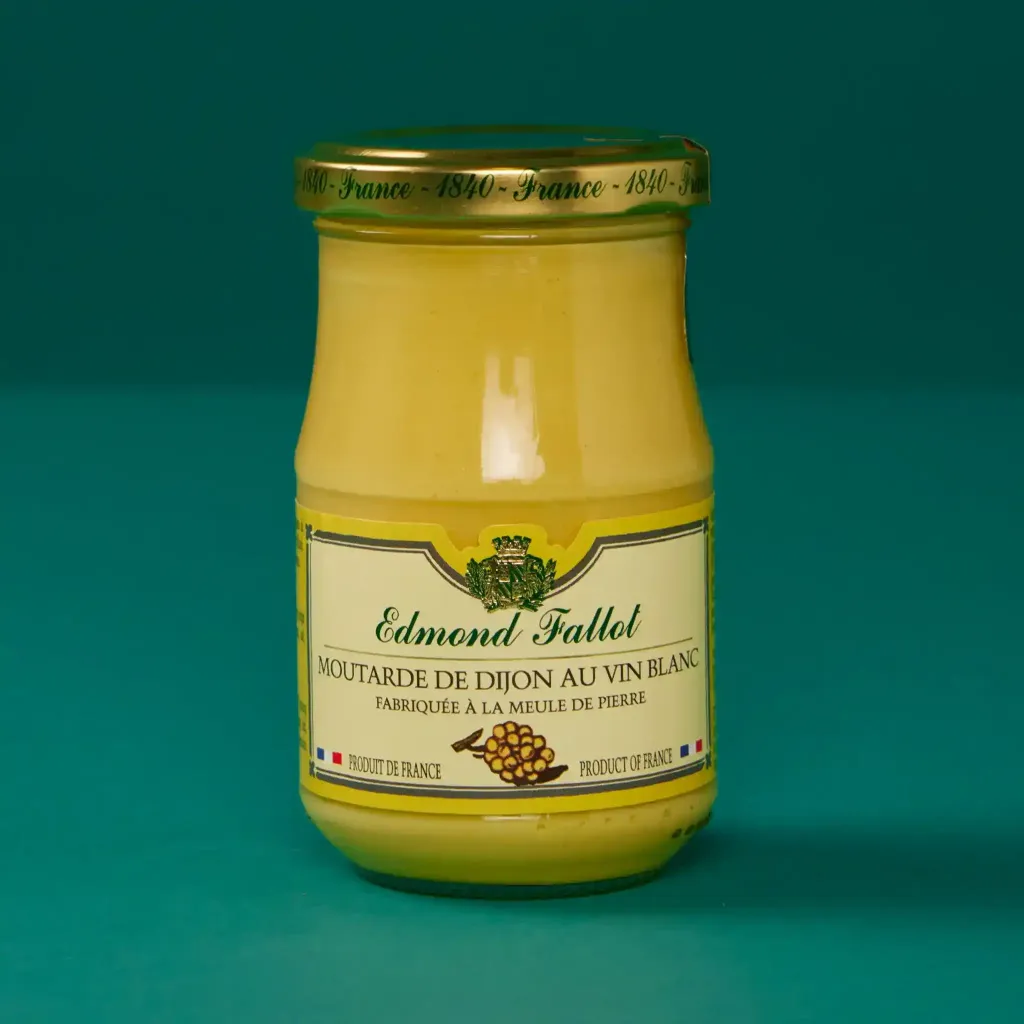

Fallot Dijon Mustard with White Wine 21cl
Fallot Dijon Mustard with White Wine, 21 cl. We've carried it since we first opened the shop in 1951 — on rue Tiquetonne in the 2nd arrondissement. A classic Dijon mustard enriched with 19% white wine: the heat is slightly softened, and the tangy notes take on a fruitier quality.
\nIngredients: mustard seeds, water, white wine (19%) (contains sulfites), vinegar, salt, antioxidant: potassium disulfite, acidifier: citric acid, spices. Format: 21 cl (210 g), €3.10 in our Paris store.
\nWhy We Carry This at G. Detou
\nThe Fallot house has been based in Beaune since 1840 (founded by Léon Bouley, taken over in 1928 by Edmond Fallot) and stands among the last independent family mustard makers in Burgundy. The house still uses stone-grinding, a slow method that generates minimal heat and preserves the volatile compounds responsible for nasal heat.
\nThat nasal kick comes from allyl isothiocyanate, a molecule released through the hydrolysis of sinigrin during grinding. The slower and cooler the grinding process, the longer that molecule holds in the jar. This chemistry explains the perceptible quality gap between a traditionally made mustard and an accelerated industrial one. The white wine used is a standard dry wine — not an Aligoté from the IGP, but its aromatic contribution is still noticeable.
\nWe keep Fallot on our shelves for its independence, which has become increasingly rare among French mustard makers. Our pastry-chef customers and neighborhood regulars alike appreciate that distinction — it aligns with G. Detou's broader philosophy: favor independent suppliers whenever the quality-to-price balance allows it. The white wine adds a welcome roundness to the Dijon mustard without dulling its nasal heat. The 21 cl format suits everyday use.
\nFallot remains one of the last independent mustard makers in Burgundy. Modest in scale compared to an Unilever or a Kraft — and it is precisely that modesty that allows for consistent quality.
\nServing Suggestions
\nFor a revisited blanquette de veau, stir a tablespoon of white wine mustard into the sauce at the end of cooking — it adds depth without changing the spirit of the dish.
\nFor a dijonnaise sauce with white wine, reduce a stock, then whisk in cream and mustard: the richness of the wine amplifies the aromatic base.
\nFor a warm salad vinaigrette, combine white wine mustard, white wine vinegar, and a neutral oil — excellent over warm lentils or new potatoes.
\nWorks beautifully as-is with white meats, white wine sauces, fish in sauce, and more delicate vinaigrettes. It's an excellent substitute for plain mustard in any recipe where white wine is already present.
\nFor less expected pairings: a sharp mustard with a sweet dessert? It's been done — contemporary molecular cuisine has explored sweet-heat combinations such as mustard with chocolate or mustard with red fruits. A niche application, but a surprising one for the adventurous.
\nA note on texture: Fallot mustards are deliberately thicker than industrial versions, which are often thinned with water to increase volume. This higher density means you use less per gram — it goes further.
\nFor composed cold sauces: mustard provides structure in a rémoulade, sauce gribiche, sauce ravigote, a fresh herb sauce verte, or a revisited aioli. All of these classic French preparations rely on the emulsifying effect and balanced heat of a true Dijon mustard.
\nOn pricing: €3.10 for 21 cl (210 g) works out to roughly €15.50/kg, consistent with Fallot's positioning relative to the industrial brands owned by major French and international food groups.
\nA look at the French mustard landscape: there are currently three notable independent family brands (Fallot in Beaune, Pommery in Meaux, and Reine de Dijon in Chevigny-Saint-Sauveur), alongside group-owned labels (Amora, Maille, Bornier). Fallot and Pommery are the two "traditional mustard" references we work with at G. Detou.
\nOn usability: a round jar mixes more evenly than a square one — the corners trap unmixed product. A small detail, but worth keeping in mind when choosing your regular format for the kitchen.
\nDelivery and Store
\nAvailable for in-store pickup at our Paris location (58 rue Tiquetonne, Paris 2nd arrondissement) or for shipping anywhere in metropolitan France. Once opened, store in the refrigerator to slow the evaporation of volatile compounds.
\nFor visitors passing through Paris: G. Detou is steps from the Étienne Marcel metro station (line 4) and the Sentier metro station (line 3). We're in the historic Les Halles neighborhood, right next to rue Montorgueil — a classic Parisian food lover's corner for those exploring the city.
\nAllergen notice: mustard, sulfites.
\nFrequently Asked Questions
\nHow does this differ from plain Dijon?
\nThe 19% white wine adds a fruity note and a touch of extra acidity; the nasal heat remains the same. It's an aromatic variation.
\nWhat white wine is used in the recipe?
\nA dry white wine of European origin — not specified further. For a 100% Burgundian terroir, look for the Moutarde de Bourgogne IGP, which requires Aligoté.
\nDoes it contain sulfites?
\nYes — the wine naturally contains sulfites, and the jar is also preserved with potassium disulfite as an antioxidant. Both must be declared on the label.
\nIs it truly artisanal?
\nYes. An independent house since 1840, still produced in Beaune using traditional methods. This is a traditional mustard in the strictest sense.
\nHow long does it keep after opening?
\nFour to six months, refrigerated. The presence of alcohol does not extend shelf life after opening — mustard remains a fresh product.
Price per kg |
15,32 € |
Description
Dijon mustard with white wine – 21 cl – Edmond Fallot. Refined and aromatic flavor.
Characteristics
- Weight: 0.200 kg
- Ingredients: MUSTARD seeds, water, white wine (19%) (with SULFITES), vinegar, salt, antioxidant: POTASSIUM DISULFITE, acidifier: citric acid, spice.
- Allergens: Mustard, disulfite
-
Nutritional values:
Energy (kJ): 638
Energy (kcal): 154
Total Fat (g): 12
Saturated Fat (g): 0.6
Total Carbohydrate (g): 1.9
Carbohydrate (g): 1.7
Protein (g): 7.1
Salt (g): 6.4 - Legal name: Dijon mustard with white wine
- Storage conditions: Keep refrigerated after opening.
Nos derniers contenus
Découvrez les nouveautés dans notre entreprise !