


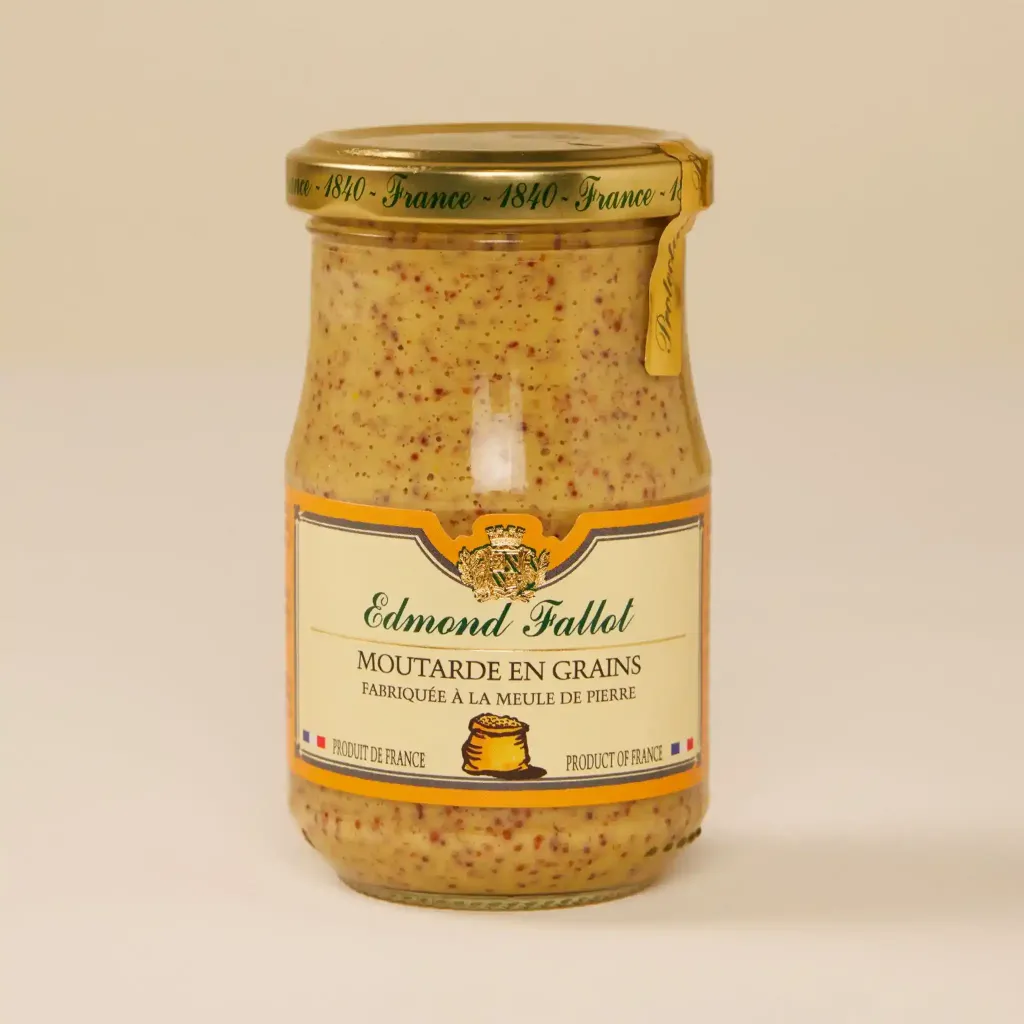

Grain mustard, white wine, 21cl, Fallot
Fallot Whole-Grain Mustard with White Wine, 21 cl. At 58 rue Tiquetonne, this one has been on our shelves for as long as anyone can remember — G. Detou has been open since 1951, and certain products have been part of the house ever since. Whole-grain mustard with white wine: whole and cracked seeds, 16.7% white wine — a rustic texture with the satisfying crunch of intact grains.
\nIngredients: Water, mustard seeds, white wine (16.7%) (contains sulfites), vinegar, salt, mustard bran, sugar, spices. 21 cl format, €3.10 in our Paris store.
\nWhy We Carry This Product at G. Detou
\nFounded in Beaune in 1840 by Léon Bouley and taken over in 1928 by Edmond Fallot, Fallot is today one of the last two or three independent French mustard makers. The Fallot technique: slow stone-grinding rather than high-speed mechanical crushing, to avoid heating the mustard paste.
\nMustard's heat comes from a plant enzyme, myrosinase, which releases allyl isothiocyanate when the seeds are ground and come into contact with water. The entire craft of mustard-making lies in preserving this fragile molecule from field to jar — every heat-exposure step means a loss of pungency. Whole-grain mustard is particularly well suited to hot preparations where a visual effect is desired.
\nOur mustard selection was guided by two main criteria: producer independence and product consistency over time. Fallot has delivered on both for decades, which is increasingly rare in a sector where most historic French mustard brands have been acquired by multinationals (Unilever, Kraft, Mars). Whole-grain mustard differs from smooth Dijon in both texture and visual appeal in cooking. It is a condiment mustard — one you set alongside a dish rather than whisk into a sauce.
\nFor the flavored variations in the range (tarragon, blackcurrant, honey, truffle…), Fallot always starts from its own house mustard base rather than purchasing a neutral base: this is what ensures aromatic consistency across the entire lineup.
\nUsage Tips
\nWith a grilled AAAAA andouillette, a teaspoon of whole-grain mustard served alongside is a classic — the pairing is canonical in the Lyonnais bistro tradition.
\nFor a mustard-crusted roasted salmon, combine whole-grain mustard with honey and herbs, spread over the fillet, and roast quickly in a hot oven.
\nFor a rustic Dijonnaise sauce, start with a white wine and shallot reduction, add cream, and finish with whole-grain mustard off the heat — to preserve the crunch.
\nGrilled sausages, andouillette, braised ham, rabbit with mustard, charcuterie. In sauces, it contributes visible texture — particularly useful with white-sauced meats or grilled fish.
\nFor plating: avoid placing mustard in direct contact with a hot garnish — serve it in a quenelle or a small ramekin alongside the dish. Prolonged exposure to heat destroys the pungency.
\nOn long-term storage: an unopened jar keeps two to three years at room temperature without deterioration. Once opened, oxygen begins to degrade the aromatics — which is why it is important to seal the jar tightly after each use.
\nSecondary uses: mustard is also a kitchen rescue ingredient — to brighten a flat dish, bind a slightly thin sauce, or emulsify an overly fatty pan dripping. It is the ultimate fix-it condiment.
\nAt 21 cl (equivalent to €15.50/kg), this jar sits firmly in the pricing range of traditional French mustard: more expensive than a store brand, less expensive than an imported Japanese or English fine-grocery mustard.
\nOn the chemistry of heat: the allyl isothiocyanate responsible for mustard's nasal kick is also present in horseradish, wasabi, and arugula — all Brassicaceae share this molecule. This explains the similar heat found in these products, and why they can be partially substituted for one another in cooking depending on the recipe.
\nA practical note on cooking: mustard is a condiment, not a sauce base — use just enough to structure a flavor, never in a dominant quantity.
\nDelivery and Store
\nYou can pick it up at our Paris store (58 rue Tiquetonne, Paris 2nd arrondissement) or order it for delivery anywhere in metropolitan France. After opening, store the jar in the refrigerator to preserve its pungency and freshness.
\nOn the sustainability front, the store favors recyclable or returnable packaging for online orders wherever possible. For in-store pickups, we encourage customers to bring their own reusable containers for bulk products (spices, sugars, seeds). It is a gradual commitment we have been developing over the years.
\nMandatory allergen notice: mustard, sulfites.
\nFrequently Asked Questions
\nWhat is the difference from smooth mustard?
\nTexture: the seeds are left whole or cracked rather than ground into a paste. The flavor is more rustic, the heat more diffuse, and the visual appeal in cooking is greater.
\nWhat percentage of seeds are left whole?
\nThis varies by recipe; in Fallot's version, the ratio produces a texture where the seeds are clearly identifiable without any unpleasant hardness in the mouth.
\nDoes it contain sulfites?
\nYes — the white wine contributes them naturally, and the jar is preserved with disulfite as an antioxidant. Mandatory labeling requirement.
\nIs it truly artisanal?
\nYes — the Fallot mustard house has maintained independent production in Beaune since the 19th century, and the slow stone-grinding method is still used today.
\nHow long does it keep after opening?
\nFour to six months refrigerated. The texture may change slightly over time — the seeds absorb moisture from the jar.
Price per kg |
15,32 € |
Description
Grain mustard with white wine – 21 cl – Edmond Fallot. Rustic and aromatic flavour.
Characteristics
- Weight: 0.200 kg
- Ingredients: Water, MUSTARD seeds, white wine (16.7%) (with SULFITES), vinegar, salt, MUSTARD husks, sugar, spices.
- Allergens: Mustard, Sulfites
-
Nutritional values:
Energy (kJ): 619
Energy (kcal): 149
Total Fat (g): 11
Saturated Fat (g): 0.8
Total Carbohydrate (g): 3.6
Carbohydrate (g): 2.1
Protein (g): 7.2
Salt (g): 5.9 - Legal name: Grain mustard
- Storage conditions: Keep refrigerated after opening.
Nos derniers contenus
Découvrez les nouveautés dans notre entreprise !