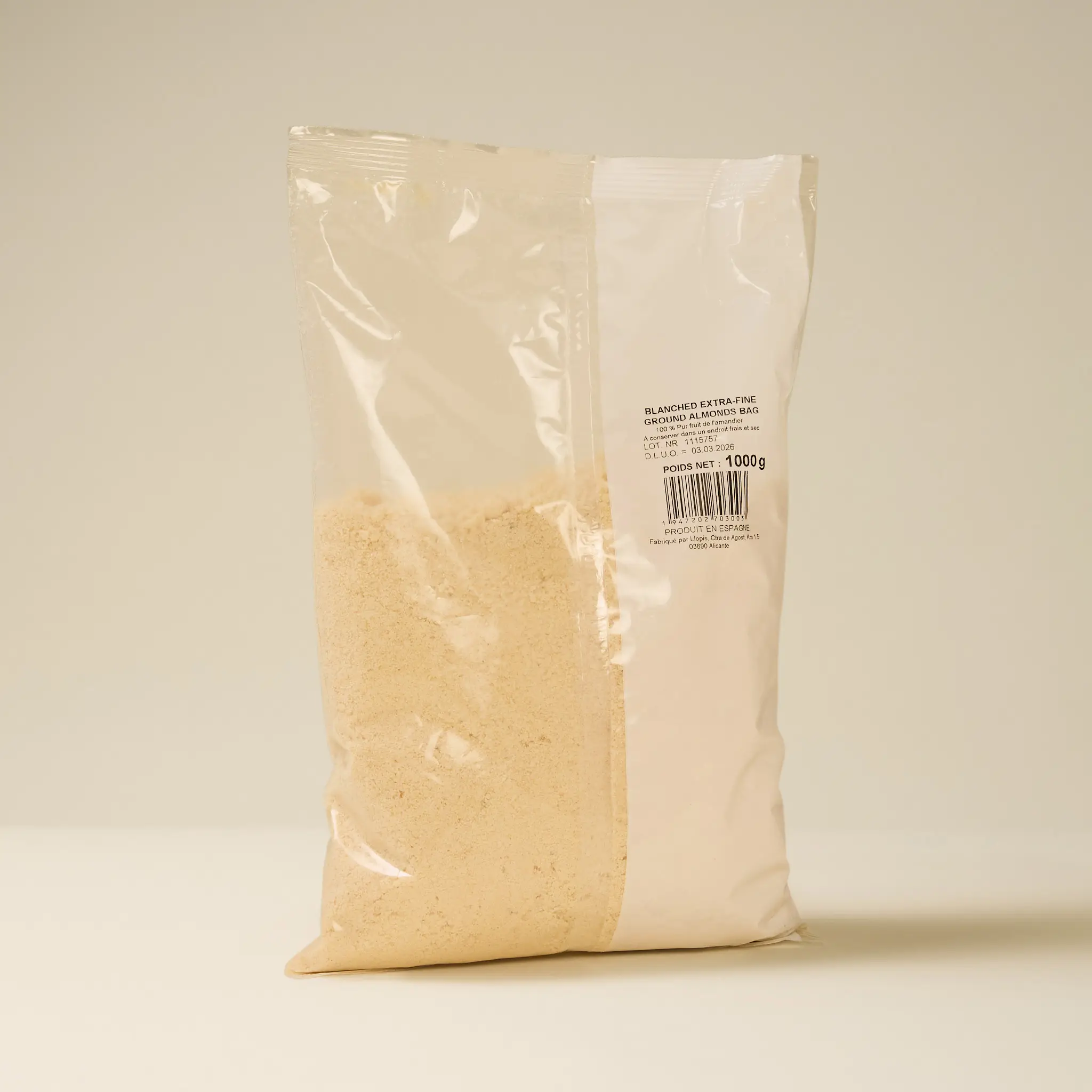



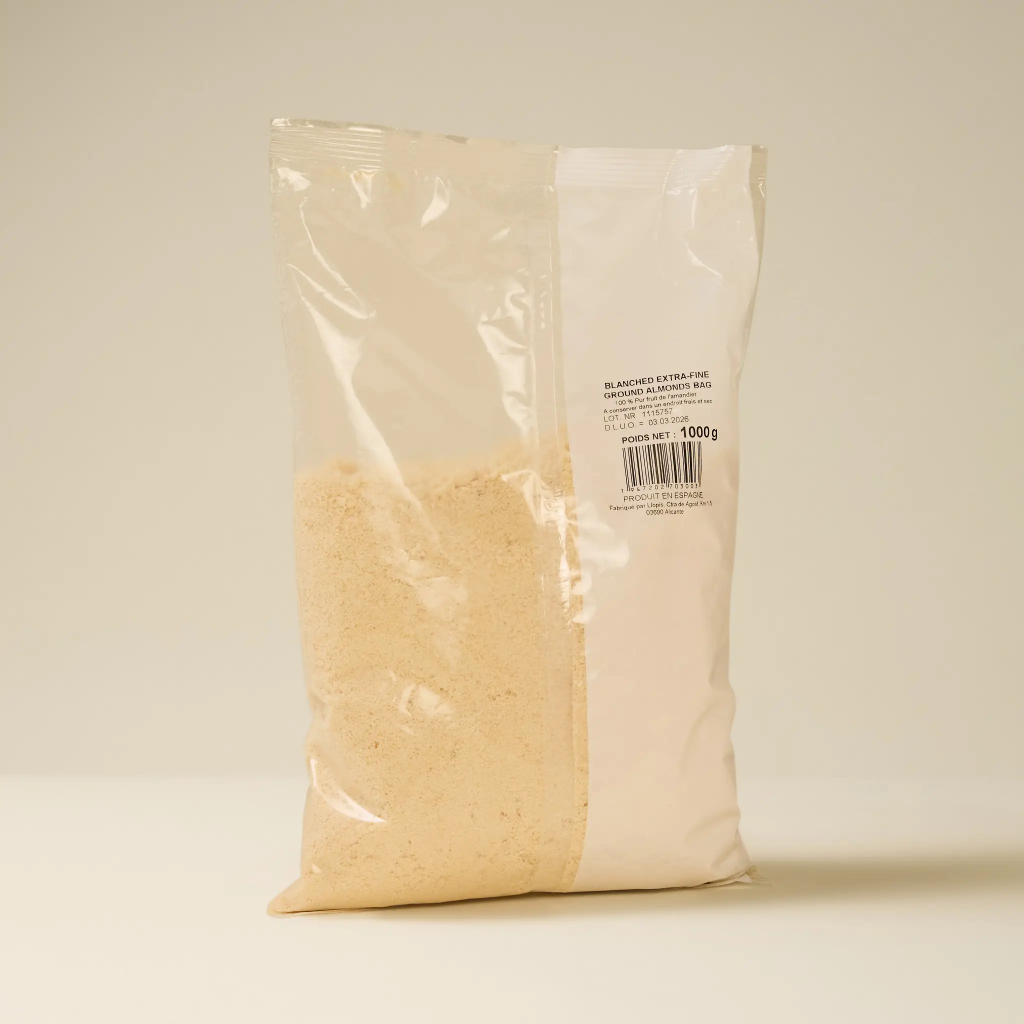
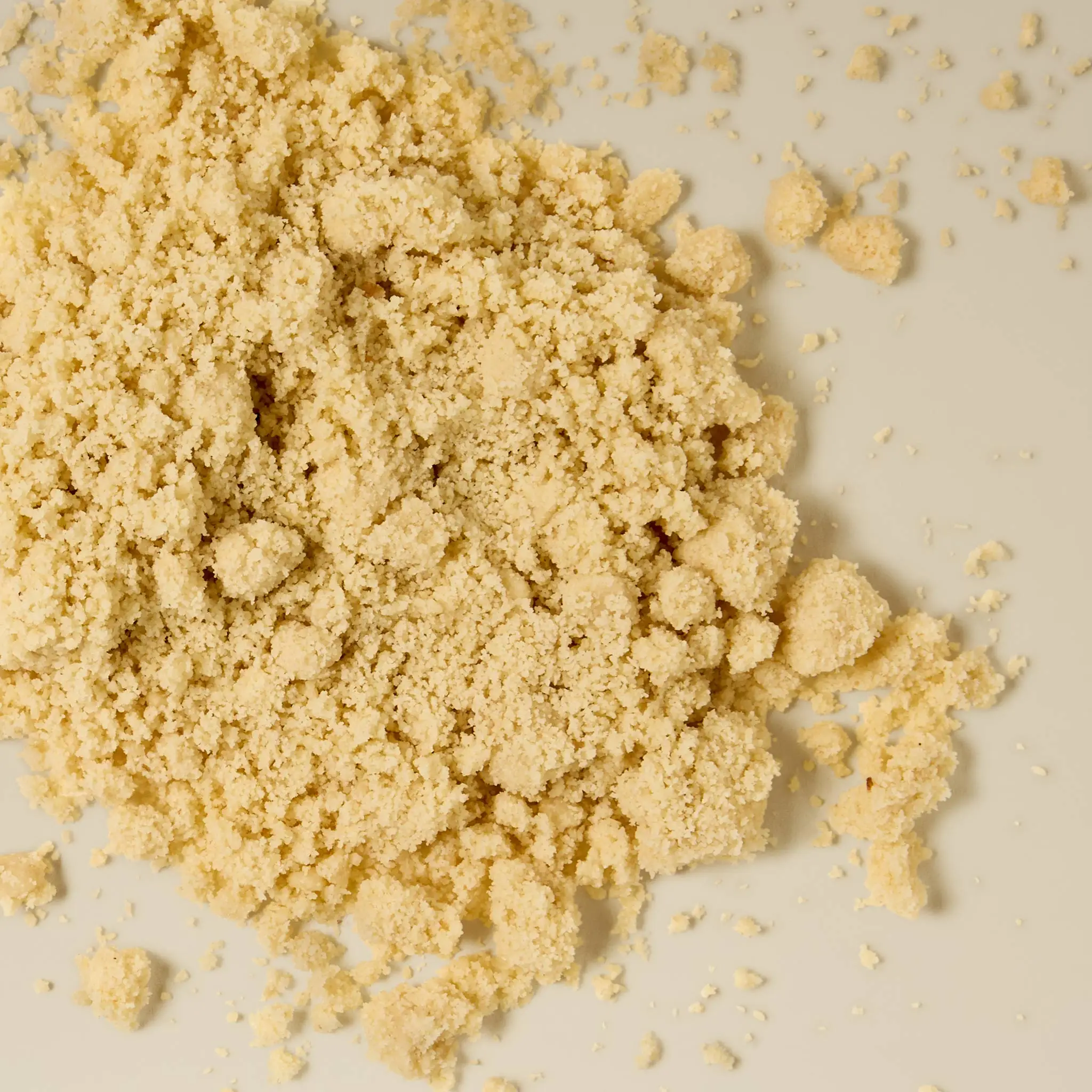
Extra fine US almond flour 1kg
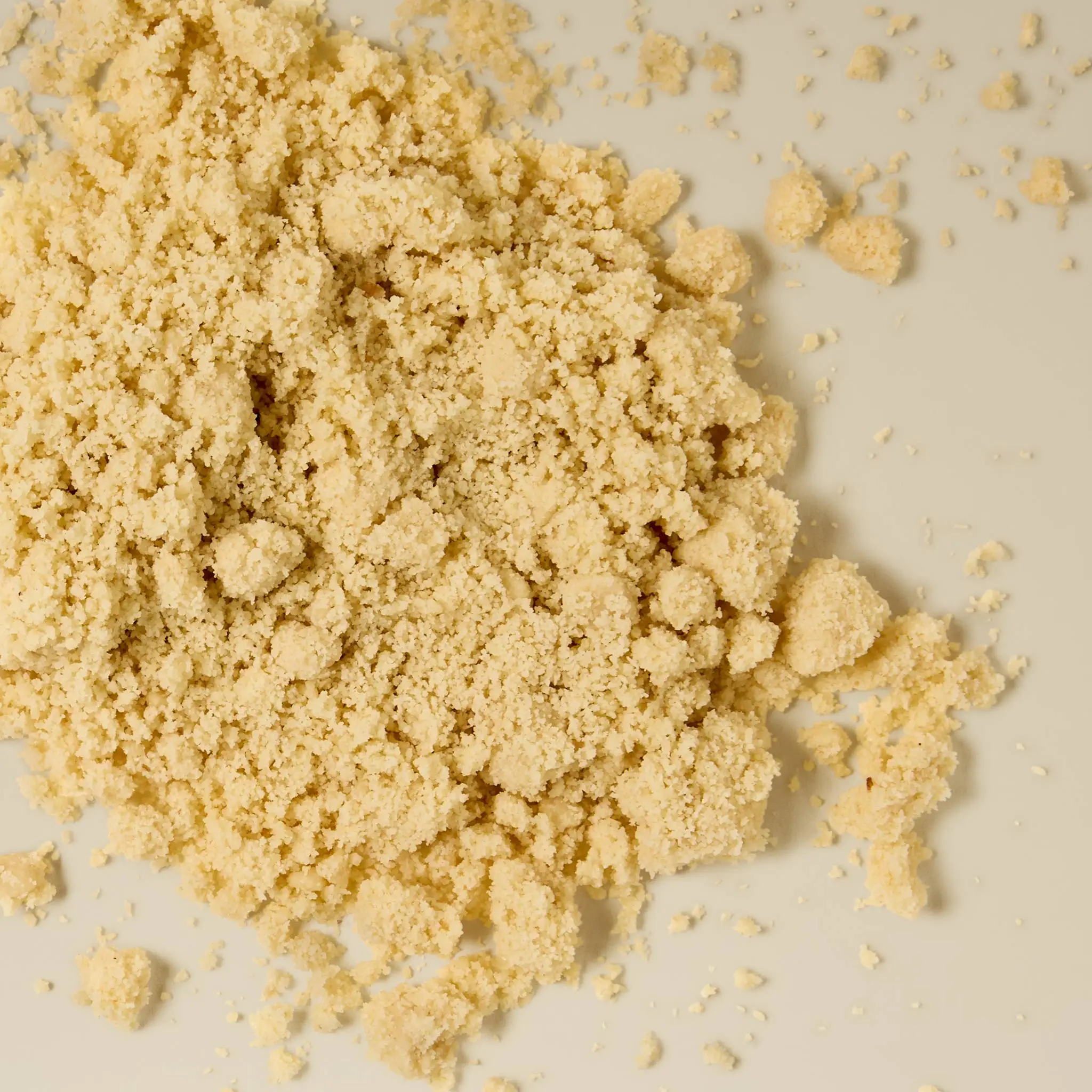
Extra-fine almond flour is the backbone of refined French pastry: macarons, financiers, dacquoise, pistachio paste, frangipane. One hundred percent ground almonds, nothing added — that's what the legal designation requires. The extra-fine grind produces a batter that is perfectly smooth on the palate, with no detectable graininess.
This 1 kg bag is the format that takes you through about ten batches of macarons or roughly twenty financiers. At our Paris store, it's one of the most sought-after products among home bakers who want genuinely professional results.
\nWhy extra-fine
\nThe particle size of almond flour changes everything about the final result. A standard grind produces a lumpy macaron that won't smooth out properly. An extra-fine, sifted flour delivers the clean ruffled foot and flawless shell surface every baker is after.
For financiers and dacquoise, the extra-fine grind creates a noticeably more tender, melt-in-the-mouth texture — the almond blends evenly into the buttery batter rather than forming gritty pockets. It's a difference you taste immediately.
The cold-milling process uses a refrigerated chamber to prevent the almond's natural oil from heating up during grinding. Without this precaution, the heat would release the oil and cause the flour to clump — which is exactly what makes home-grinding large quantities so tricky.
\nUsage tips
\nFor macarons, always sift the almond flour together with the powdered sugar through a fine-mesh sieve before use. This step eliminates any coarser particles and guarantees a smooth shell. Fold into the whipped egg whites in several additions to preserve the aeration.
For frangipane, almond flour is combined in equal parts with softened butter, sugar, and whole eggs. For a more pronounced almond flavor, replace ten percent of the flour with natural (skin-on) almond flour — the added depth is immediately noticeable.
For dacquoise, almond flour is folded into stiff egg whites and powdered sugar, then spread into rounds and baked at 340 °F (170 °C) for twelve to fifteen minutes. A perfectly made dacquoise is soft and yielding at the center, with a lightly crisp outer shell.
For a macaron-style almond cream, combine 100 g extra-fine almond flour with 100 g powdered sugar, 80 g softened butter, and one whole egg. Spread over a tart shell, top with fresh or cooked fruit, and bake for 30 minutes at 355 °F (180 °C). The finished texture is smooth and melt-in-the-mouth, completely grain-free.
For molecular gastronomy enthusiasts or ultra-refined pastry work, you can sift the extra-fine almond flour twice through a 200-micron sieve — this is the step that achieves the benchmark fineness of a true Parisian macaron. At this stage, the flour is almost impalpably fine and folds seamlessly into the whipped egg whites without leaving a single grain.
California produces roughly 80% of the world's almond flour, processed in specialized facilities that cover the entire chain — hulling, blanching, cold milling, and packaging. It's a highly standardized industry that supplies the vast majority of professional almond flour used across Europe.
\nStorage and shelf info
\nStore the 1 kg bag in a cool, dry place away from light. Once opened, transfer to an airtight container — almond flour readily absorbs moisture from the air and loses its free-flowing texture, making sifting more difficult. Available for pickup at our Paris store or shipped anywhere in metropolitan France.
The extra-fine 1 kg bag is aimed primarily at dedicated home bakers who make three or four batches of macarons a month or bake refined pastries on a regular basis. For occasional use, a 500 g version is also available in the same aisle.
For serious macaron enthusiasts, we recommend a simple test when you open a new bag: pinch a small amount of flour and rub it between two fingers. If it glides like an impalpable powder, you're good to go for macarons. If you can feel a perceptible grain, you're looking at a standard grind that will need double sifting through a finer mesh. The difference shows up directly on the baked shell.
\nFrequently asked questions
\nWhat's the difference between extra-fine and standard almond flour?
\nParticle size. Extra-fine: very thorough milling, approximately 400-micron sieve, ideal for macarons. Standard: coarser grind, perfectly acceptable for financiers and frangipane but less smooth in macarons.
\nCan you make almond flour at home?
\nYou can. But grinding almonds in a food processor releases the oil and causes the flour to clump — you'll never reach the fineness achieved by industrial cold milling.
\nHow long does it keep after opening?
\nThree months in an airtight container kept dry, six months in the refrigerator. Because almonds are naturally high in fat, the flour can turn rancid if exposed to heat or light.
\nBlanched or natural almond flour for macarons?
\nBlanched for classic macarons in pastel shades — the color stays true. Natural (skin-on) for financiers, dacquoise bases, or preparations where a more intense almond flavor is the goal.
\nWhy California origin rather than Mediterranean?
\nCalifornia produces more than 80% of the world's almonds — it's a well-structured industrial market offering competitive pricing and consistent sizing. For Marcona or Valencia almonds, we carry other references in the same aisle.
\nWhy is an oily feel a bad sign?
\nAlmond flour that oozes slightly when pressed has either been ground at too high a temperature (causing premature oil release) or stored for too long. It will produce a less stable macaron shell. Good almond flour feels dry to the touch and glides without leaving a trace.
Price per kg |
12,82 € |
Description
Extra fine US ground almonds, perfect for pastry preparations and delicate desserts.
Characteristics
- Weight: 1.000 kg
- Ingredients: 100% almonds
- Allergens: almonds
- Legal name: Extra finely ground almonds
- Storage conditions: Store in a cool, dry place, away from light.
Nos derniers contenus
Découvrez les nouveautés dans notre entreprise !