


The candied fruit cake is a cornerstone of French pâtisserie, yet few people ever truly nail it. Fruits sinking to the bottom of the pan, a dry crumb, an overwhelming sweetness — the pitfalls are many. And yet, with the right ingredients and a handful of professional techniques, this cake becomes something extraordinary: tender, fragrant, with fruit distributed evenly from the first slice to the last.
In this article, we go back to basics: choosing your candied fruits, preparing the batter, avoiding common mistakes, and mastering the little tricks that make all the difference. Whether you're baking a cake for the holidays or simply for the pleasure of a homemade afternoon treat, you'll have everything you need.
Why your choice of candied fruit changes everything
Before we even talk about the recipe, we need to talk about ingredients. A mediocre candied fruit cake is almost always the result of mediocre candied fruit.
Artisan candied fruit vs. mass-produced candied fruit
The candied fruit you find in most supermarkets typically consists of fruit pieces soaking in artificially colored syrup. The flavor is flat, the texture is mushy, and the dyes give your cake an unappetizing appearance.
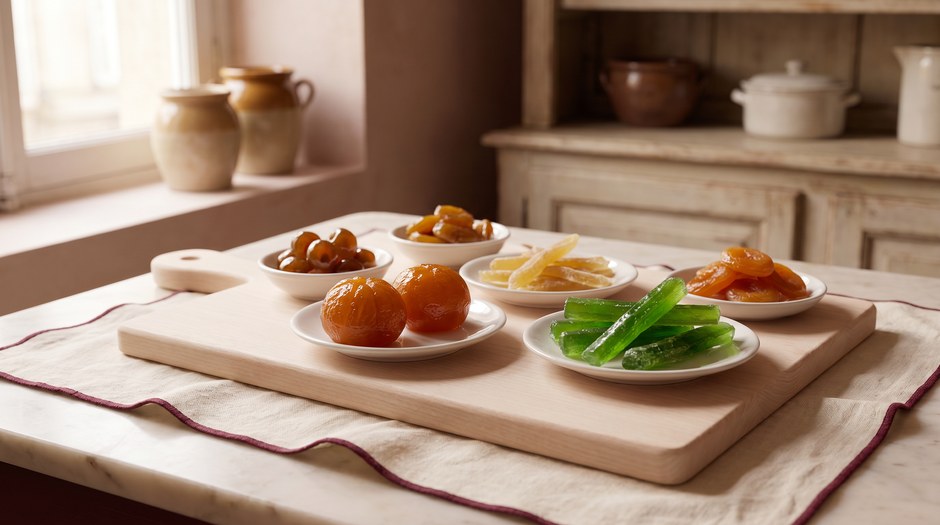
Artisan-crafted candied fruits, on the other hand, are made through a slow, progressive confit process: the fruits are immersed in syrups of increasing concentration over several days — sometimes several weeks. The sugar gradually penetrates the flesh of the fruit, which retains its original flavor and a texture that is both tender and slightly firm.
That's the difference between a candied fruit that brings a genuine taste of cherry, orange, or citron to your cake, and one that contributes nothing but a sugary, colored mass.
The essential candied fruits for a great cake
A well-made candied fruit cake typically combines:
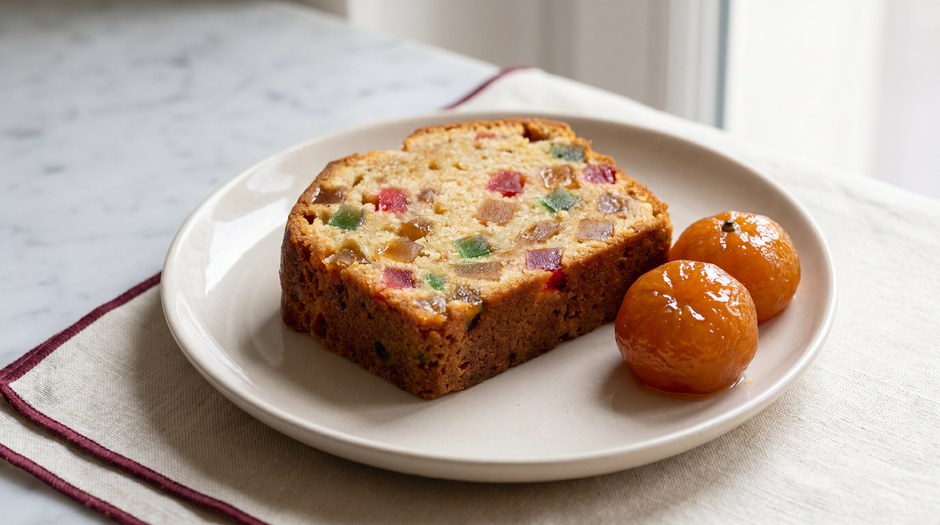
- Candied cherries: both red and green, for color and a pleasantly tart flavor.
- Candied orange peel: it adds a citrusy note that balances the richness of the butter. In cubes, it's ideal for even distribution throughout each slice.
- Candied citron Failing candied citron, candied lemon peel is a good alternative.: this is the signature ingredient of traditional French cakes. Its floral, citrus-forward flavor is truly irreplaceable — a rare product that isn't easy to find just anywhere.
- Candied pineapple: for an exotic touch, cut into small dice.
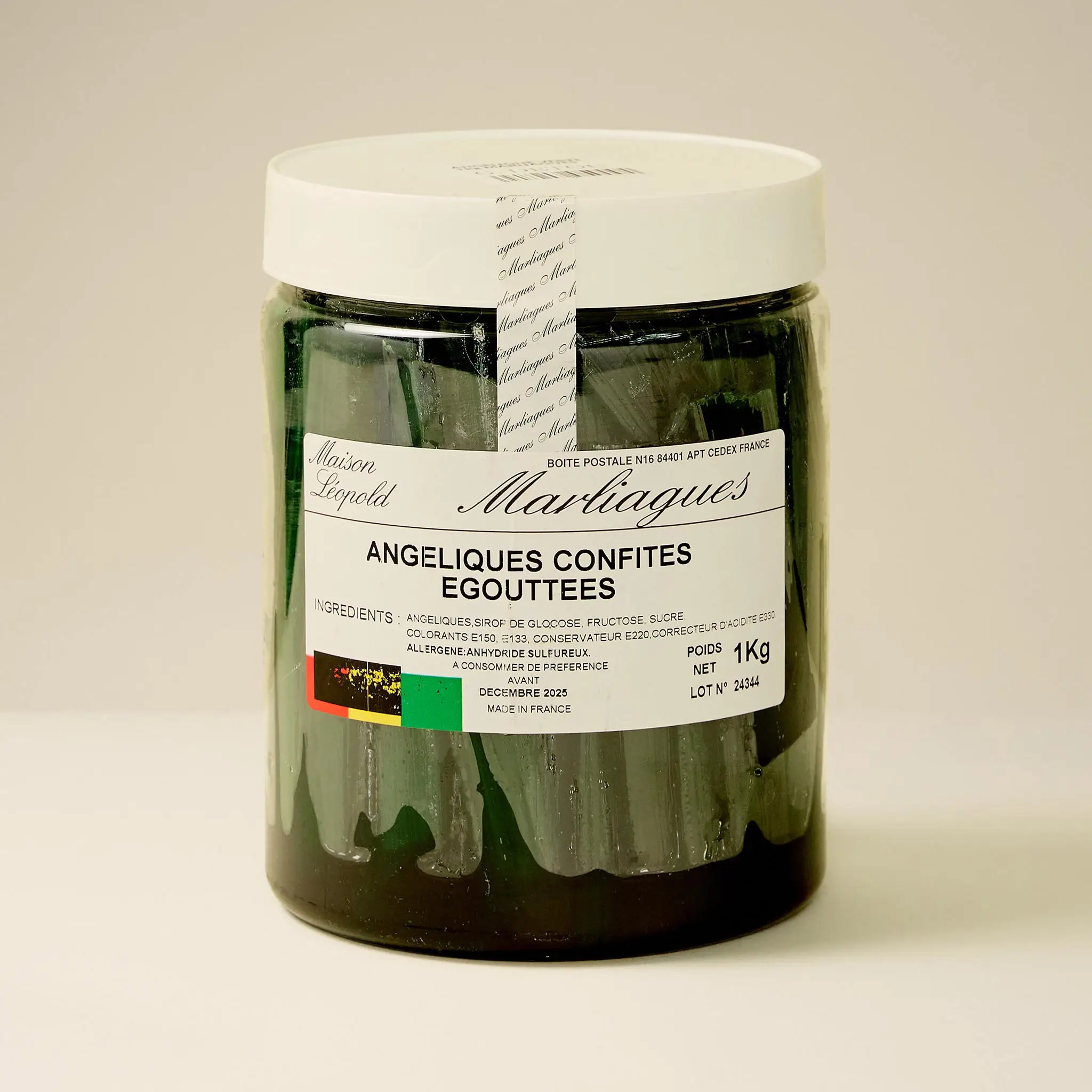
- Candied angelica: the green strips that bring a uniquely herbaceous note.
You'll find all of these artisan-quality candied fruits at G. Detou, available in cubes, strips, or whole.
The ideal blend? Roughly one-third citrus peel (orange and citron), one-third cherries, and one-third made up of pineapple, angelica, and any other fruit you enjoy. Feel free to adjust according to your own taste.
Quantity of fruit: getting the ratio right
A truly great candied fruit cake contains a generous amount of fruit. The rule among professional pastry chefs: the weight of the candied fruit should equal or exceed the weight of the batter. In practical terms, for a standard-size cake (a 26–28 cm pan), plan on between 400 and 500 g of candied fruit.
That may sound like a lot, but it's precisely what sets a truly generous candied fruit cake apart from an ordinary pound cake with three lonely cherry pieces lost somewhere in the crumb.
The Candied Fruit Cake Recipe (for a 26 cm loaf pan)
Prep time: 30 min (+ 12 to 24 hours of macerating) · Baking time: 1 hr 10 min to 1 hr 20 min
This version is the one used by many professional pastry chefs, adapted for home baking.
Ingredients
For the batter





For the fruit and flavoring


Method
The day before (an essential step): cut the candied fruits into roughly 1 cm dice. Place them in a bowl with the raisins and pour the rum over them. Stir, cover with plastic wrap, and leave to macerate for at least 12 hours — ideally 24. This step allows the rum to permeate the fruit and develop complex, layered flavors.
On the day:
Step 1
Preheat your oven to 160 °C (320 °F) on convection setting, or 170 °C (340 °F) for a conventional oven. Butter and flour your loaf pan, or line it with parchment paper.
Step 2
Cream the butter and sugar
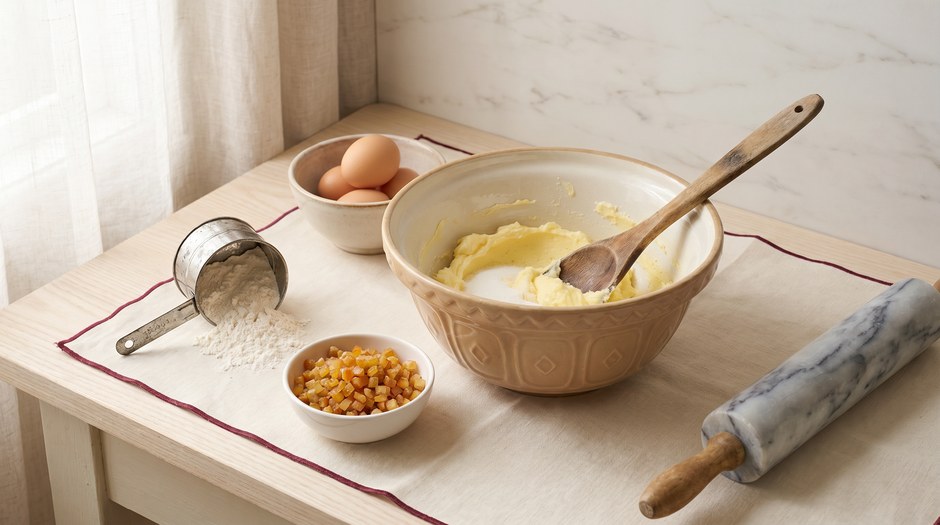
Beat the softened butter (at room temperature) with the sugar for a good 5 minutes using a hand or stand mixer, until the mixture is pale and creamy. This step determines how light your cake will be — don't rush it.
Step 3
Add the eggs
Add the eggs (at room temperature) one at a time, beating well after each addition. If the batter looks like it's splitting, add a spoonful of flour — it will stabilize the emulsion.
Step 4
Flavor the batter
Stir in the vanilla seeds (split the bean and scrape out the seeds with the tip of a knife) and the lemon zest.
Step 5
Fold in the dry ingredients
Sift together the flour, baking powder, and salt. Fold them into the butter-egg mixture using a spatula, with a gentle hand. The key here is not to overwork the batter — that's what makes a cake tough and dense.
Step 6
Prepare the fruit
Drain the macerated fruit and set the remaining rum aside. Lightly coat the fruit in flour (about 2 tablespoons), then shake them in a sieve to remove any excess. Fold them gently into the batter.
Step 7
Fill the pan
Pour the batter into the prepared pan and smooth the surface. Using the back of a spoon, trace a shallow groove lengthwise down the center — this encourages the cake to rise evenly.
Step 8
Bake
Bake for 1 hr 10 min to 1 hr 20 min. Halfway through (around 35 minutes), score the top of the cake lengthwise with a dampened knife. This is what creates that beautiful characteristic split down the center.
Step 9
Check for doneness
Insert a knife blade into the center of the cake — it should come out clean. Let the cake rest in the pan for 10 minutes, then turn it out onto a wire rack.
Step 10
Soak the cake
While the cake is still warm, brush it generously with the reserved macerating rum. This step deepens the flavor and is what gives the cake its wonderful moistness.
Storing your candied fruit cake
Wrapped first in plastic wrap and then in aluminum foil, the cake will keep for 2 to 3 weeks at room temperature — and its flavor only improves with time. Professional pastry chefs often bake it a week ahead, brushing it with rum every 2 to 3 days to keep it tender and fragrant. It also freezes beautifully for up to 3 months — the same logic of slow maturation that applies to homemade panettone, its Italian cousin.
Common mistakes to avoid with candied fruit cake
Even with a solid recipe, a few pitfalls come up again and again. Here are the most common ones, and how to fix them.
The fruit sinks to the bottom
This is the number one complaint. There are several possible culprits:
- Fruit that's too wet: drain it thoroughly after macerating, then toss it lightly in flour before folding it into the batter. That thin coating of flour gives the batter something to grip onto.
- Batter that's too loose: a thick, dense batter holds fruit in suspension far better. Never add milk or cream to a candied fruit cake.
- Fruit cut too large: aim for even 1 cm dice at most. Larger, heavier pieces will inevitably sink.
- Oven too hot: excessive heat causes the edges of the cake to set and rise before the center has a chance to firm up, leaving a liquid core that lets the fruit slide down.
The cake is dry
A dry cake is usually the result of:
- Overbaking: candied fruit cake continues to cook after it comes out of the oven. Pull it the moment the blade comes out clean — not a minute longer.
- Too little butter: never reduce the butter quantity. It's what keeps the crumb moist and tender. A quality butter with a high fat content (at least 82%) makes a genuine difference.
- Skipping the soaking step: brushing with rum after baking is not optional — it's essential.
The cake tastes too sweet
Candied fruits already bring a significant amount of sugar to the equation. That's why the recipe above calls for only 200 g of sugar to 250 g of flour — quite restrained by the standards of a classic quatre-quarts. If your candied fruits are on the sweeter side, you can easily drop to 180 g of sugar without any issue.
The crumb is dense and heavy
Two usual suspects: butter that wasn't creamed long enough with the sugar (a full 5 minutes of vigorous beating is genuinely necessary), or a batter that was overworked after the flour was added. The moment the flour is incorporated, stop mixing. Every additional stroke of the spatula develops gluten and makes the cake rubbery — the same principle that ruins a frangipane (almond cream filling) when it's beaten too vigorously for a galette des rois.
Variations and adaptations
Spiced candied fruit cake
Stir 1 teaspoon of quatre-épices (a French blend of pepper, cloves, nutmeg, and ginger) or a combination of cinnamon, cardamom, and nutmeg into the batter. Warm spices pair beautifully with candied fruit and rum — especially in a winter version.
Candied fruit and chocolate cake
Replace 30 g of flour with 30 g of unsweetened cocoa powder. The pairing of chocolate and candied orange is a timeless classic — the same combination that makes chocolate-dipped orange peel (orangettes) so irresistible.
Alcohol-free version
Replace the rum with freshly squeezed orange juice for both the macerating and soaking steps, and add a tablespoon of orange blossom water. The result is quite different, but every bit as delicious.
Candied fruit and nut cake
Fold 50 g of slivered almonds and 50 g of roughly chopped hazelnuts into the batter. The nuts add crunch and an extra layer of flavor. Reduce the candied fruit to 350 g to keep the balance right.
How to serve candied fruit cake
Candied fruit cake is best served in thin slices — it's a rich cake, and a little goes a long way. It pairs beautifully with:
- Earl Grey tea or a plain black tea, whose slight bitterness balances the cake's sweetness
- A shot of espresso, for a classic French afternoon treat
- A naturally sweet wine (Muscat de Beaumes-de-Venise, Banyuls) for a festive end to a meal
- Breakfast, lightly toasted with a little butter — an absolute treat
G. Detou's tip
The classic pitfall with homemade candied fruit cake is residual moisture — it causes the fruit to sink straight to the bottom of the pan during baking. We've had a foolproof trick on rue Tiquetonne since day one: soak the chopped fruit for 30 minutes in 2 tablespoons of dark rum, then toss them in a tablespoon of flour before folding into the batter. Every pastry professional who has walked through our doors since 1951 does exactly this — and the advice won't cost you a thing.
FAQ — Candied Fruit Cake
Candied fruit isn't meant to be frozen — it's the slow sugar-preservation process (confisage) that keeps it shelf-stable. That said, you can absolutely buy candied fruit months ahead of time: stored in a cool, dry place, it will keep for well over a year without any loss of quality. The key is to choose artisan-quality candied fruit made through traditional, progressive confisage.
Macerating the fruit serves two purposes. First, it infuses the fruit from the inside out — dark rum brings warm, vanilla-tinged notes that beautifully complement the fruity flavors. Second, the alcohol mildly inhibits gluten development where the fruit meets the batter, resulting in a noticeably more tender crumb. If you'd rather skip the alcohol, fresh orange juice is the best substitute.
This is where the cake truly shines: it only gets better with time. Made 5 to 7 days ahead and brushed with rum at regular intervals, it hits its flavor peak just when you need it. Well wrapped at room temperature, it keeps for 2 to 3 weeks; in the freezer, it will hold for up to 3 months. That's precisely why candied fruit cake is the ideal make-ahead centerpiece for the holiday season.
The English fruit cake (or Christmas pudding) tends to be denser, darker, and heavily laden with dried fruit — raisins, prunes — and bold warm spices. The French candied fruit cake is lighter and more buttery, with colorful candied pieces front and center: glacé cherries, cédrat (citron), candied orange peel — all perfumed primarily with vanilla. Both traditions share a love of alcohol-soaking and reward patience by improving over time.
A candied fruit cake is fundamentally an exercise in patience — patience to macerate the fruit, to cream the butter properly, to let it bake low and slow, and then to let it rest and mature for a few days before the first slice. But that patience pays off with results that no shortcut version can match.
It all starts with the quality of your ingredients. Artisan candied fruit, a great Bourbon vanilla, and impeccable butter: with those three things in your corner, your cake will stand alongside anything the finest pâtisseries have to offer.
To go further: browse our full Candied Fruits & Peels selection.