


Pistachio cream has become the #1 obsession of French pastry-making since the Dubai chocolate craze swept through. Pistachio tiramisu, pistachio éclair, pistachio fraisier, pistachio tartlet — you can't look at a single pastry shop display without running into it. And for good reason: when it's done right, it's a dense, deep, almond-green cream that blows everything a classic buttercream could ever offer clean out of the water.
The problem is that dozens of "pistachio cream recipes" are floating around out there — recipes that are nothing more than pastry creams vaguely tinted with syrup, with no real pistachio paste. Here, we give you the real thing, the one pastry chefs use — the one that calls for a good pistachio paste and nothing else.
What "pistachio cream" actually means
In French pastry, there are several pistachio-based creams, and it's worth knowing the difference:
- Crème pâtissière pistache (pistachio pastry cream): classic pastry cream + pistachio paste. The most common version — the base for éclairs, choux, and mille-feuilles.
- Crème mousseline pistache (pistachio mousseline cream): pastry cream + whipped butter. Richer and more voluminous, used in Paris-Brest and Saint-Honoré.
- Crème d'amandes pistache (pistachio almond cream): ground almonds + sugar + eggs + butter + pistachio paste. For tarts and galettes.
- Ganache pistache (pistachio ganache): white chocolate + cream + pistachio paste. For macarons, confections, and firm fillings.
- Chantilly pistache (pistachio whipped cream): whipped cream + pistachio paste. For light entremets and charlottes.
You are given here the three most commonly used recipes: pistachio pastry cream (universal base), pistachio mousseline (for large pieces) and pistachio ganache (for macarons and confections).
The key ingredient: pistachio paste
We'll say it again because it really matters: the quality of your pistachio cream depends 80% on the pistachio paste you use. Not 50% — 80%.
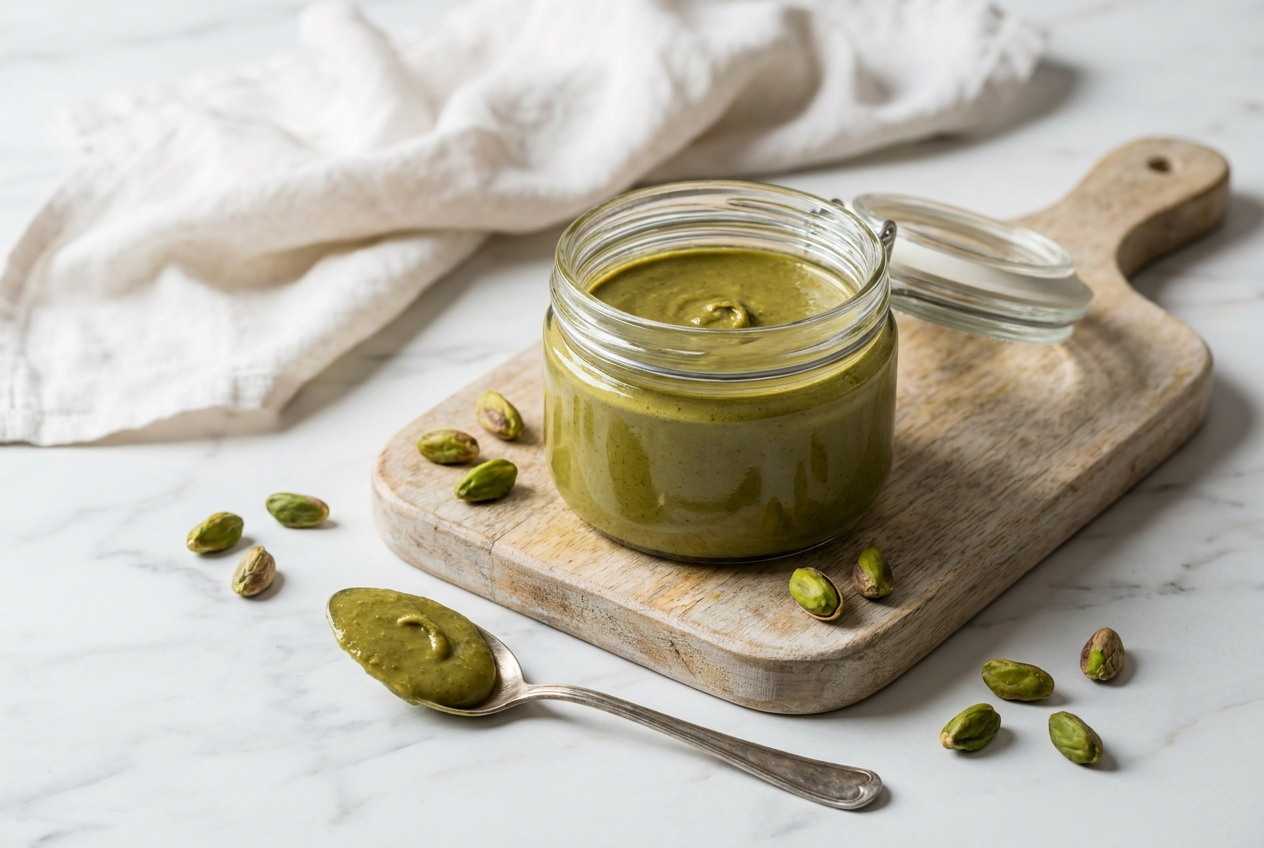
The differences between pistachio pastes on the market are enormous:
- 100% Bronte pistachio paste (Sicily): the gold standard. Naturally vibrant green, deep flavor, premium price (€80–130/kg).
- 100% Sicilian or Iranian pistachio paste: solid quality, slightly duller color, more accessible price point (€40–70/kg).
- 100% organic pistachio paste: varies widely by brand. Always check origin and freshness.
- Sweetened "pistachio cream": avoid entirely. 30–50% sugar content, added oils, and the pistachio flavor is virtually nonexistent.
- Artificially colored pistachio paste: even worse. Green dyes, artificial flavorings, little to no actual pistachio. Walk away.
A good rule of thumb: if the pistachio paste contains more than two ingredients (pistachios, and occasionally a pinch of salt), put it back on the shelf.
At G. Detou, at 58 rue Tiquetonne, we carry several references of 100% pistachio paste: from Bronte PGI in small jars for home enthusiasts, to professional 1 kg and 3 kg formats for pastry chefs.
Pistachio cream: 3 recipes
Everything starts from the same foundation — pistachio pastry cream — which you then enrich depending on how you plan to use it.
Recipe 1 — Pistachio pastry cream (the base)
The most versatile of the three. It works as a filling for éclairs, choux, mille-feuilles, and tarts, and also as a filling for viennoiseries.
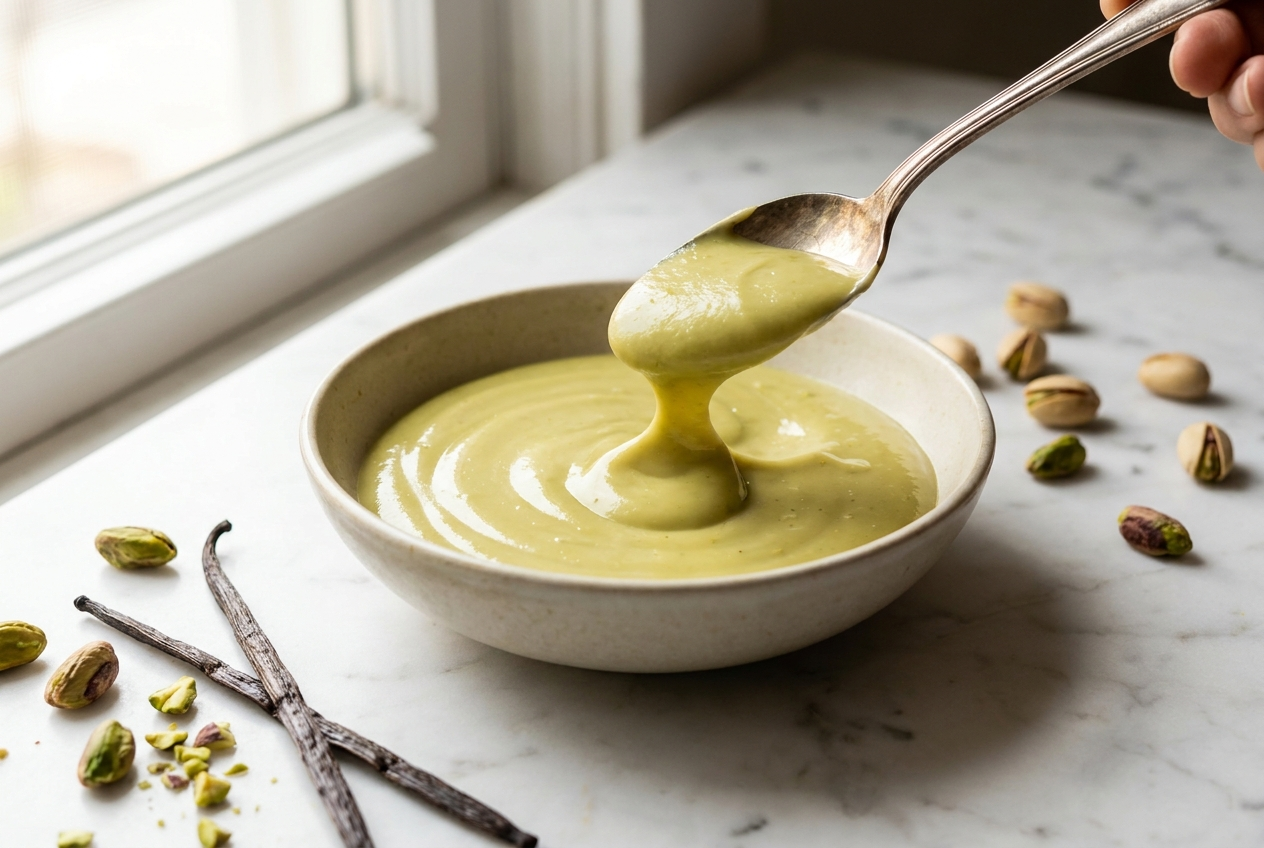
Ingredients (makes 500 g of cream):





Step 1
Heat the milk
Bring the milk to a simmer in a heavy-bottomed saucepan.
Step 2
Whisk the yolks
Meanwhile, whisk the egg yolks and sugar together until pale and thick. Add the cornstarch and whisk until smooth.
Step 3
Temper the eggs
Pour one third of the hot milk over the egg mixture, whisking vigorously to temper.
Step 4
Cook the cream
Pour everything back into the saucepan. Bring to a boil over medium heat, whisking constantly, and keep at a full boil for 1 to 2 minutes to cook out the starch and achieve a thick, set texture.
Step 5
Add the pistachio
Off the heat, stir in the pistachio paste, butter, and pinch of fleur de sel. Whisk until completely smooth.
Step 6
Cover and chill
Press plastic wrap directly onto the surface to prevent a skin from forming. Refrigerate for at least 2 hours before using.
The result: a dense pastry cream with a natural almond-green color and a deep, true pistachio flavor. Perfect for filling éclairs, choux, or tarts.
Recipe 2 — Pistachio mousseline cream (for showpiece desserts)
A richer version of the previous recipe, enriched with whipped butter. This is the cream used in the modern Paris-Brest the pistachio Saint-Honoré, and the pistachio fraisier.
Ingredients (makes 700 g):
- 500 g pistachio pastry cream (recipe above, fully chilled)
- 200 g AOP butter, softened to room temperature (beurre pommade)
Step 1
Loosen the cream
Beat the chilled pastry cream in a stand mixer until completely smooth.
Step 2
Add the butter
Add the softened butter in small pieces, gradually, while continuing to whip.
Step 3
Whip the mousseline
Whip on medium-high speed for 3 to 5 minutes: the cream should double in volume and take on a light, airy yet dense texture.
Critical point: the butter and cream must be at the same temperature (ideally 64–68°F). If the cream is too cold, the butter will seize into lumps; if it's too warm, the cream will break. If you do get lumps, briefly warm the mixture over a bain-marie while whisking.
Recipe 3 — Pistachio ganache (for macarons and confections)
A white chocolate ganache enriched with pistachio paste. Dense, perfectly set, and ideal for fillings that need to hold at room temperature.
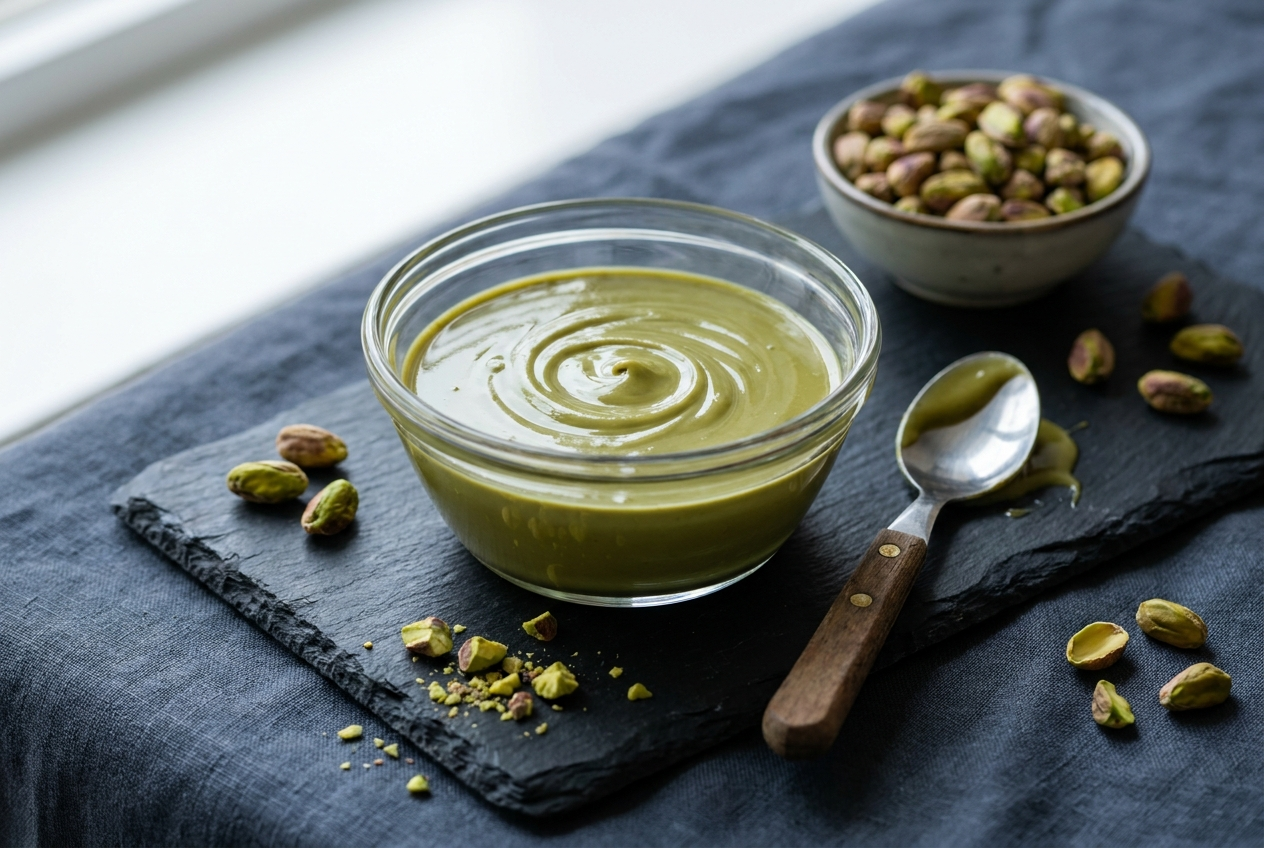
Ingredients (makes 400 g):

Step 1
Melt the white chocolate
Melt the white chocolate over a bain-marie at 113°F maximum — white chocolate scorches easily.
Step 2
Emulsify the cream
Heat the cream to a gentle simmer and pour it over the melted chocolate in three additions, emulsifying with a spatula using small circular motions at the center of the bowl.
Step 3
Add the pistachio
Stir in the pistachio paste and butter. Mix until the ganache is completely smooth and glossy.
Step 4
Let it set
Press plastic wrap directly onto the surface and allow to crystallize for 12 hours at room temperature (ideally 68°F) before using.
This ganache holds its structure beautifully at room temperature, making it ideal for macarons that need to travel or for chocolate confections.
The mistakes we see all the time
- Using sweetened pistachio cream. The result is cloying and the pistachio flavor vanishes entirely. Insist on 100% pistachio paste.
- Adding green food coloring. A real pistachio cream is not fluorescent green — it's a soft, natural almond green, sometimes leaning slightly dull. The bright green you see in supermarket pastries is artificial.
- Under-dosing the pistachio paste. Less than 10% of the total weight gives you a hint of pistachio at best. Aim for a minimum of 12–15%.
- Adding the paste while the cream is still hot. With pastry cream, always add off the heat. Heat oxidizes the natural oils in pistachio paste and dulls its aroma.
- Skipping the fleur de sel. A pistachio cream without salt falls flat. That single pinch makes all the difference.
Variations and riffs
Pistachio-lemon cream
Add the zest of one lemon to the pastry cream. Lemon lifts the pistachio without masking it — a touch used by several top pastry chefs.
Pistachio-orange blossom cream
Stir a teaspoon of orange blossom water into the cream at the very end. The result is beautifully Middle Eastern in character — divine in a mille-feuille or spooned into a baba.
Pistachio-raspberry cream
A classic pairing: layer pistachio cream on one side and a raspberry compote on the other. One of the canonical combinations in French pastry (fraisier, tarts, verrines).
Intense pistachio cream
Double the pistachio paste (24% of the total weight instead of 12%) and reduce the sugar slightly. Denser, more powerful. For true pistachio enthusiasts only.
How to use it
- Pistachio éclairs: pistachio pastry cream as filling, topped with a white chocolate–pistachio fondant or glaze
- Pistachio tart: pâte sucrée (sweet shortcrust) + pistachio almond cream + red fruits or chocolate
- Pistachio fraisier: génoise sponge + pistachio mousseline + fresh strawberries
- Pistachio Paris-Brest: a modern take on the classic, with pistachio mousseline in place of the praliné (a paste of caramelized nuts)
- Pistachio macarons: pistachio ganache (recipe 3) as filling
- Pistachio tiramisu: mascarpone + pistachio mousseline + ladyfingers + raspberry coulis
- Pistachio chocolates: pistachio ganache for filled bonbons or chocolate bars
Storage
- Pistachio pastry cream: up to 48 hours in the refrigerator, covered with plastic wrap pressed directly onto the surface.
- Pistachio mousseline: 24 to 36 hours in the refrigerator. Re-whip briefly before using.
- Pistachio ganache: 7 days refrigerated in an airtight container, or 24 hours at room temperature.
What it costs
A homemade pistachio cream works out to roughly €7–15 per 500 g, depending on the quality of the pistachio paste. That may seem steep, but it's on par with what high-end pâtisseries charge (€15–25 for 500 g of pistachio cream from a fine food shop).
Where to find the right ingredients
At G. Detou, you'll find:
- Pâte de pistache 100 % Bronte IGP: the gold standard
- 100% Sicilian or Iranian pistachio paste: the more accessible option
- Valrhona Ivoire white couverture chocolate for the ganache
- Charentes-Poitou AOP butter and 35% heavy cream
- Guérande fleur de sel
And if you're not sure about the quality of your pistachio paste, come in to the shop — we'll taste them side by side, compare, and point you in the right direction.
G. Detou's advice
Pistachio pastry cream fails when you go too light on the paste: 30 g for 500 ml of milk gives you something closer to pistachio-scented water. The dosage we recommend in the shop is 60 to 80 g of 100% paste per 500 ml of milk — that's 12–16%. Since we sell Iranian pistachio paste in 250 g jars on rue Tiquetonne, one jar gives you exactly 3 batches of Paris-Brest cream. And the natural color you get is that tender khaki-green you recognize in the windows of the great Parisian pastry houses.
FAQ — Pistachio cream
Because it's made with real pistachios. The natural color of pistachio is a soft, pale green — almost beige — especially once it's blended with milk, butter, and egg yolks. The neon green you see in supermarket pastries comes from food coloring. An authentic pistachio cream is understated in color — and intense in flavor.
Add more pistachio paste gradually, cold, a spoonful at a time, stirring thoroughly between each addition. You can go up to 20% of the total cream weight. Beyond that, the texture starts to turn greasy.
Not ideal — the texture will be grainy. Pistachio paste is made by grinding pistachios at length until they release their natural oils and form a smooth paste (several minutes in a high-powered food processor). If you want to make your own: toast 200 g of unsalted pistachios for 10 minutes at 300°F (150°C), then process for about 10 minutes in a powerful food processor until you have a smooth paste.
Not well. Pastry cream releases a lot of water when thawed, and the texture turns grainy. Only the pistachio ganache (recipe 3) freezes properly.
Two likely culprits: the pastry cream wasn't cooked long enough (you really do need 1 to 2 minutes at a full boil to cook out the cornstarch), or the pistachio paste was added too late (it contains natural oils that loosen the cream). If this happens, return the cream to low heat for 2 minutes, whisking constantly.
Yes, but the texture will be less creamy. Whole milk provides the fat that gives the cream its richness and roundness. If whole milk isn't an option, compensate by adding an extra 10 g of butter at the end of cooking.
Using the pistachio ganache (recipe 3), count approximately 5 g of ganache per macaron. That means one batch of 400 g ganache fills about 80 macarons.
Pistachio cream is the recipe that separates a decent dessert from an unforgettable one. The secret comes down to a single thing: the quality of your pistachio paste. Everything else is pure technique — nothing you can't master in an afternoon.
At G. Detou, we always have several pistachio pastes in stock — come in and taste them for yourself. The difference between Bronte and everything else is immediately obvious.
To go further: browse our full Nut Puree selection.