


The Paris-Brest is one of those classics that everyone has botched at least once. Choux that collapses, grainy cream, industrial praliné (a paste of caramelized nuts) that tastes of nothing — the possibilities for failure are many. Yet when executed properly, it is one of the most magnificent desserts in French pâtisserie: a crisp crown of golden slivered almonds, a dense mousseline cream built on real praliné, a buttery-sweet balance that defines indulgence at its finest.
The recipe we share here is the one followed by professional pastry chefs, using real homemade praliné or one of excellent quality, with the right proportions for a 24 cm crown that serves 8.
A brief history
Created in 1910 by Louis Durand, a pastry chef in Maisons-Laffitte, the Paris-Brest was conceived as a tribute to the legendary Paris-Brest-Paris cycling race. The ring shape evokes a bicycle wheel. The original recipe featured mousseline cream made with almond and hazelnut praliné, garnished with crushed pralines.
More than a century later, that same recipe still defines the great Paris-Brest. Every modern variation — individual portions, reinterpretations by today's leading pastry chefs — traces its lineage back to this foundation.
The ingredients that make the difference
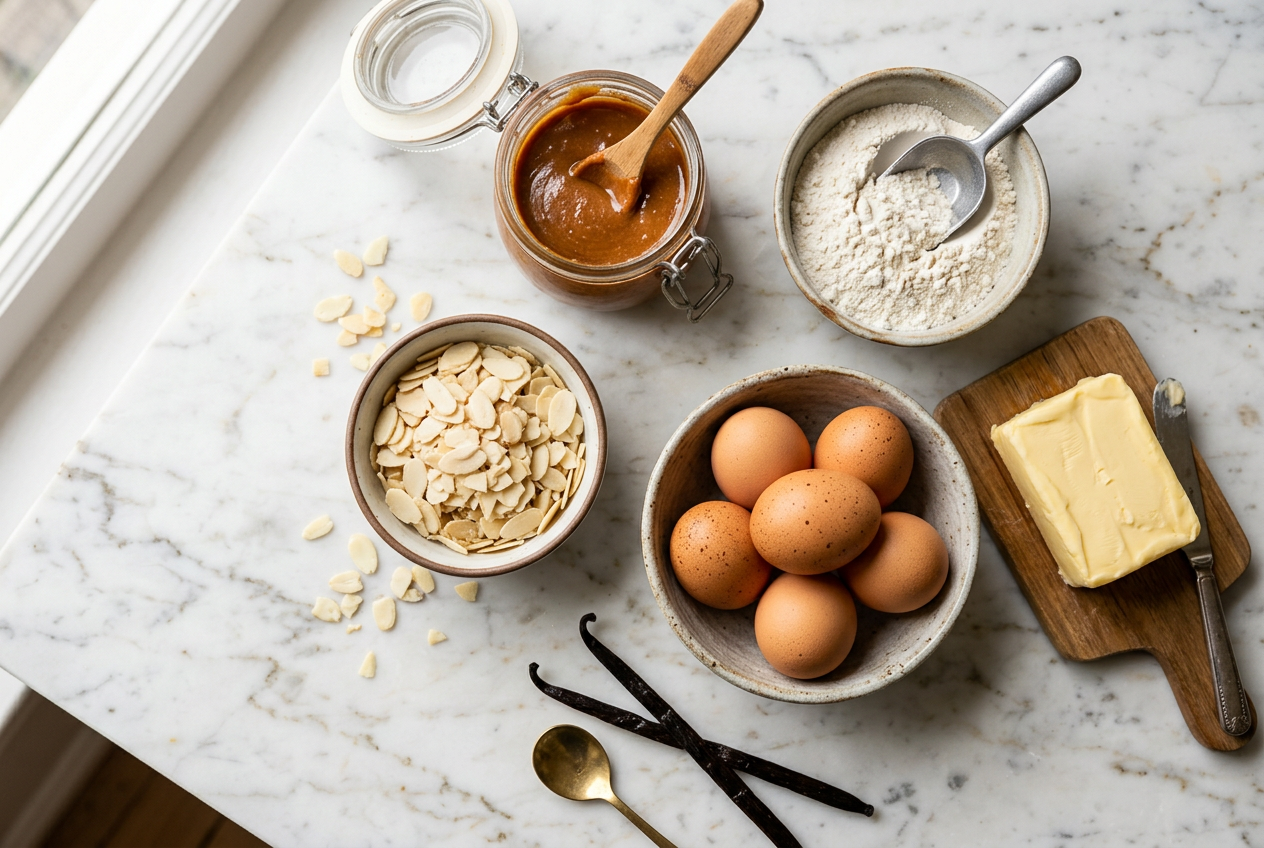
The praliné
This is the heart of the Paris-Brest. An industrial praliné yields a decent Paris-Brest. A homemade praliné yields an unforgettable one.
Two options:
- Make your own homemade praliné: this is what we recommend, and it's far simpler than it looks. See our complete homemade praliné recipe for the proportions and method. Use 50% hazelnuts, 50% sugar.
- Buy a quality artisan praliné: a 50/50 praliné paste (50% nuts) or 60/40 (60% nuts, more intense). At G. Detou, we carry several references.
Supermarket praliné often contains less than 30% nuts and a significant amount of palm oil. It has no place in a Paris-Brest worth the name.
The butter
AOP-certified butter throughout: for the choux pastry and for the mousseline cream. Butter accounts for 30 to 40% of the final flavor.
The flour
Standard T55 flour for the choux pastry. Nothing special required.
The eggs
Whole eggs and yolks. A Paris-Brest calls for a generous number of eggs — they give the choux its structure and the cream its richness.
The slivered almonds
For the crown decoration. Skin-on slivered almonds, lightly toasted just before use. At G. Detou, we carry pastry-grade slivered almonds.
The milk and vanilla
Whole milk for the base pastry cream, and a bourbon vanilla bean (Madagascar or Tahiti) for flavoring. The vanilla doubles the complexity of the praliné — it's not just there for show.
The step-by-step recipe (for a 24 cm crown, serves 8)
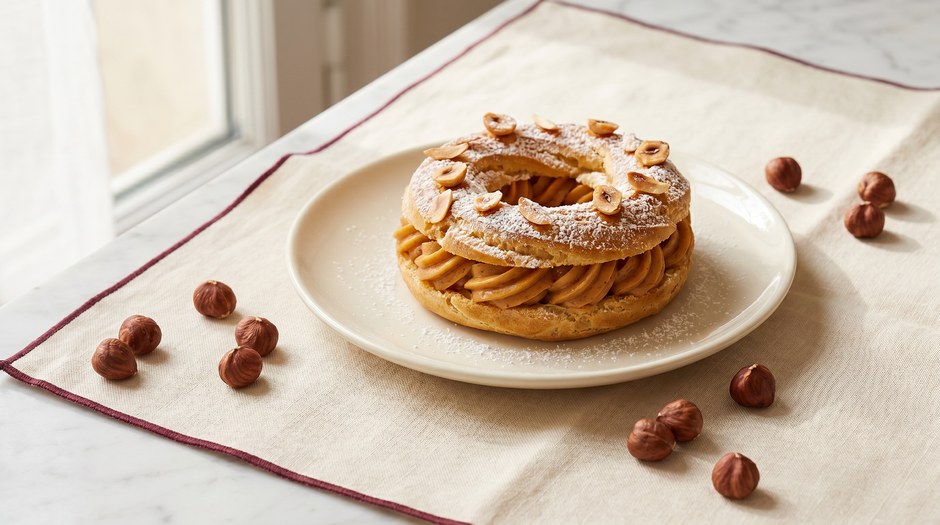
Prep time: 1 hour (+ resting time for the cream) · Baking time: 35 to 40 minutes
Ingredients
For the choux pastry






For the praliné mousseline cream


The pastry cream (ideally made the day before)
Step 1
Infuse the vanilla
Bring the milk to a gentle simmer with the split and scraped vanilla bean. Remove from heat and steep for 10 minutes.
Step 2
Whisk the yolks
Whisk together the egg yolks and sugar until pale and slightly thickened. Add the cornstarch and whisk until smooth.
Step 3
Temper the eggs
Remove the vanilla bean from the milk. Pour one third of the hot milk over the egg mixture, whisking constantly, then pour everything back into the saucepan.
Step 4
Cook the cream
Bring to a boil over medium heat, whisking without pause. Hold at a boil for 1 to 2 minutes to fully cook the starch.
Step 5
Chill
Transfer to a shallow dish, press plastic wrap directly onto the surface, and refrigerate until completely cold.
The crown template
On a sheet of parchment paper, draw a 24 cm circle in pencil. Flip the sheet over onto your baking tray — the outline should remain visible through the paper, while keeping the graphite away from the dough.
The choux pastry
Step 1
Bring to a boil
In a saucepan, bring the water, milk, diced butter, sugar, and fleur de sel to a rolling boil.
Step 2
Add the flour
Remove from heat and add all the flour at once. Stir vigorously with a wooden spoon or spatula until fully combined.
Step 3
Dry out the dough
Return to medium heat and cook the dough, stirring constantly, for 1 to 2 minutes — it should pull away cleanly from the sides of the pan and form a smooth, glossy ball.
Step 4
Incorporate the eggs
Transfer to a large bowl. Add the eggs one at a time, mixing energetically after each addition. The dough should be smooth and glossy, falling from the spatula in a slow, thick ribbon that forms a V-shape. Add a 5th egg if needed to reach this consistency.
Piping
Step 1
Fill the piping bag
Transfer the dough to a piping bag fitted with a 14–16 mm star tip.
Step 2
Pipe the crown
Pipe three concentric rings following the template: one just inside the drawn circle, one on the line, one just outside. The three rings should touch one another, forming a crown 6–8 cm wide.
Step 3
Scatter the almonds
Scatter the slivered almonds evenly over the entire surface.
Step 4
Dust with confectioners' sugar
Lightly dust with confectioners' sugar: this thin layer encourages a beautiful caramelization during baking.
Baking
Step 1
Preheat the oven
Preheat to 180 °C (355 °F), conventional (static) heat — avoid convection/fan-assisted mode, which dries the dough too aggressively.
Step 2
Bake without opening the door
Bake for 35 to 40 minutes. Never open the oven door during the first 25 minutes — even a brief rush of cold air will cause the choux to collapse.
Step 3
Cool on a wire rack
The crown should be deep golden and firm to the touch. Remove from the oven and cool completely on a wire rack — at least 1 hour.
The praliné mousseline cream
Step 1
Bring the cream to temperature
Remove the pastry cream from the refrigerator 30 minutes ahead. It should reach 18–20 °C (64–68 °F) — not cold.
Step 2
Loosen with the whisk
Whisk the pastry cream in the bowl of a stand mixer until smooth and lump-free.
Step 3
Add the butter
Add the softened butter (at the same temperature, 18–20 °C / 64–68 °F) in small pieces, continuing to whisk.
Step 4
Whip the cream
Whisk on medium-high speed for 3 to 5 minutes: the cream will roughly double in volume and turn light and airy.
Step 5
Fold in the praliné
Add the praliné and whisk for another minute until fully incorporated.
Assembly
Step 1
Slice the crown
Using a serrated knife, cut the crown horizontally in half. Set the top half aside.
Step 2
Pipe the cream
Using a star-tipped piping bag, pipe the mousseline cream generously over the bottom half, working in even rosettes or mounds.
Step 3
Replace the top
Place the top half back on and dust generously with confectioners' sugar.
Refrigerate for 1 hour before serving to allow the cream to set.
The most common mistakes
- Opening the oven during baking. The choux collapses, the crown is lost. Never before the 25-minute mark.
- Adding cream and butter at different temperatures. They must be at exactly the same temperature (18–20 °C / 64–68 °F). Otherwise: lumps, or a cream that breaks.
- Using industrial praliné. The recipe does 80% of the work; the praliné accounts for the remaining 20%. Don't cut corners here.
- Making the choux too runny. The dough must fall from the spatula in a slow V-ribbon, not pour like a batter. Adjust the number of eggs accordingly.
- Assembling too early. A filled crown will begin to soften within 3–4 hours. Assemble as close to serving as possible.
Storage
A fully assembled Paris-Brest keeps for 24 hours maximum in the refrigerator. Beyond that, the choux softens where it meets the cream.
The mousseline cream keeps for 48 hours in the refrigerator, stored in an airtight container. Re-whisk before use to restore its texture.
The unfilled choux crown keeps for 24 hours at room temperature in a dry spot — do not store it in an airtight container, which will make it go soft. It can be baked the day before assembly.
What does it cost to make at home?
A homemade 24 cm Paris-Brest comes to roughly €15 to €20 (the praliné being the main variable). Compare that to €35–50 at a quality pastry shop for an equivalent piece.
Modern variations
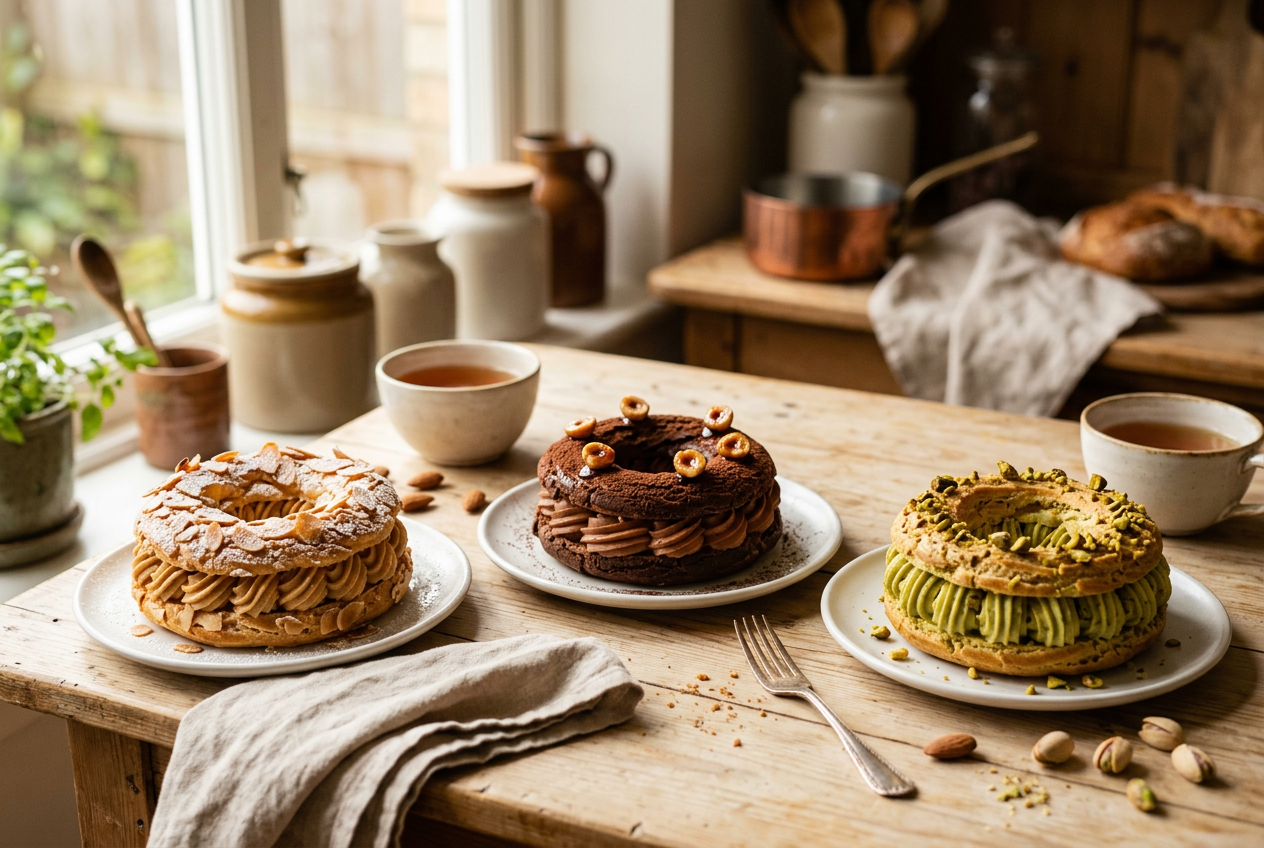
Individual Paris-Brest
Pipe 8 small crowns of 10 cm instead of one large one. Bake for 25 minutes at 180 °C (355 °F). Fill individually. More elegant, and far easier to serve.
Paris-Brest with a liquid praliné insert
At the center of each individual crown, hide an insert of flowing praliné (50 g pure praliné + 10 g confectioners' sugar, frozen into small balls). Spectacular on the palate — this has become the hallmark of modern interpretations.
Pistachio Paris-Brest
Replace the hazelnut praliné with 150 g of pistachio praliné (pistachios in place of hazelnuts in the recipe for the homemade praliné). Different color and taste, a trend fully embraced since the Dubai chocolate wave. In the same spirit, our pistachio cream also makes a wonderful flavoring for a mousseline.
Chocolate-praliné Paris-Brest
Fold 50 g of melted dark chocolate (Valrhona Guanaja 70%) into the mousseline cream along with the praliné. A more intense, almost entremet-like version.
Where to find the right ingredients
At G. Detou, 58 rue Tiquetonne, Paris 2nd arrondissement:
- Artisanal hazelnut-almond praliné 50/50 — the backbone of the Paris-Brest
- Whole hazelnuts and almonds if you're making your praliné from scratch
- Slivered almonds for decorating the crown
- Bourbon vanilla pods Madagascar and Tahiti
- Valrhona dark chocolate for the variations
- Fleur de sel from Guérande
G. Detou's advice
The Paris-Brest stands or falls on its praliné mousseline cream — and that cream has no tolerance for industrial praliné. Made with a praliné containing just 30% nuts, it turns greasy and flat; made with one at 50% minimum, it becomes something ethereal. That gap explains most of the difference between a forgettable bakery version and the real thing from a great pastry house. The quality of the praliné accounts for half the result. On rue Tiquetonne, professional pastry chefs come specifically for the 50/50 pralinés and the nuts they toast themselves: that is the true starting point of a mousseline worth making.
FAQ — The Paris-Brest
Yes — work in stages: make the pastry cream the day before, bake the choux crown the morning of, and assemble 3–4 hours before serving. Trying to do everything on the day is a lot to take on.
Three likely culprits: the oven was opened too early, the choux dough was too loose, or the baking time was insufficient. Address all three on your next attempt.
The butter and cream were at different temperatures. To rescue it: gently warm the bowl over a bain-marie (no more than 30 seconds) while continuing to whisk. The cream should come back together within seconds.
- 18 cm: serves 4
- 20 cm: serves 6
- 24 cm: serves 8
- 28 cm: serves 10–12
- Individual (10 cm): 1 crown per person
Yes — unfilled only. Let it cool completely, freeze for 24 hours, then transfer to a freezer bag. Use within 2 weeks. Thaw at room temperature for 2–3 hours, then refresh in a 355 °F (180 °C) oven for 5 minutes to restore the crunch.
Cornstarch produces a smoother, glossier cream with no raw-flour aftertaste. Flour works, but the result is noticeably more rustic.
Some recipes do include it (10–20%) for added body. It is a matter of taste — it makes the cream denser and richer, almost cake-like. In the classic version, we prefer the lightness of a pure praliné mousseline.
The Paris-Brest is one of those desserts that makes you want to get back in the kitchen even after a failure. When the choux rises beautifully and the mousseline is silky and fragrant with praliné, it is a joy to share.
To go further, take a look at our recette du praliné
At G. Detou, we always encourage making your own praliné at least once — if only to feel the difference firsthand.
To go further: browse our full Pralines & Gianduja selection.