



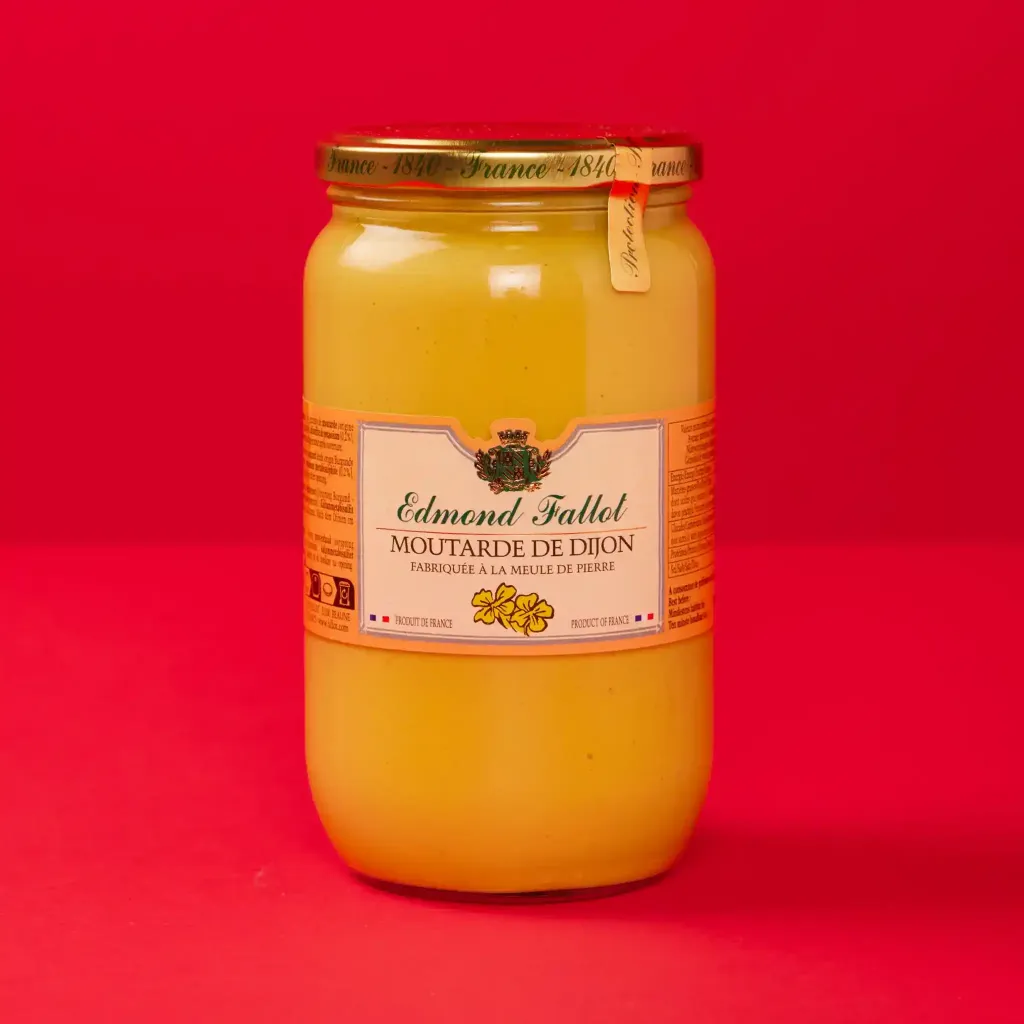
Dijon mustard E. Fallot 85cl Fallot
E. Fallot Dijon Mustard, 85 cl. A staple at our Paris store since 1951, kept in stock year-round. A double restaurant or large-family size: the same classic Dijon recipe, in a bigger jar.
\nIngredients: Water, mustard seeds, vinegar, salt, antioxidant: potassium disulfite, acidifier: citric acid, spices. 85 cl format, €5.10 — available for in-store pickup at our Paris location or shipped anywhere in France.
\nWhy We Carry This at G. Detou
\nMaison Fallot, founded in Beaune in 1840 by Léon Bouley and taken over in 1928 by Edmond Fallot, is one of the rare Burgundian mustard houses to have remained independent amid widespread industry consolidation. Grinding is done with stone millstones, which prevents heat build-up and preserves the fresh aromatic character that defines traditional mustard.
\nThat sharp, nose-tingling heat comes from a volatile compound released when the seeds are ground: allyl isothiocyanate. It's what makes fresh mustard instantly recognizable next to an aged one — and it's also why a jar that's been open for a while tastes flat. The molecule evaporates over time, even in a tightly closed jar. The 85 cl size is a favorite among the small restaurants in the neighborhood, many of which stop by the Paris store every week to restock.
\nWe keep Fallot on our shelves because of its independence — a quality that has become genuinely rare in French mustard-making. Our pastry-professional customers and regular neighborhood shoppers alike appreciate this, and it aligns with G. Detou's broader philosophy: favor independent producers whenever the quality-to-price equation allows. The 85 cl size suits heavy weekly use — bistros, family kitchens, neighborhood caterers. Refrigerate after opening to preserve the mustard's punch.
\nSeed sourcing remains a sensitive topic for French mustard makers: 2022 saw a shortage of Canadian seeds due to drought, driving prices up by 30% within just a few months. By also sourcing from Burgundy, Fallot weathered that crisis better than competitors relying entirely on imports.
\nHow to Use It
\nFor a classic mustard kidney sauce, deglaze sautéed kidneys with a half-glass of cognac, add two tablespoons of cream and a heaping spoonful of Dijon mustard, then finish off the heat.
\nFor a family roast chicken marinade, combine three tablespoons of mustard with two of olive oil, thyme, and garlic. Coat the bird before roasting at 180 °C (350 °F).
\nFor a large-batch sauce gribiche, build a mustard mayonnaise, then fold in chopped cornichons, capers, fresh herbs, and crumbled hard-boiled egg.
\nThis mustard shines in long-simmered mustard sauces (kidneys in mustard sauce, a revisited escalope normande), weekend homemade mayonnaise, and large-quantity vinaigrettes for cold buffets.
\nClassic wine pairings with mustard: a dry, mineral white (Bourgogne aligoté, Mâcon-Villages) alongside mustard-forward poultry or fish dishes; a light red (Beaujolais, Pinot d'Alsace) with grilled red meats finished with mustard.
\nA note on texture: Fallot mustards are deliberately thicker than industrial versions, which are often thinned with water to increase volume. That extra density translates to more economical use per gram.
\nFor more creative applications: stir a spoonful into potato gnocchi dough for a subtle, comforting depth, blend into a compound butter for escargots, add to a homemade barbecue sauce for brightness, or even mix into a Bloody Mary for extra kick.
\nA quick note on value: at the 85 cl size, this jar works out to roughly €6.00/kg — a fair price for a traditional French mustard compared to industrial brands that compete on price alone but offer far less aromatic complexity.
\nOn the French mustard landscape: today, three notable independent family-owned brands remain — Fallot in Beaune, Pommery in Meaux, and Reine de Dijon in Chevigny-Saint-Sauveur — alongside corporate brands (Amora, Maille, Bornier). Fallot and Pommery are the two "traditional mustard" references we work with at G. Detou.
\nTasting tip: take the jar out of the refrigerator ten minutes before serving so the aromas can open up — mustard that's too cold loses aromatic intensity on the palate.
\nDelivery and In-Store
\nAvailable for free in-store pickup at our Paris location, 58 rue Tiquetonne, Paris 2nd arrondissement, or shipped anywhere in metropolitan France. Once opened, keep refrigerated.
\nIn store, our team can walk you through uses, help you compare brands and sizes, and point you in the right direction based on your needs. That's what a traditional neighborhood specialty grocer does — and it's what G. Detou has been doing since 1951 in the heart of the 2nd arrondissement: proximity, expertise, and rigorous selection. Our staff knows these products and their producers inside and out.
\nAllergen information: mustard, disulfite (please disclose in food service settings).
\nFrequently Asked Questions
\nWho is the 85 cl size for?
\nRestaurateurs, caterers, institutional kitchens, or households that go through a lot of mustard — sauces, weekly marinades. For occasional use, the 21 cl jar is the better fit.
\nHow long after opening?
\nUp to six months in the refrigerator, tightly closed. Beyond that, the heat fades noticeably and the color darkens.
\nWhat's the difference from the 21 cl?
\nNo difference in recipe or origin: the same Fallot Dijon mustard, with only the format changed to suit different usage frequencies.
\nIs it truly artisanal?
\nYes. An independent house since 1840, still produced in Beaune using traditional methods. This is traditional mustard in the strictest sense of the term.
\nWhere do the seeds come from?
\nBurgundian seeds are the priority, supplemented by European seeds depending on the harvest. The Moutarde de Bourgogne IGP supply chain requires full traceability, which Fallot upholds across its IGP range.
Price per kg |
5,93 € |
Description
E. Fallot Dijon Mustard – 85 cl, traditional and tangy taste.
Characteristics
- Weight: 0.850 kg
- Ingredients: Water, MUSTARD seeds, vinegar, salt, antioxidant: potassium diSULFITE, acidifier: citric acid, spice.
- Allergens: Mustard, disulfite.
-
Nutritional values:
Energy (kJ): 681 kJ
Energy (kcal): 164 kcal
Total Fat (g): 12
Saturated Fat (g): 0.8
Total Carbohydrate (g): 3
Carbohydrate (sugars) (g): 2.5
Protein (g): 7.4
Salt (g): 6.4 - Legal name: Dijon Mustard
- Storage conditions: Keep refrigerated after opening.
Nos derniers contenus
Découvrez les nouveautés dans notre entreprise !