


Fallot Dijon Mustard with Walnuts 21cl
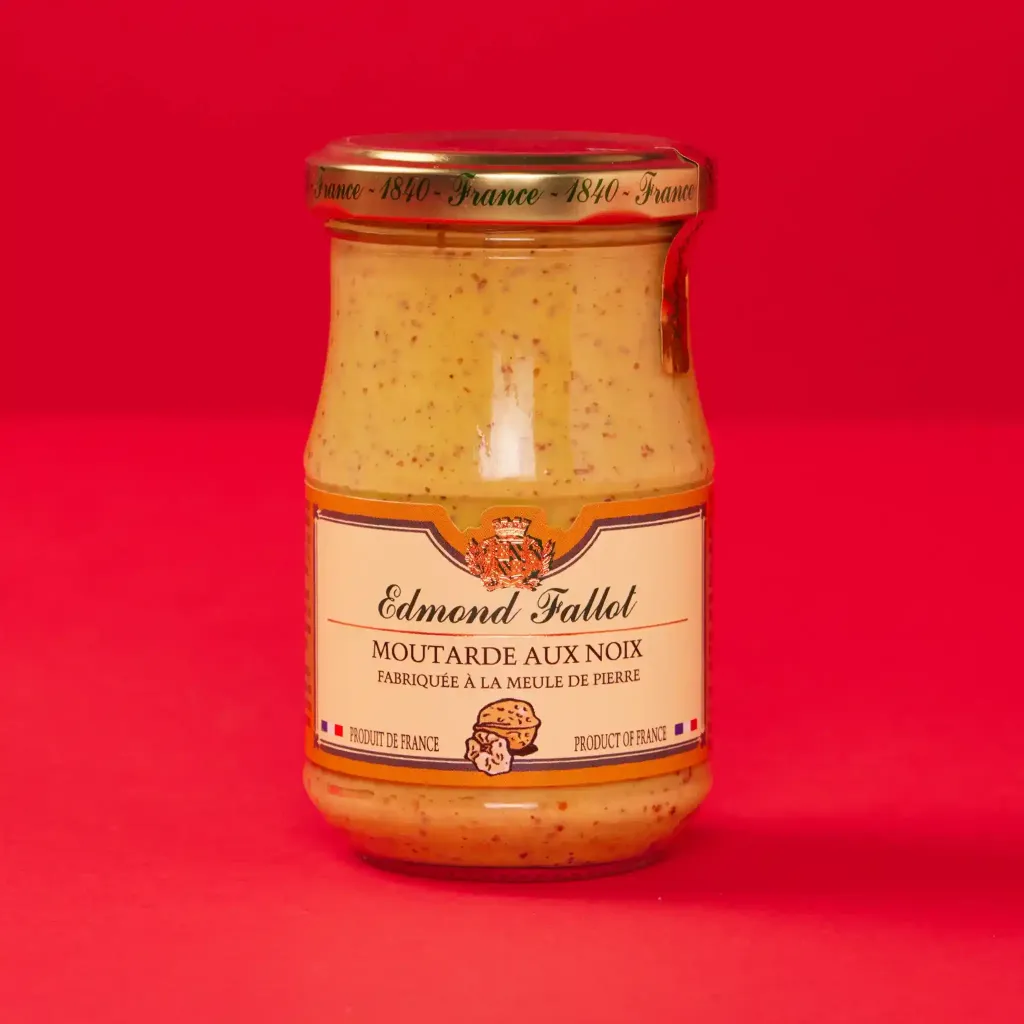
Fallot Walnut Dijon Mustard, 21 cl. A classic we have carried since 1951 at our Paris store. This Dijon mustard is enriched with 2% walnut powder and natural walnut flavoring, its heat softened by the rich, roasted quality of the nut.
\nIngredients as listed by the manufacturer: Water, mustard seeds, vinegar, salt, mustard bran, walnut powder (2%) (tree nuts), natural walnut flavor (tree nuts), antioxidant: potassium disulfite, acidifier: citric acid, spices. 21 cl format (210 g), €3.10 in our Paris store.
\nWhy we carry this at G. Detou
\nFallot has been based in Beaune since 1840 — founded by Léon Bouley and taken over in 1928 by Edmond Fallot — and stands among the last independent, family-owned mustard houses in Burgundy. The house still uses stone-wheel grinding, a slow method that generates little heat, preserving the volatile compounds responsible for mustard's nasal heat.
\nThat nasal kick comes from allyl isothiocyanate, a molecule released through hydrolysis of sinigrin during grinding. The slower and cooler the grind, the longer the molecule holds once the jar is sealed. It is this chemistry that explains the perceptible quality gap between a traditionally made mustard and a fast-tracked industrial one. The walnut flavor carries well in a vinaigrette — which is precisely what sets this mustard apart from simply adding walnut oil to a dressing.
\nWe chose Fallot for its consistency over time: every jar delivers the same aromatic profile, with minimal batch-to-batch variation — an essential criterion for the neighborhood's restaurateurs who build their recipes around this base. An inconsistent mustard throws a professional kitchen off balance. The walnut note pairs naturally with autumn salads, blue cheeses, and white meats. The 21 cl format is ideal for regular use.
\nOn the export front, Fallot sells its mustard in roughly thirty countries, primarily across Europe and North America. The brand serves as a French reference point in Anglo-Saxon and Northern European specialty food stores — an ambassador for France's mustard-making tradition beyond its borders.
\nServing suggestions
\nFor an autumn vinaigrette, whisk together the walnut mustard, apple cider vinegar, walnut oil, and salt. Toss with endive, lamb's lettuce, or arugula through the winter months.
\nFor duck breast, brush the flesh side before cooking — while the skin side renders, the mustard caramelizes gently and the walnut aroma blooms.
\nFor a cheese board, a small dollop alongside Bleu d'Auvergne or Roquefort is all you need — the walnut-blue cheese pairing is a French kitchen classic.
\nIt works beautifully in an endive, walnut, and Roquefort salad, alongside fresh goat cheese, duck breast, or poached pear. Walnut mustard can seamlessly replace plain mustard in any recipe that already calls for walnut.
\nOn regional pairings: a Burgundy mustard alongside a Burgundian dish (beef, rabbit), an herbed Provençal mustard with a dish from the South, an English mustard with roast beef and Yorkshire pudding. Regional coherence nearly always works in the kitchen.
\nOn pH: a standard mustard falls between 3.2 and 3.8 (acidic), which is sufficient to inhibit bacterial growth and preserve the product naturally for several months. It is the mustard's acidity — not an added preservative — that ensures its longevity.
\nIn savory baking: Dijon mustard is at home in a revisited olive cake, in a Burgundian gougère (made with Emmental), in a traditional pâté en croûte, or in a Comté cheese puff pastry appetizer. It is a lesser-known classic of southeastern French cuisine.
\nA note on price: at 21 cl (210 g), this jar works out to roughly €15.50/kg — a positioning that reflects what a traditionally made French mustard is worth, especially compared to mass-market alternatives that compete on price but fall short on character.
\nA note on Dijon vs. Burgundy mustard: the former is an open commercial designation (anyone can use it), while the latter is a protected geographical indication (PGI) with strict specifications — 100% Burgundian seeds, Aligoté wine. This distinction matters when you want genuine assurance of a product's French origin.
\nFor restaurant or catering use, transferring the mustard into food-grade squeeze bottles makes portioning faster during service. It is a standard trick in modern professional kitchens for keeping pace with à la carte orders.
\nDelivery and store
\nStore located at 58 rue Tiquetonne, Paris 2nd arrondissement — free in-store pickup at our Paris location or shipping anywhere in France. Once opened, refrigerate the jar to preserve its heat and freshness.
\nFor professional orders (restaurants, caterers, retailers), we offer volume pricing and a dedicated account manager. Contact the store to open a trade account and access rates tailored to your business — G. Detou has long served a wide range of food professionals in the neighborhood, from Michelin-starred chefs to local caterers.
\nAllergens: mustard, disulfite, tree nuts.
\nFrequently asked questions
\nHow much walnut is in it?
\n2% real walnut powder, complemented by a natural walnut flavoring that amplifies the aromatic perception without overloading on tree nut.
\nAny allergens?
\nYes — tree nuts (walnut), in addition to mustard and disulfite. Strictly avoid if you have a tree nut allergy.
\nIs it genuinely artisan?
\nYes — Fallot has turned down acquisition offers from multinational groups. Production takes place in Beaune using the historic Burgundian stone-grinding method.
\nWhich cheeses does it work with?
\nBlue cheeses first — Roquefort, Fourme d'Ambert — then fresh or semi-dry goat cheeses. The walnut-cheese pairing is universally reliable.
\nHow long does it keep once opened?
\nFour to six months refrigerated. The walnut aroma can oxidize faster than plain mustard, so seal the jar tightly after each use.
Price per kg |
15,23 € |
Description
Edmond Fallot Dijon mustard with walnuts – 21 cl, delicate and smooth taste.
Characteristics
- Weight: 0.200 kg
- Ingredients: Water, MUSTARD seeds, vinegar, salt, MUSTARD husks, WALNUT powder (2%) (NUTS), natural WALNUT flavouring (NUTS), antioxidant: potassium diSULFITE, acidifier: citric acid, spice.
- Allergens: Mustard, disulfite, nuts (tree nuts)
-
Nutritional values:
Energy (kJ): 704 kJ
Energy (kcal): 169 kcal
Total Fat (g): 13
Saturated Fat (g): 0.9
Total Carbohydrate (g): 4.2
Carbohydrate (g): 1.8
Protein (g): 7.2
Salt (g): 6.1 - Legal name: Dijon Mustard
- Storage conditions: Keep refrigerated after opening.
Nos derniers contenus
Découvrez les nouveautés dans notre entreprise !