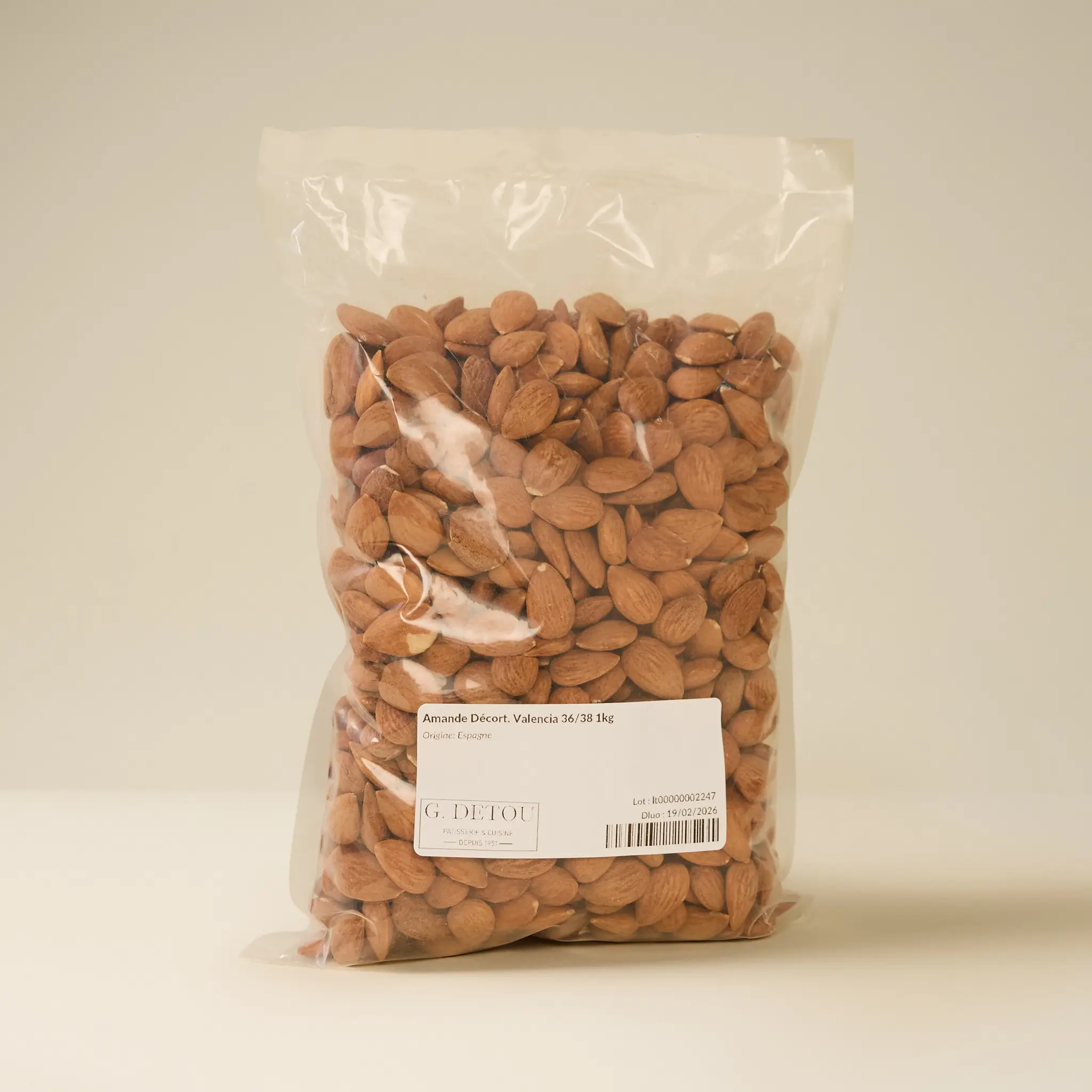



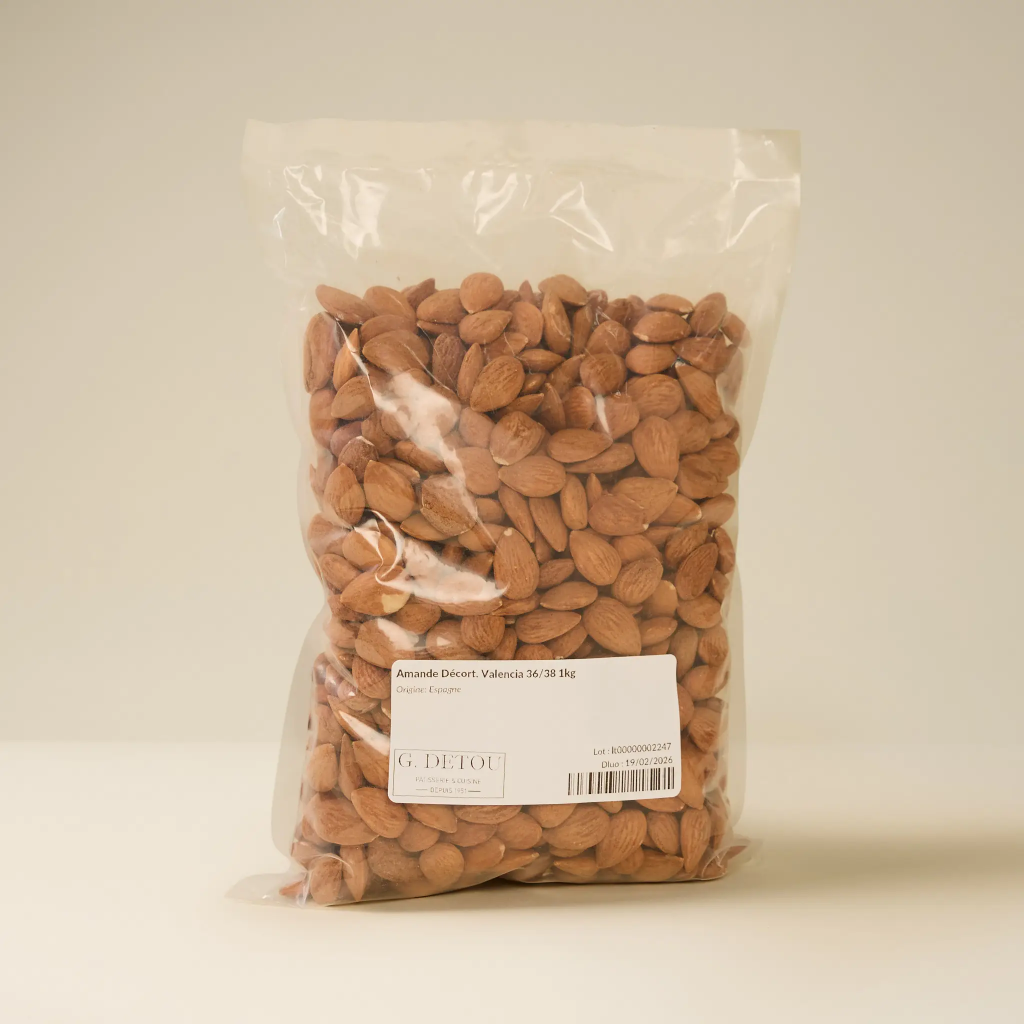
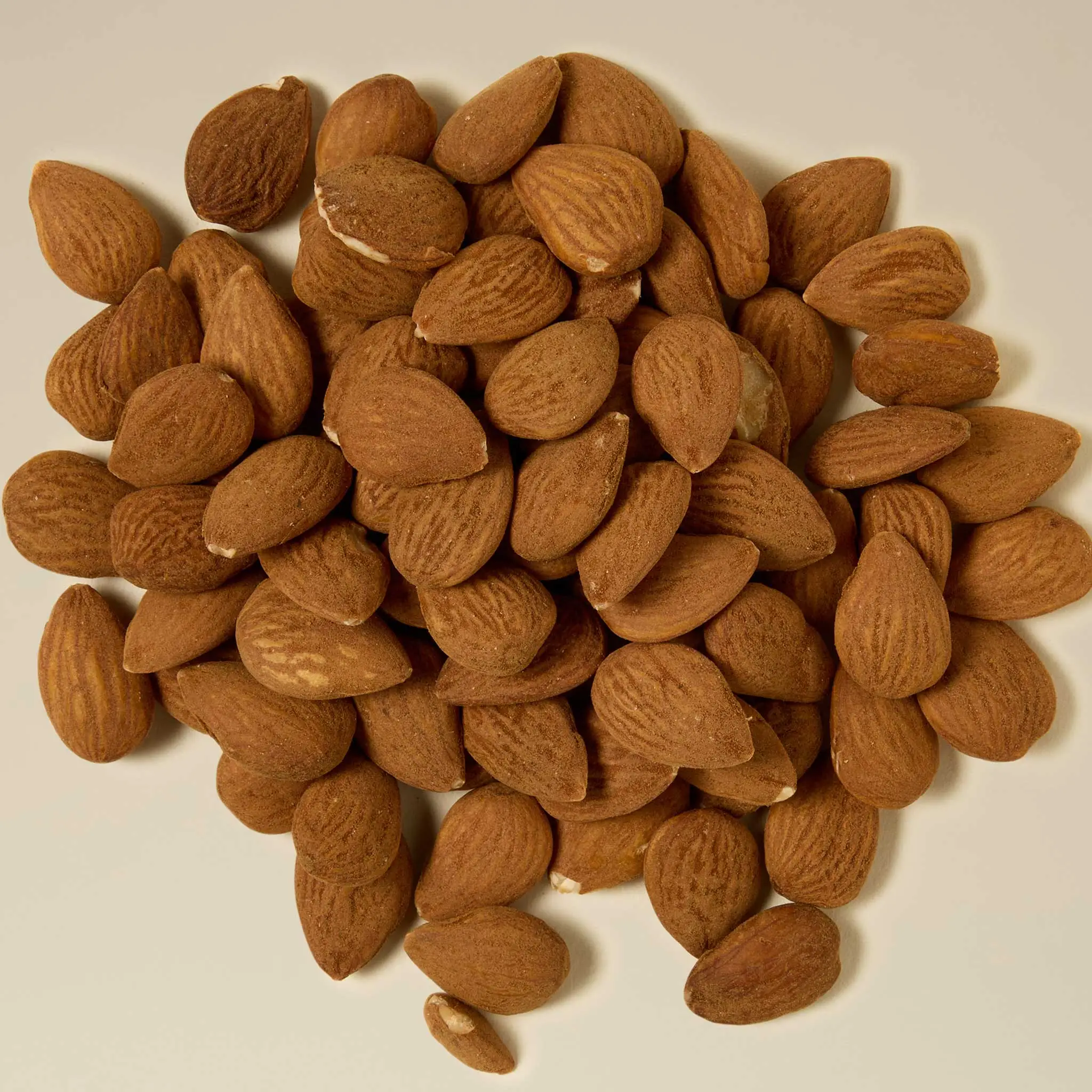
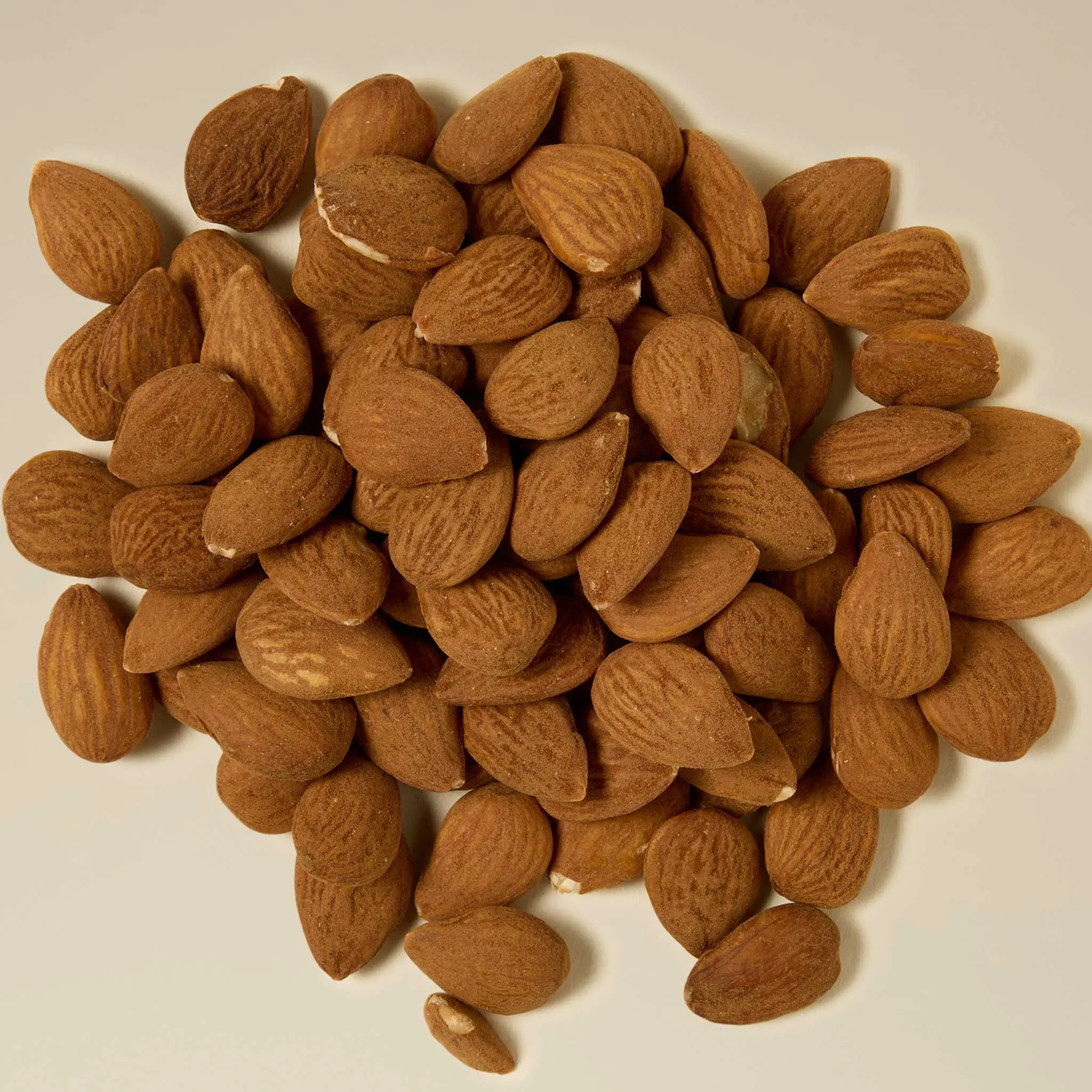
Shelled Valencia almonds 36/38 1kg
The Spanish Valencia almond is the go-to variety for French pastry when bakers aren't reaching for a Marcona or a Piedmont. The flesh is dry and mildly sweet, with a bitterness that comes through roasting. This 1 kg format is a professional-grade pack that covers biscuits, pralinés, and almond paste without interruption.
Grade 36/38 means 36 to 38 almonds per gram. Not too small, not too large: a standard eating-almond size, consistent, that roasts evenly in the oven without scorched spots.
\nWhat we love about this almond
\nOrigin Spain, store dry in a sealed bag: both details come straight from the supplier's label. The Valencia is more elongated than the Marcona, drier, and delivers consistent results when roasting — minimal loss, very few broken almonds.
At 1 kg, this is the bag we recommend to serious home cooks making their own pralinés or almond pastes. For occasional use, 500 g options are available among our other dried-fruit references.
The Valencia region of Spain has cultivated almond trees since the Middle Ages. The dry climate and limestone soil produce an almond with a lighter skin than California varieties and a slightly lower oil content — which translates to better stability during roasting and a cleaner finish on the palate.
\nHow to use it
\nRoast in the oven at 150 °C (300 °F), twelve to fifteen minutes, stirring halfway through. The almond should turn light amber: over-roasted, it picks up a bitter note that overwhelms the caramel in a praliné.
For homemade almond paste: fifty percent blanched almonds blended in a food processor, fifty percent confectioners' sugar, one egg white, and a few drops of vanilla extract. For pralinés: roast the almonds, cook a syrup to 117 °C (243 °F), coat the almonds, let cool, then grind.
In baked goods, keep Valencia almonds whole in financiers and shortbread for chew. They can also be roughly chopped with a knife for decorating tart bases or adding crunch to a crumble.
For Provençal croquants — calissons d'Aix, navettes — the Valencia is the traditional almond. Broken into irregular pieces and folded into the dough with a little orange blossom water, it provides the characteristic chew of these southern French cookies. Low-temperature baking (140–150 °C / 285–300 °F) preserves the aromas.
Another approach for the dedicated home baker: make a pralin (praliné ground to a fine powder, not a paste) from toasted Valencia almonds. This dry pralin can be scattered over entremet cakes, folded into shortbread, or used to coat chocolate truffles. The aromatic, powdery texture comes from carefully pulverizing pralined almonds.
The Aragon region of Spain — particularly the province of Zaragoza — is today one of the major Valencia almond-growing areas, with modern cooperatives that have streamlined harvesting and processing while preserving the traditional variety.
\nDelivery and storage
\nThe 1 kg bag is available for in-store pickup at our Paris location (58 rue Tiquetonne, 2nd arrondissement), Tuesday through Saturday. For delivery, orders ship within three to five business days anywhere in mainland France, packed in a rigid cardboard box.
Once opened, store in an airtight jar in a dry place. Almonds absorb ambient moisture and lose their crunch within a few weeks if left exposed to air.
In terms of yield: one 1 kg bag is enough for approximately three batches of homemade almond paste (250 g each) or two batches of praliné (400 g each). It's the right format for a serious home workshop over the course of a month.
Price-wise, the cost per kilo of a Valencia 36/38 almond remains one of the best value-for-money options in our dried-fruit section. For a home baker who pastry-makes regularly, it's the economical benchmark without any compromise on quality. We recommend pairing it with a Marcona almond in a smaller format for signature pralinés where flavor truly matters.
\nFrequently asked questions
\nWhat is the difference between Valencia and Marcona?
\nThe Marcona is rounder, meatier, sweeter, and noticeably more expensive. It's reserved for signature pralinés and premium cocktail almonds. The Valencia is more versatile, striking the right balance between price and quality.
\nWhat does the 36/38 grade mean?
\nThe grade refers to the number of almonds per gram. 36/38 corresponds to a medium-large size sought after in pastry. Smaller grades — 40/42 or 45+ — are used in industrial applications.
\nHow do I blanch almonds at home?
\nDrop them into boiling water for three minutes, drain, then slip the skins off between two fingers. Useful for nougats, white almond paste, and blanched almond decorations.
\nHow long will an opened 1 kg bag keep?
\nIn an airtight jar at room temperature, six to eight months with no loss of aroma. Beyond that, the oil can turn rancid — especially after roasting.
\nDo you carry organic almonds?
\nWe do carry a few organic options in other formats — ask in the Paris store. This Valencia 36/38 1 kg is conventionally grown, origin Spain.
\nWhat yield can I expect when making homemade almond flour from 1 kg of almonds?
\nRoughly 950 g to 1 kg of raw almond flour if you grind in a food processor without sifting. With fine sifting (for macarons, for example), the yield drops to 800–850 g — the remainder being coarser particles that can be repurposed in financiers or crumbles.
Price per kg |
12,01 € |
Description
Valencia 36/38 shelled almonds (1kg) are ideal for your sweet and savory recipes. Crunchy and flavorful, they add a touch of freshness and quality to your pastries, snacks, or gourmet dishes.
Characteristics
- Weight: 1.000 kg
- Ingredients: 100% almonds
- Storage conditions: Stored in a dry place, tightly sealed.
Nos derniers contenus
Découvrez les nouveautés dans notre entreprise !