

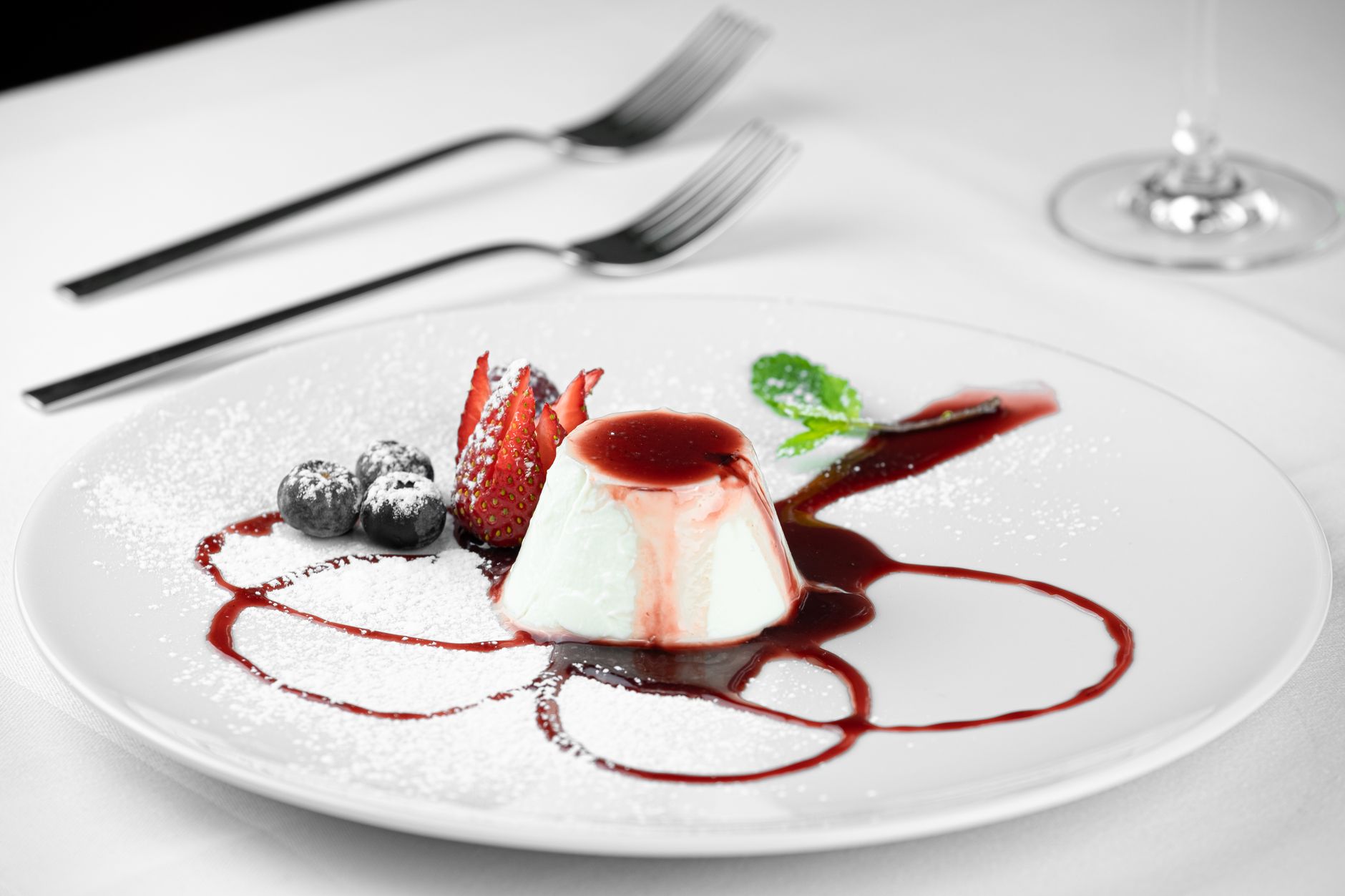
A perfectly trembling panna cotta, a cloud-light bavarois (a classic French chilled mousse), a flawless mirror glaze… Behind every successful texture lies a well-measured gelling agent. But when it comes to choosing between animal-based gelatin — a centuries-old staple of French pastry — and agar-agar, the seaweed-derived alternative that has been winning over more and more cooks, the decision isn't always straightforward. Gelatin or agar-agar: the right answer depends above all on what you're making, the texture you're after, and your dietary requirements.
This in-depth guide gives you everything you need to choose the right gelling agent, dose it correctly, and nail your recipes every single time.
Understanding Gelatin: Origins, Forms, and Properties
Where Does Food-Grade Gelatin Come From?
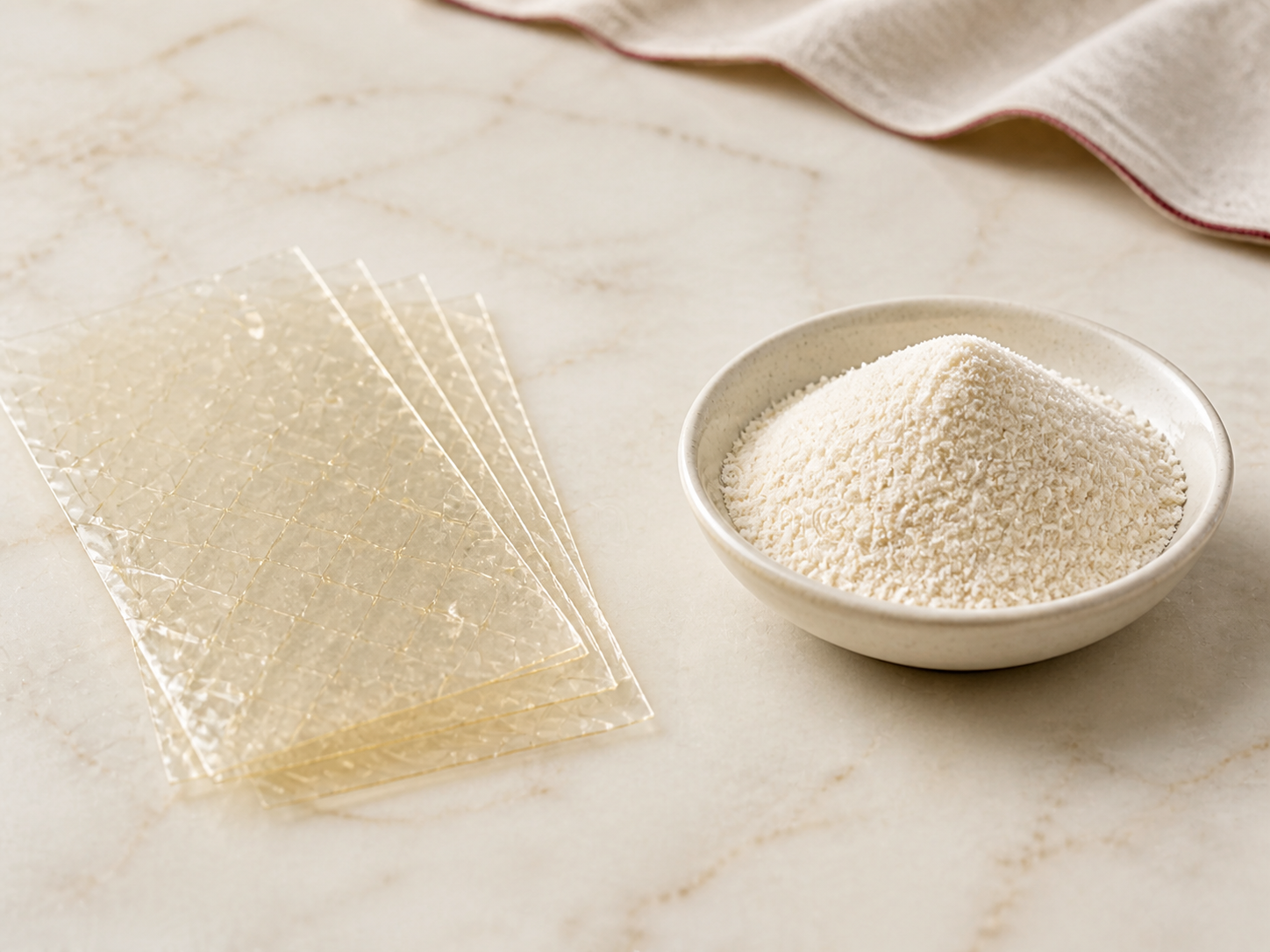
Gelatin is an animal protein derived from collagen, sourced primarily from the skin and bones of pork or beef. In professional pastry, the format of choice is almost exclusively sheet gelatin, standardized at 2 g per sheet across Europe. Powdered gelatin also exists and is more common in English-speaking countries, but it is less convenient for precise measurement.
Gelatin comes in different "bloom" ratings (from 80 to 250), a unit that measures its gelling strength. The higher the bloom, the stronger the setting power. Commercially available sheets are generally calibrated so that each sheet delivers the same gelling power regardless of its bloom rating — it is the weight of the sheet itself that varies accordingly.
How to Use Sheet Gelatin
The process is straightforward but requires care:
- Blooming: submerge the sheets in a large volume of cold water for 10 to 15 minutes. They should become supple and fully softened.
- Squeezing: gently wring them between your hands to remove excess water.
- Incorporating: add the sheets to a warm preparation (between 122–140 °F / 50–60 °C). Gelatin melts at around 95 °F (35 °C). Never let it boil, or you risk degrading its gelling power.
- Setting: gelling takes place in the refrigerator, generally over 4 to 6 hours.
The Strengths of Gelatin
- Silky, elastic texture: gelatin produces a supple gel that melts on the tongue at body temperature (around 99 °F / 37 °C). This is precisely the property that gives panna cottas and mousses their irresistibly smooth, yielding texture.
- Clarity: it yields a crystal-clear result, ideal for mirror glazes and transparent jellies.
- Thermal reversibility: a gelatin-set gel can be gently rewarmed and re-set, offering considerable flexibility during preparation.
- Foam-stabilizing power: gelatin stabilizes mousses and aerated creams by trapping air bubbles within its structure.
Understanding Agar-Agar: The Plant-Based Alternative
What Is Agar-Agar?
Agar-agar is a polysaccharide extracted from red algae (Gelidium or Gracilaria). Used in Japan since the 17th century under the name kanten, it has established itself in the West as the go-to plant-based gelling agent. It is most commonly found in powder form, the most practical format for accurate measuring. Louis François powdered agar-agar is a reliable choice for home bakers and professionals alike.
How to Use Powdered Agar-Agar
The technique differs significantly from that of gelatin:
- Dispersing: whisk the agar-agar powder into a cold liquid and mix thoroughly.
- Cooking: bring the mixture to a full boil and maintain it for at least 2 minutes. This step is non-negotiable: without boiling, agar-agar will not gel.
- Setting: gelling begins at around 95–104 °F (35–40 °C), at room temperature. Refrigeration is not required to achieve a set gel, although cold will firm it up further.
The Strengths of Agar-Agar
- 100% plant-based: suitable for vegetarian, vegan, and certain religious dietary requirements (halal, kosher).
- High gelling power: agar-agar gels 8 to 10 times more effectively than gelatin at equal weight, so far less is needed.
- Heat resistance: an agar-agar gel does not melt until around 185 °F (85 °C), making it highly stable at room temperature — even in summer.
- Neutral flavor: when properly measured, it does not alter the flavors of the preparation.
- Very low in calories: as a plant fiber, agar-agar is virtually calorie-free.
Gelatin vs. Agar-Agar: A Detailed Texture Comparison
This is where the real decision lies for your recipes. The two gelling agents produce fundamentally different textures, and that distinction should be your primary guide.
| Criterion | Gelatin | Agar-Agar |
|---|---|---|
| Gel texture | Supple, elastic, melt-in-the-mouth | Firm, brittle, clean-cut |
| Melts on the tongue | Yes (99 °F / 37 °C) | No (melts at 185 °F / 85 °C) |
| Clarity | Excellent | Slightly cloudy |
| Stability at warm temperatures | Poor (melts from 77–86 °F / 25–30 °C) | Excellent (stable up to 176 °F / 80 °C) |
| Setting time | 4–6 hours in the refrigerator | 30–60 minutes at room temperature |
| Thermally reversible | Yes | Yes |
| Suitable for vegetarians | No | Yes |
In short: gelatin produces a trembling, melt-in-the-mouth gel; agar-agar produces a firm, clean-breaking one. You cannot truly replicate the texture of one with the other.
Dosages and Equivalences Between Gelatin and Agar-Agar
Standard Gelatin Dosages
The basic rule of thumb in French pastry:
- Soft gel (panna cotta, bavarois): 6 to 8 g of gelatin (3 to 4 sheets) per 500 ml of liquid
- Firm gel (aspic, unmolded jelly): 10 to 12 g of gelatin (5 to 6 sheets) per 500 ml of liquid
- Mousse, cream: 4 to 6 g of gelatin (2 to 3 sheets) per 500 ml of preparation
The gelatin sheets available at G. Detou — bovine or porcine depending on your needs — each weigh 2 g, which makes calculations straightforward.
Standard Agar-Agar Dosages
Agar-agar is far more concentrated:
- Soft gel: 2 g of agar-agar per 500 ml of liquid
- Firm gel: 4 g of agar-agar per 500 ml of liquid
- Jam: 2 g of agar-agar per kilogram of fruit
Gelatin-to-Agar-Agar Conversion Chart
The conversion is not a simple ratio, since the resulting textures differ. That said, here are the equivalences most widely accepted in professional practice:
- 1 gelatin sheet (2 g) is equivalent to approximately 0.5 g of agar-agar (just under half a level teaspoon)
- 6 gelatin sheets (12 g) are equivalent to approximately 2 to 3 g of agar-agar
Keep in mind: these equivalences yield a gel of comparable firmness, but not comparable texture. A preparation made with agar-agar will always be more brittle and less yielding on the palate. To partially compensate, some pastry chefs add a touch of fat — heavy cream or coconut milk — to agar-agar-based preparations.
Which Recipe Calls for Which Gelling Agent?
Recipes Where Gelatin Is the Better Choice
- Panna cotta: the signature trembling, melt-in-the-mouth texture of this dessert is inseparable from gelatin. Agar-agar will produce a result that is too firm and brittle.
- Bavarois and mousses: gelatin stabilizes airy preparations while preserving their lightness and melt-on-the-tongue quality — both essential here.
- Mirror glaze: the transparency and elasticity of gelatin are indispensable for achieving a flawless mirror finish.
- Marshmallow: the soft, springy, elastic texture relies entirely on gelatin.
- No-bake cheesecake: gelatin holds the structure together while maintaining that characteristic creaminess.
Recipes Where Agar-Agar Excels
- Low-sugar jam: agar-agar sets without requiring the large amount of sugar needed for a traditional jam to gel.
- Fruit jelly served in summer: agar-agar's heat resistance means your desserts won't soften on the table in warm weather.
- Japanese sweets (yokan, anmitsu): agar-agar is the traditional ingredient; the firm, clean-cut texture is precisely what's intended.
- Vegetable terrines: agar-agar's clean, brittle gel slices neatly and holds its shape beautifully.
- Vegan preparations: between the two gelling agents, it is the only option.
Recipes Where Either Can Work (With Adjustments)
- Dessert cream / flan: both agents work, but the texture will differ. Gelatin yields a trembling, wobbly flan; agar-agar produces a firmer one that slices cleanly.
- Entremets (layered mousse cakes): some pastry chefs combine both agents to achieve a gel that is simultaneously stable and melt-in-the-mouth.
Vegan Pastry and Clean-Label: Agar-Agar in the Spotlight
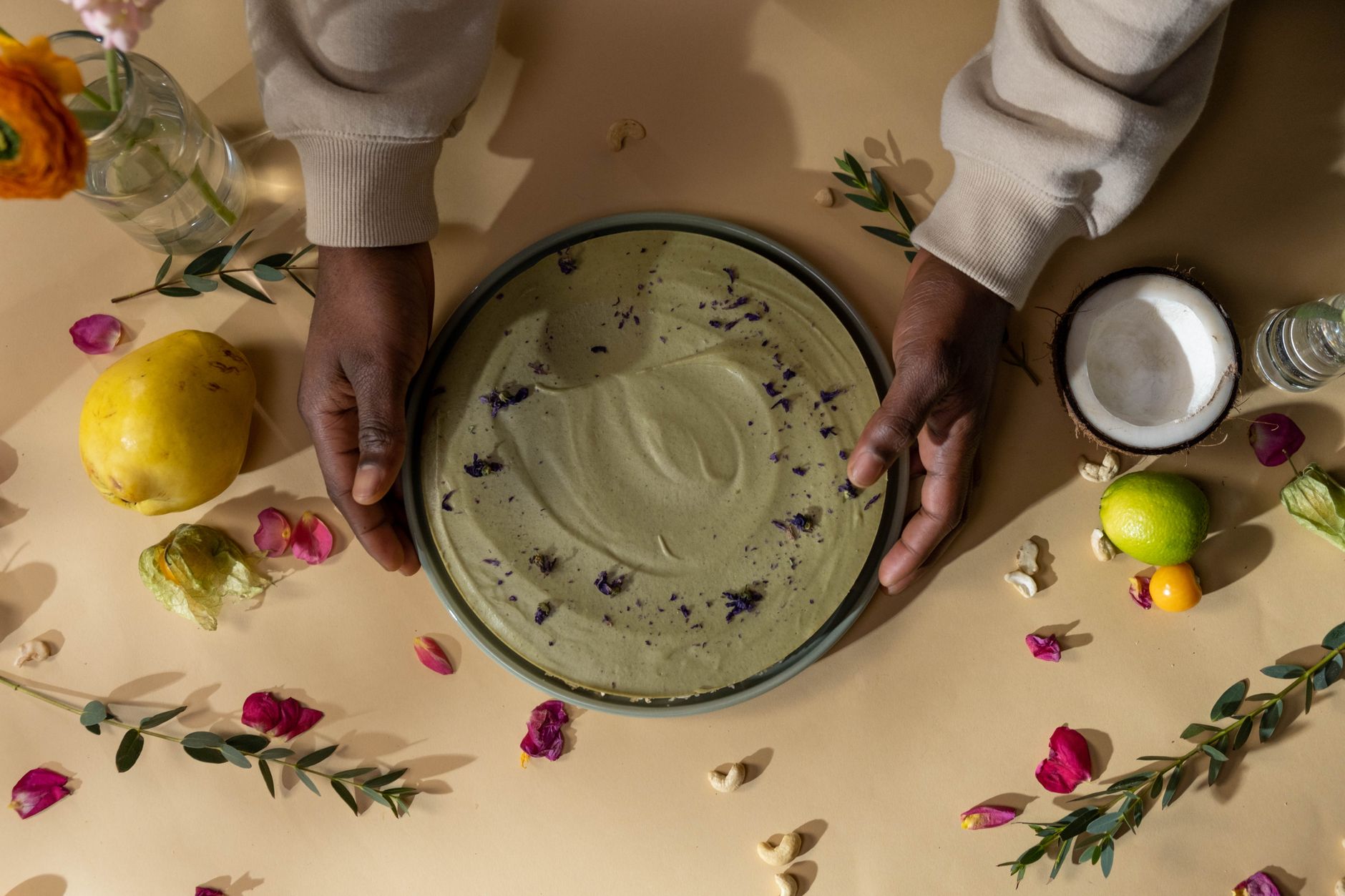
Vegan pastry is no longer a niche. Driven by growing demand for products free from animal-derived ingredients and shorter ingredient lists (the clean-label movement), it represents a rapidly expanding segment that is reshaping the practices of professionals and home bakers alike.
Why Agar-Agar Dominates the Vegan Segment
In an animal-product-free pastry kitchen, gelatin (whether porcine or bovine in origin) is off the table by definition. Agar-agar becomes the default gelling agent, and its technical characteristics take on a new significance:
- 100% plant-based and clean-label: agar-agar is extracted from red algae — a natural, recognizable ingredient. On a label, "agar-agar" resonates far more with today's consumers than "E406."
- Compatible with all dietary requirements: vegan, vegetarian, halal, kosher — agar-agar checks every box.
- Very low in calories: as a plant fiber, it is virtually calorie-free, aligning well with health-conscious trends.
Standout Vegan Recipes Using Agar-Agar
Here are the preparations where agar-agar has become indispensable for pastry chefs offering a vegan menu:
- Vegan panna cotta with coconut milk or oat milk: use 2 g of agar-agar per 500 ml of plant-based milk. The fat content of coconut milk partially compensates for the lack of melt-in-the-mouth quality compared to the gelatin version.
- Vegan chocolate mousse: agar-agar can replace gelatin to stabilize a mousse made with aquafaba (chickpea brine). Dosage: 1 g of agar-agar per 500 ml of preparation, dissolved in a small amount of hot plant-based milk.
- Vegan flans and creams: agar-agar produces a clean, precise texture that cuts beautifully — perfectly suited to flans.
- Low-sugar jams: agar-agar is already the gelling agent of choice for reduced-sugar preserves, regardless of vegan considerations.
Halal Gelatin: A Growing Demand
Alongside the vegan trend, demand for halal gelatin (certified bovine gelatin) is steadily rising in France. The bovine gelatin sheets meet this need for pastry chefs working with a clientele mindful of halal compliance, while retaining the characteristic melt-in-the-mouth texture of gelatin.
For pastry chefs who wish to offer options for every dietary requirement, having both certified bovine gelatin andagar-agar on hand makes it possible to accommodate virtually any request.
Common Mistakes and Professional Tips
Pitfalls with Gelatin
- Boiling gelatin: above 140°F (60°C), gelatin begins to break down. Never add it to a boiling liquid — let the liquid cool slightly first.
- Skipping the blooming step: poorly hydrated sheets will form lumps in your preparation.
- Acidity and enzymes: certain fresh fruits (pineapple, kiwi, papaya, fig) contain proteolytic enzymes (bromelain, actinidin) that break down gelatin. The solution: use cooked or canned fruit, or switch to agar-agar, which is unaffected by these enzymes.
- Freezing: a gelatin-set gel does not freeze and thaw well — the texture becomes grainy upon defrosting.
Pitfalls with Agar-Agar
- Failing to bring to a full boil: this is the most common mistake. Without a rolling boil sustained for 2 minutes, agar-agar will remain in suspension and simply won't gel.
- Overdosing: given its high gelling power, too much agar-agar results in an unpleasant, rubbery texture. Always weigh with a precision scale.
- Adding it directly to a hot liquid without dispersing first: this causes lumps that are impossible to dissolve.
- Highly acidic environments: agar-agar loses some of its effectiveness in very acidic preparations (pure citrus juice, vinegar). You will need to increase the quantity slightly to compensate.
Storage and Quality
Gelatin sheets keep for several years in a dry place away from light. Quality varies by brand: professional sheets, such as those found at G. Detou, are consistent in thickness and bloom strength, which guarantees reliable results.
Powdered agar-agar also keeps for a very long time (2 years and more) in an airtight container. Choose a certified food-grade agar-agar: Louis François agar-agar offers consistent gelling power and reliable dosing, which is essential for reproducible results.
G. Detou's Advice
We regularly see customers come into the shop wanting to swap gelatin for agar-agar on a 1-for-1 basis, only to end up with a bavarois as stiff as an overcooked flan. The real ratio is 1 g of agar-agar for every 4–5 g of gelatin — and a proper rolling boil is absolutely non-negotiable to activate the gelling agent. If you happen to be passing by rue Tiquetonne (Paris 2nd arrondissement), just ask us which gelling agent to use for which dessert. We have the answer for all 30 classic preparations.
FAQ — Gelatin or Agar-Agar
No. The substitution works for jellies and flans, but it is not recommended for mousses, bavarois, or mirror glazes. Agar-agar does not produce the elastic, melt-in-the-mouth texture of gelatin, nor does it stabilize aerated preparations in the same way. For recipes that depend on that yielding, melt-on-the-tongue quality, gelatin remains irreplaceable.
Use approximately 0.5 g of powdered agar-agar to replace one 2 g gelatin sheet. This yields a gel of comparable firmness, though the texture will be more brittle and less melt-in-the-mouth. For 6 gelatin sheets (12 g), use 2 to 3 g of agar-agar.
Technically, yes — but the result will be quite different from a traditional panna cotta. Made with agar-agar, it will be firm and slice cleanly rather than tremble delicately. If you need to avoid gelatin (for a vegan diet, for instance), use 1.5 g of agar-agar per 500 ml of cream-and-milk mixture, and increase the proportion of cream to partially compensate for the loss of that melt-in-the-mouth quality.
Yes — in terms of gelling power and texture, they are perfectly interchangeable. The choice between the two comes down entirely to dietary or religious requirements. Bovine gelatin is suitable for halal diets (when certified), while pork gelatin is the most widely used in French pastry. At G. Detou, you'll find both to cover every need.
G. Detou, at 58 rue Tiquetonne in Paris, has been supplying both professionals and home bakers with pastry ingredients since 1951. Sheet gelatin (bovine and pork) and Louis François powdered agar-agar are available in store and at gdetou.com. To learn more about gelling agents, see our
To go further: browse our full Gelling Agents selection.