


Almond flour is probably the most underrated ingredient in French pastry. Found in macarons, financiers, frangipane, dacquoise, marzipan — it's everywhere, and yet few people truly understand what sets a good almond flour apart from a bad one. White or gray? Fine or coarse? And what exactly is that famous tant-pour-tant the pros keep talking about?
With Easter just around the corner, it's peak season for colombes, golden financiers, and late-season frangipane galettes — the perfect moment to take stock of this foundational ingredient. This guide covers everything a pastry maker — whether a dedicated home baker or a seasoned professional — needs to know to get the most out of almond flour.
Blanched vs. natural almond flour: two products, two purposes
This is the first distinction to understand, and it is not cosmetic. The difference between blanched almond flour and natural almond flour comes down to a single step: blanching.
Blanched almond flour
The almonds are briefly plunged into boiling water, which loosens and removes the brown skin — that's blanching. The result is a smooth, ivory-white almond that, once ground, yields a pale, fine flour with a delicate, mild flavor.
This is the gold standard in French pastry. Its flavor is subtle, almost neutral, which makes it remarkably versatile. Its light color won't interfere with the hue of your preparation — a decisive factor when you're working with pastel macarons or a pale frangipane.
When to use it:
- Macaron shells (essential for color and fineness)
- Classic frangipane
- White marzipan
- Financiers with an even golden color
- Tant-pour-tant
- Any preparation where appearance is a priority
Natural almond flour (unblanched)
Here, the almonds are ground skin and all. The result is a darker flour flecked with brown particles, with a more assertive flavor. The skin lends a touch of bitterness — not unpleasant, but noticeable — along with more rustic, intensely almond-forward notes.
It costs less than blanched flour (blanching requires an extra labor step) and is perfectly suited to recipes where flavor matters more than appearance.
When to use it:
- Cakes and travel cakes (the bolder flavor is an asset)
- Crumbles and pâte sablée (shortcrust pastry)
- Rustic financiers (when you want a more pronounced character)
- "Traditional"-style almond frangipane
- Homemade praliné (a paste of caramelized nuts, used alongside hazelnuts)
The pitfall to avoid
Never substitute natural almond flour in a macaron recipe. The skin particles create visible brown specks on the shell, and the grind is rarely fine enough. The result will be visually flawed and texturally gritty. For macarons, it's extra-fine blanched almond flour — no debate.
Grind size: why the fineness of the milling changes everything
Particle size — the fineness of the grind — is the most technically overlooked criterion among home bakers. Yet it's what determines the final texture of your preparation.
Extra-fine flour (under 0.5 mm)
This is the flour used for macarons. The particles are so fine they melt seamlessly into the tant-pour-tant, yielding a smooth shell with no visible grain. To achieve this fineness, manufacturers use roller or ball mills with strict sieving controls.
In professional pastry kitchens, many pastry chefs still sift their almond flour before use — even when it's already labeled "extra-fine." This simple step eliminates any clumps and stray coarser particles that may have slipped through.
Standard flour (0.5 to 1.5 mm)
This is the most common grind. It suits the vast majority of recipes: financiers, frangipane, dacquoise, marzipan, almond cakes. The particles are perceptible in the mouth, lending that slightly grainy texture that's characteristic of a classic financier.
Coarsely ground flour (over 1.5 mm)
At this point, we're moving beyond "flour" in the strict sense. These are more like finely broken almond pieces, used for texture and crunch: crumbles, streusel, tart decorations, coatings.
Why this changes everything in a recipe
Take the financier as a concrete example. With extra-fine flour, the interior will be moist, tender, almost creamy — the style of the great Parisian pastry houses. With standard flour, you get a more rustic financier with noticeable grain and chew. Both are delicious — but they're not the same cake.
For frangipane, particle size affects how the butter and eggs are absorbed. A fine flour produces a smoother, more homogeneous cream. A coarser flour lets the almond texture come through, which some pastry chefs actively seek for a more artisanal result.
Tant-pour-tant: the secret weapon of professional pastry chefs
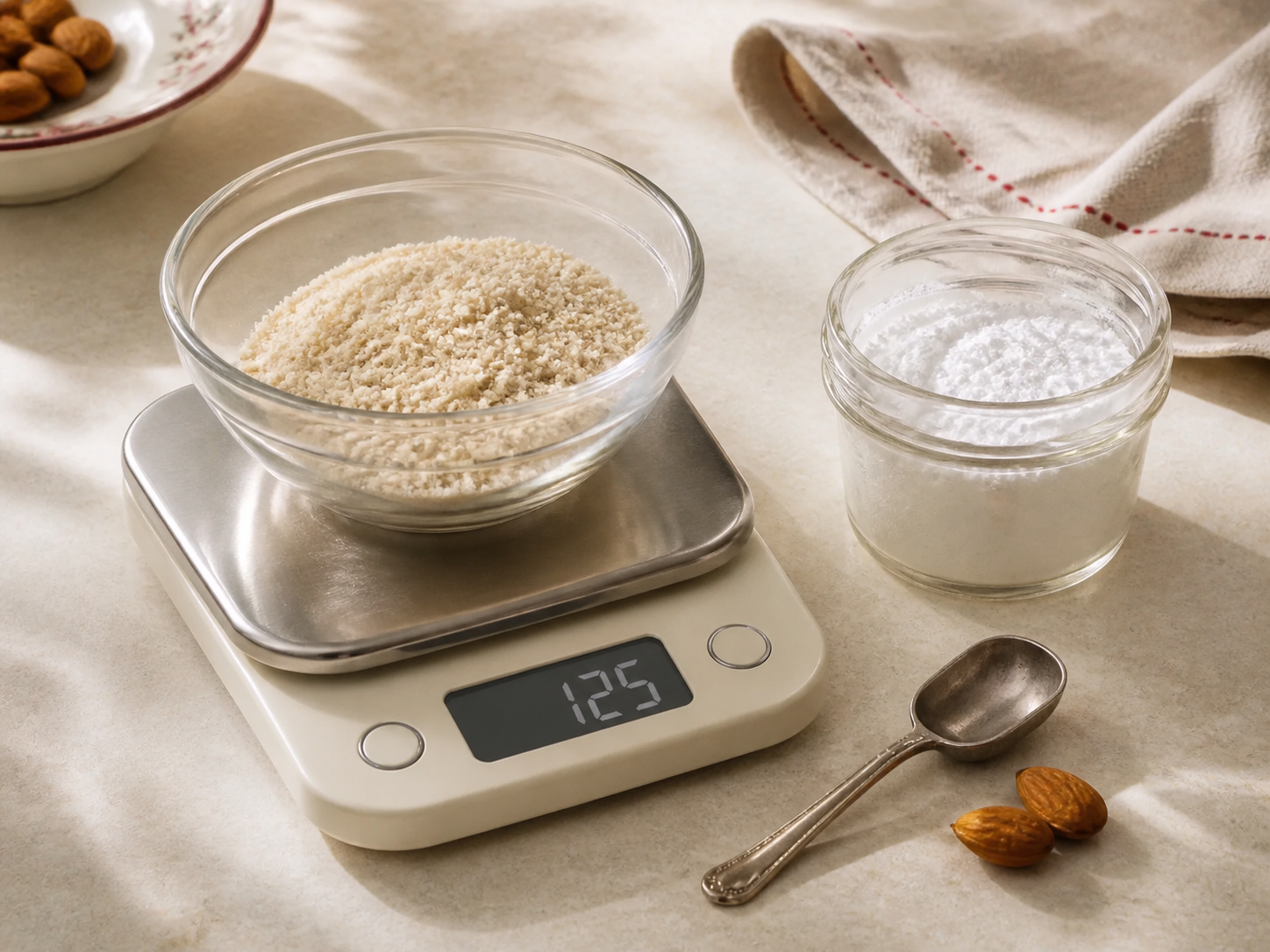
If you spend time around pastry chefs, you've heard them talk about "TPT." fifty-fifty (equal parts) is an equal-parts blend of almond flour and powdered sugar. 50/50 — hence the name.
Why the pros use it systematically
Tant-pour-tant isn't just a shortcut for weighing. Co-grinding the two powders together offers a genuine technical advantage: the powdered sugar absorbs the fat released by the almonds during milling, preventing the flour from clumping and turning greasy. The result is a drier, more fluid, more consistent blend than anything you'd achieve by simply combining almond flour and powdered sugar in a bowl.
It forms the base of:
- Macaron shells (tant-pour-tant is literally the primary ingredient)
- Raw marzipan
- Certain dacquoise recipes
- Joconde sponge
Making tant-pour-tant at home
It's possible, but with some precautions. Weigh out equal parts extra-fine blanched almond flour and powdered sugar (not blended granulated sugar — powdered sugar contains anti-caking starch that plays a role in texture). Pulse briefly in a food processor — 3 to 5 seconds per burst — then sift. Caution: if you over-process, the heat from the blade releases the oil from the almonds and you end up with a paste instead of a powder.
Commercially produced tant-pour-tant, ground cold in industrial equipment, is more consistent. For macarons, where even the slightest variation in particle size shows on the shell, ready-made tant-pour-tant is an investment that pays off.
Tant-pour-tant and macarons: the key ratio
For classic macaron shells (approximately 60 pieces), the standard ratio is:
- 300 g tant-pour-tant (i.e., 150 g almond flour + 150 g powdered sugar)
- 110 g egg whites for the batter
- 110 g egg whites + 300 g sugar for the Italian meringue
This 300/110/110/300 ratio is the baseline that professionals adjust according to their oven and environment. If you add a powder food coloring For colored macarons, incorporate it into the dry mixture (the TPT) before combining — never into the meringue.
Almond, hazelnut, or pistachio flour: a comparison and substitution guide
Nut flours are often interchangeable — but not always, and not in the same proportions. Here's a technical breakdown to clear things up.
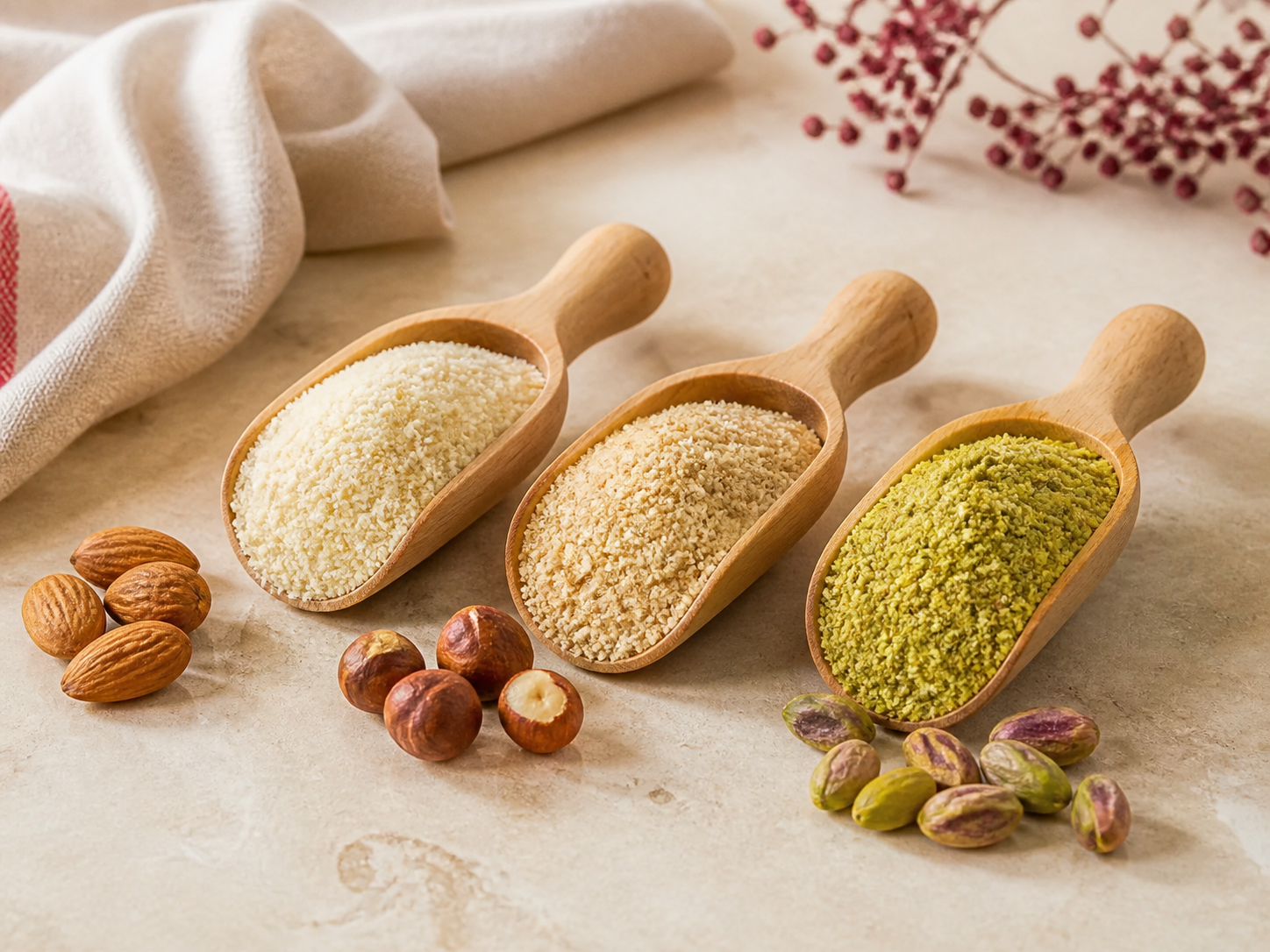
Almond flour
- Fat content: approximately 54%
- Flavor: mild, delicate, subtle (blanched) to more pronounced (natural)
- Color: off-white to light beige
- Price: the baseline reference
- Key uses: macarons, financiers, frangipane, marzipan, dacquoise
Hazelnut flour
- Fat content: approximately 61%
- Flavor: toasty, warm, with notes of brown butter and caramel
- Color: light to medium brown
- Price: 10 to 30% more expensive than almond flour, depending on origin
- Key uses: hazelnut financiers, hazelnut dacquoise, homemade praliné, pâte sablée, crumbles
La hazelnut flour contains more fat than almond flour. If you fully substitute almond with hazelnut in a recipe, the preparation will be richer and denser. For a successful substitution, slightly reduce the butter (by about 10%) or use a 50% almond / 50% hazelnut blend.
Hazelnut pairs particularly well with chocolate. For chocolate-hazelnut macarons, replace 30% of the almond flour in the TPT with hazelnut flour — the result is remarkable, especially with a dark couverture chocolate ganache.
Pistachio flour
- Fat content: approximately 45%
- Flavor: herbaceous, vegetal, slightly sweet
- Color: olive green (natural) — beware of fluorescent green, which indicates added coloring
- Price: 3 to 5 times the price of almond flour
- Key uses: pistachio financiers, creams, decorations
La pistachio flour is drier than almond flour (lower fat content). In a direct substitution, add a little fat to compensate — 5 to 10 g of butter per 100 g of substituted flour.
The high cost of pistachio explains why professionals rarely use it as a full substitution. Common practice is to replace 20 to 30% of the almond flour with pistachio, optionally supplementing with pistachio paste to intensify the flavor and color.
Substitution summary table
| Substitution | Ratio | Adjustment |
|---|---|---|
| Hazelnut | 1:1 by weight | Reduce the butter by 10 % |
| Almond → Pistachio (partial) | 50/50 | None |
| Almond → Pistachio (partial) | 70 almond / 30 pistachio | Add 5 g butter per 100 g |
| Pistachio | 1:1 by weight | Add 10 g butter per 100 g |
| Hazelnut → Almond | 1:1 by weight | Add 5 g butter per 100 g |
Storing almond flour: the pitfalls of rancidity
Almond flour is a fat-rich product. And fat goes rancid. This is the number one problem, and it's consistently underestimated.
# Why Almond Flour Goes Rancid Almond flour is prized in baking for its rich, nutty flavor and moist texture — but it has a well-known Achilles' heel: it goes rancid relatively quickly compared to wheat flour. Understanding why this happens can help you store it properly and get the most out of this premium ingredient. ## The Role of Fat The primary reason almond flour goes rancid comes down to its **high fat content**. Almonds are composed of roughly 50–55% fat, most of which are unsaturated fatty acids — predominantly oleic acid (monounsaturated) and linoleic acid (polyunsaturated). When almonds are ground into flour, the cell walls are broken down, exposing these fats to the environment. ## Oxidation: The Main Culprit Once exposed, the unsaturated fats in almond flour undergo a chemical process called **lipid oxidation**. Oxygen molecules react with the fatty acid chains, breaking them down into smaller compounds — including aldehydes, ketones, and carboxylic acids — that produce the characteristic **stale, bitter, or paint-like smell** associated with rancidity. Several factors accelerate this process: - **Heat** speeds up oxidative reactions - **Light** (especially UV) catalyzes oxidation - **Moisture** promotes both oxidation and microbial activity - **Air exposure** provides the oxygen needed for the reaction ## How to Slow It Down - Store in an **airtight container** - Keep in the **refrigerator or freezer** - Avoid **temperature fluctuations** - Buy in **smaller quantities** if you don't bake frequently Properly stored in the freezer, almond flour can last up to **12 months**. At room temperature, expect only **1–3 months** before quality degrades noticeably.
Oleic acid and linoleic acid — the two primary fatty acids in almonds — oxidize when exposed to air, light, and heat. Oxidation produces aldehydes and ketones, the compounds responsible for that characteristic rancid smell and flavor: sharp, slightly acrid, and penetrating enough to taint an entire preparation.
Storage guidelines
Once opened:
- Transfer to an airtight container (a glass jar or food-safe plastic box with a tight seal)
- Press out as much air as possible before sealing
- Store in the refrigerator (39°F / 4°C) for up to 3 to 4 months
- For longer storage (6 months or more): the freezer works perfectly well
What to avoid at all costs:
- The cabinet above the stove (too much heat)
- Loosely folded bags clipped shut (not airtight enough)
- Exposure to direct light
- Stockage à proximité d'aliments à forte odeur (la farine d'amande absorbe facilement les odeurs)
How to tell if your almond flour has gone rancid
Before using it, smell it. Fresh almond flour has a gentle, faintly milky aroma. If you detect a sour note, something reminiscent of paint, or stale cardboard, it's rancid. When in doubt, taste a small pinch: a harsh, acidic bitterness is the unmistakable sign.
Never use rancid almond flour in a recipe. Rancidity doesn't cook out — if anything, it intensifies with heat. A frangipane or financier made with rancid flour will be inedible.
The best-before date: an indicator, not an absolute truth
An unopened bag stored in a cool place will keep well beyond its best-by date. But a bag that has been open for two months in a pantry at 77°F can go rancid well before that date. Trust your nose, not the label.
5 classic preparations decoded: the precise role of almond flour
Rather than providing complete recipes, let's break down the technical role of almond flour in five foundational preparations. Understanding why it's there allows you to adapt recipes intelligently and troubleshoot when things go wrong.
1. Macarons
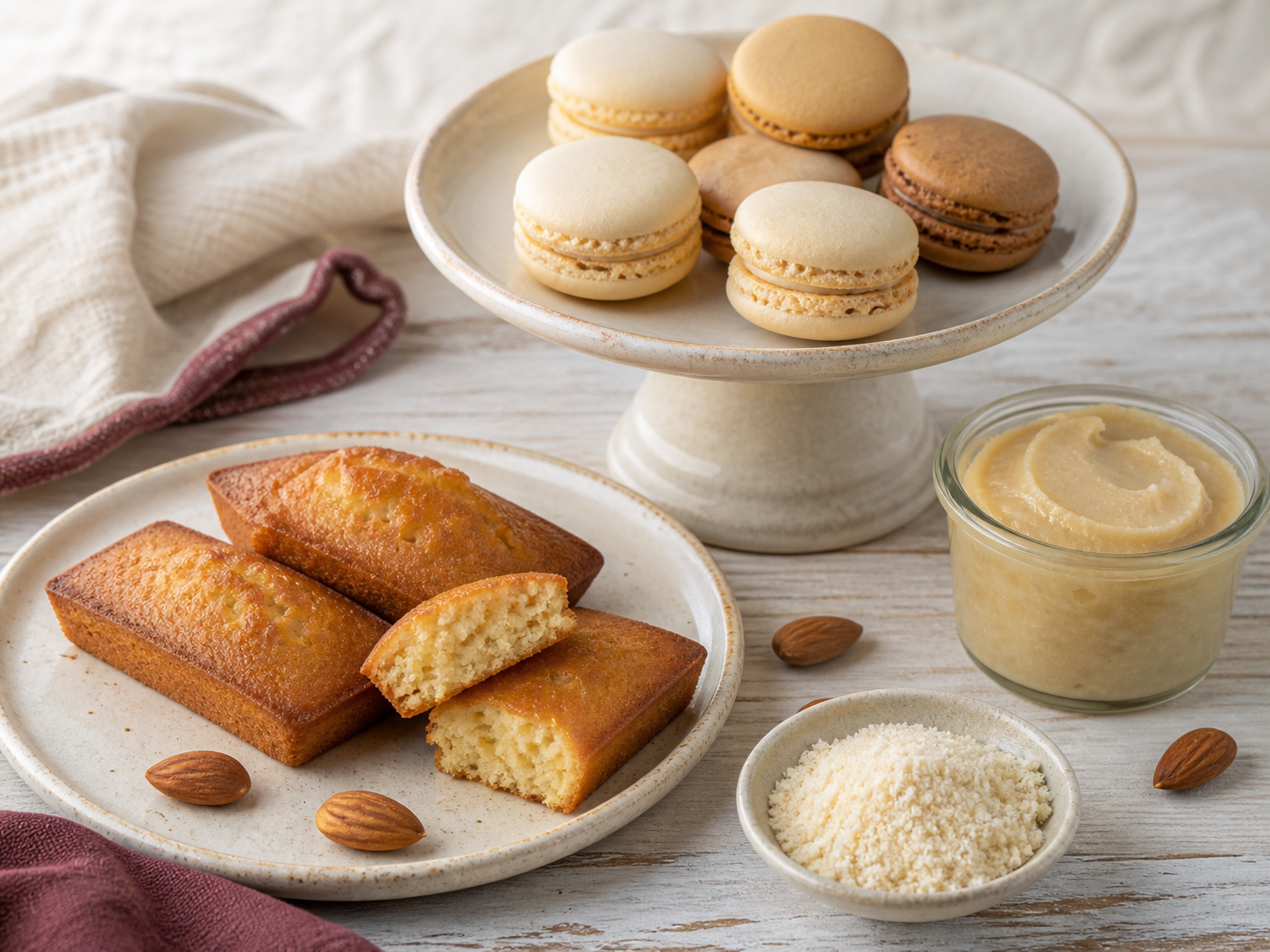
Role of almond flour: structure, texture, and flavor. Almond flour forms the dry backbone of the macaron shell alongside the powdered sugar (the tant-pour-tant). Without it, there is no shell — it's that simple. The fat in the almond flour contributes to the characteristic moist, tender interior, while the proteins help the structure hold together after baking.
Critical requirement: extra-fine blanched almond flour, sifted. Any coarser particle creates a visible defect on the surface of the shell. The macaronnage — the folding technique that incorporates the dry mixture into the meringue — should produce a batter that flows in a wide, continuous ribbon. If the flour is too coarse, the ribbon will be uneven.
For chocolate macarons, a ganache made with Valrhona couverture chocolate (Guanaja 70% or Manjari 64%) makes all the difference compared to ordinary chocolate. 2. Financiers
Role of almond flour: tenderness, moisture, and flavor. The financier is essentially a cake built around almond flour, brown butter, egg whites, and sugar. Almond flour accounts for 25 to 35% of the batter by weight — it's the dominant ingredient. Its fat content, combined with the brown butter, produces that moist, tender crumb that defines a great financier.
The detail that matters: brown butter (beurre noisette). Heat the butter until it turns a deep amber — the milk solids caramelize, developing nutty, toasted aromas that pair beautifully with the almond. It's the interplay between brown butter and almond flour that makes a financier what it is, not either element alone.
The detail that matters: brown butter. Heat the butter until it turns amber: the milk solids caramelize and develop hazelnut aromas that pair perfectly with almond. It is the synergy of brown butter and almond flour that makes the financier, not one or the other on its own.
hazelnut flour yields a remarkable hazelnut financier. Replace 20% with pistachio flour for a springtime version. hazelnut flour 3. Frangipane
Role of almond flour: body, texture, and aromatic identity. Crème d'amande — the base of frangipane — is a blend of almond flour, butter, sugar, eggs, and sometimes a splash of
bourbon vanilla or rum. The almond flour absorbs the liquids and puffs slightly during baking, creating that dense yet meltingly tender texture. Full frangipane is a blend of crème d'amande (two-thirds) and pastry cream (one-third). The pastry cream brings silkiness and lightness; the almond flour provides structure and flavor.
Pro tip: for a more aromatic frangipane without changing the recipe, lightly toast the almond flour in the oven (300°F / 150°C, 8–10 minutes, stirring halfway through) before incorporating it. The Maillard reaction develops toasted, nutty aromas that add an extra layer of depth. Watch it closely — almond flour goes from toasted to burned in a matter of seconds.
4. Dacquoise
Role of almond flour: airy structure and pleasant chew. Dacquoise is a meringue enriched with almond (or hazelnut) flour. It serves as the foundational layer in many contemporary French pastries — Paris-Brest, chocolate entremets, tropical layered cakes. Almond flour plays a structural role here: it stabilizes the meringue, absorbs some of the moisture, and creates that signature crisp outer shell with a slightly chewy interior.
Classic ratio: 125 g almond flour + 125 g powdered sugar folded into 4 egg whites (120 g) with 30 g granulated sugar. The flour and powdered sugar are gently folded into the meringue — much like a macaron, but with a lighter, more aerated batter.
5. Marzipan
Role of almond flour: it is the ingredient. Marzipan is nothing more than almond flour bound with sugar (powdered or syrup) and occasionally a little egg white or glucose. There's nowhere to hide: the quality of the almond flour entirely determines the flavor of the marzipan.
Basic recipe: 250 g fine blanched almond flour + 250 g powdered sugar + 1 egg white (or 30 g glucose syrup). Knead until you have a smooth, pliable dough. For colored marzipan fruits — an Easter classic — use
powdered food coloring to tint without adding any liquid. How to choose your almond flour: quality criteria
Not all bags of almond flour are created equal. Here are the criteria to consider before buying.
The origin of the almonds
Spanish almonds (Marcona, Largueta) and Californian almonds dominate the market. Marcona almonds, rounder and higher in fat, yield a flour with a richer, fuller flavor. Californian almonds (primarily the Nonpareil variety) are less expensive and more neutral in taste — not a flaw when making macarons, where you want a neutral canvas for other flavors.
Sicilian almonds (from Avola, in particular) are rarer and more expensive, but offer a distinct aromatic profile — more floral, almost honeyed.
Freshness
This is the most important criterion and the hardest to evaluate online. A serious supplier maintains fast stock rotation and recent production dates. Specialty food stores like G. Detou, which supply professional chefs on a daily basis, have a natural advantage here: turnover is high, and products don't sit on the shelf for months.
Price per kilogram: a quality indicator
Professional-grade extra-fine blanched almond flour typically falls between $7 and $12 per pound ($15–25/kg), depending on origin and purchase volume. Below $5.50/lb ($12/kg), proceed with caution — you may be looking at older almonds, blends with other nuts, or inconsistent grind size.
Natural (unblanched) flour, being less processed, is naturally less expensive: $4.50–8/lb ($10–18/kg) is a reasonable range.
The grey (unblanched) flour, less processed, is naturally cheaper: 10 to 18 €/kg is a reasonable range.
Read the label. A quality almond flour contains exactly one ingredient: almonds. Some cheaper products add starch or sugar to reduce the cost per kilo. Avoid them — they will throw off your recipes.
To build your essential pantry of baking staples, blanched almond flour is one of the must-have ingredients in your
To build your basic pastry pantry, white almond flour is one of the essential ingredients of the beginner pastry kit, alongside couverture chocolate, vanilla, and gelatin.
G. Detou's advice
Macarons often fail because of the almond flour: too fatty, too coarse, or worse — gone slightly stale after a few weeks in the pantry. At G. Detou, we carry blanched Valencia almond flour sifted to 0.5 mm, packaged in 250 g vacuum-sealed pouches with a 6-month shelf life when unopened. Home bakers who have been struggling with their macarons for years frequently succeed on the first try once they switch to this quality level. For financiers, we also stock a rarer extra-fine flour that's worth seeking out.
FAQ — Almond flour
Technically yes, but the result will be quite different. Hazelnut flour has a higher fat content (61% vs. 54% for almond), which makes the shell more fragile and the macaronnage more difficult to control. The color will be darker and the flavor considerably more pronounced. If you want to try the substitution, replace no more than 30% of the almond flour with hazelnut for a manageable result. A full substitution is best left to experienced pastry chefs who have already mastered the macaronnage technique.
The test is simple: open the bag and smell it. Fresh almond flour has a gentle, faintly milky, pleasant aroma. Rancid flour smells sour, like stale cardboard, or faintly of paint. When in doubt, taste a small pinch: a harsh, acidic bitterness is the unmistakable sign. Stored in an airtight container in the refrigerator, opened almond flour keeps for 3 to 4 months. In the freezer, it holds for 6 months or more without any issue.
Commercial tant-pour-tant is co-ground: the almond flour and powdered sugar are milled together in the same industrial process. The sugar absorbs the fat released by the almonds during grinding, producing a drier, more homogeneous, and finer blend than anything achieved by mixing the two powders together by hand. For macarons, this difference translates to smoother, more consistent shells. For financiers or frangipane, a homemade mixture works perfectly well.
No. Blitzing whole almonds in a home food processor produces an uneven result, with particles of wildly varying sizes and a high risk of ending up with a greasy paste (the blade's heat releases the almond oil). Commercial almond flour is cold-milled using industrial equipment that guarantees a consistent particle size without overheating. For precision pastry work — macarons, dacquoise — store-bought almond flour is essential. For a cake or crumble where exact texture matters less, quickly pulsed almonds can do the job in a pinch.
Almond flour may seem like a straightforward ingredient, but mastering it is what separates a decent bake from an excellent one. White or gray, fine or standard, tant-pour-tant or pure — every technical choice has a direct impact on the result. Take the time to choose the right flour for the right recipe, store it properly, and you will notice the difference from the very first batch. Browse our full selection of nut flours at G. Detou, the fine grocery store for pastry chefs since 1951.
To go further: browse our full Nuts selection.