


Chocolate chips are an absolute staple of home baking. American cookies, muffins, brioche, homemade pains au chocolat — they deliver those irresistible pockets of melted chocolate that make all the difference. Yet not all chips are created equal, and choosing the right product can turn an ordinary recipe into something truly memorable.
This guide covers everything you need to know: the difference between chips and pistoles, how to select the right product, the varieties available, and the techniques to use them well.
Chocolate chips or pistoles: what's the difference?
This is the first confusion worth clearing up. Chips and pistoles look similar — both are small, ready-to-use pieces of chocolate — but they're formulated and used quite differently.
Pistoles (or wafers)
Pistoles are couverture chocolate discs. They are designed to be melted: their uniform shape ensures even melting, and their composition (rich in cocoa butter) makes them very fluid once heated.
Characteristics of pistoles:
- High cocoa butter content (minimum 31%)
- Melt completely and quickly
- Designed for tempering, ganaches, and mousses
- Will spread and lose their shape when used as inclusions in baked goods
Chocolate chips
Chocolate chips are specifically formulated to hold their shape during baking. Their composition is adjusted to withstand oven temperatures without melting completely or spreading through the batter.
Characteristics of chocolate chips:
- Generally lower cocoa butter content than pistoles
- Sometimes contain a stabilizer to maintain their shape
- Keep their structure during baking while remaining soft and melty inside
- Available in a drop or small cylinder shape, depending on the brand
Can you substitute chips for pistoles (and vice versa)?
A common question. In practice:
- Pistoles in a cookie: they will melt more aggressively, creating "puddles" of chocolate rather than defined pockets. The result is different but not bad — some pastry chefs actually prefer this effect.
- Chips in a ganache: they will melt, but less readily and with a potentially grainy result due to their formulation. Not recommended.
For baked inclusions (cookies, muffins, cakes, breads), chips are the best choice. For chocolate work (tempering, ganache, coating), pistoles of couverture chocolate are essential.
How to choose your chocolate chips
Three criteria determine quality and the final result: the type of chocolate, the chip size, and the composition.
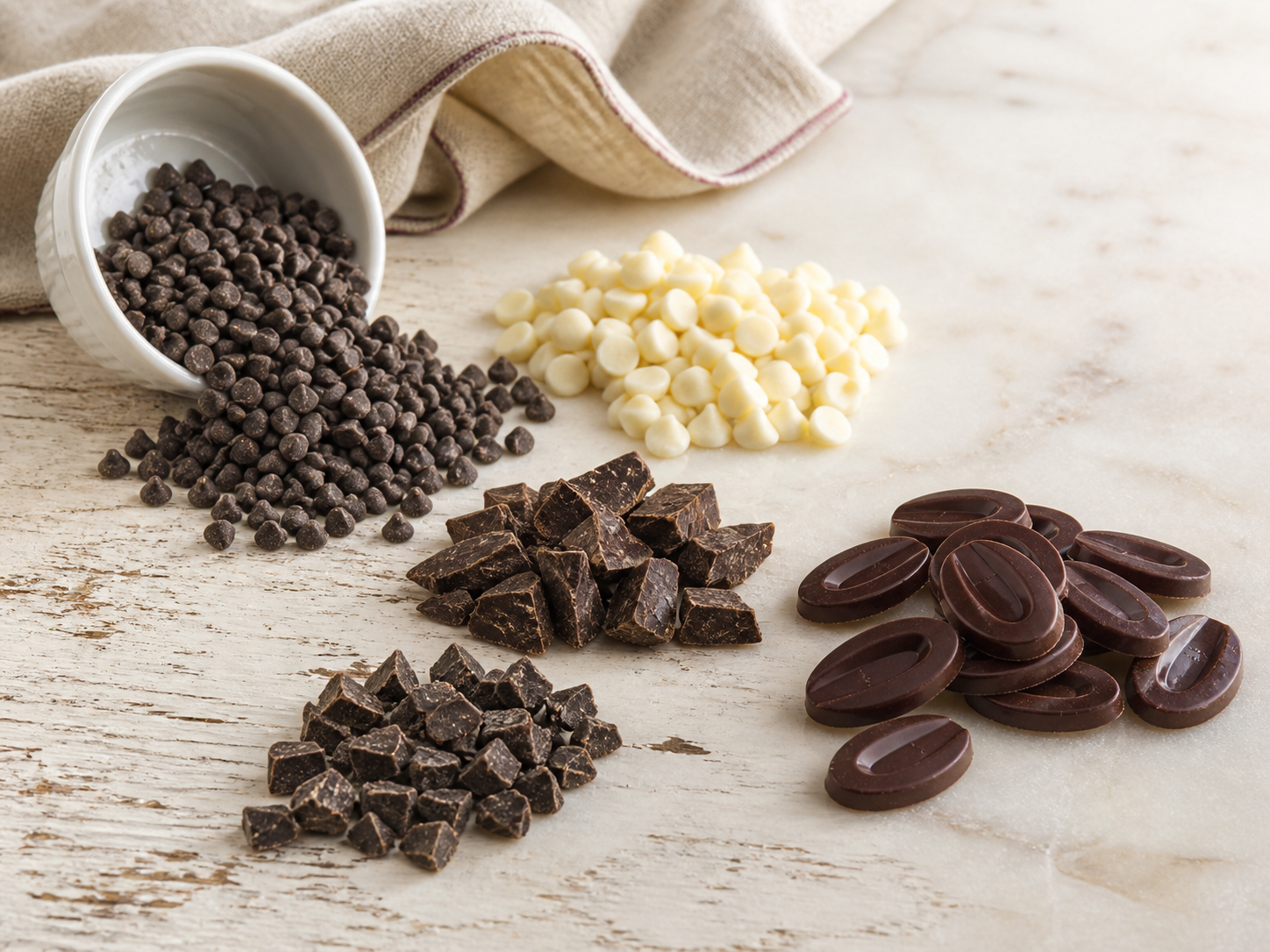
The type of chocolate: dark, milk, or white
Dark chocolate chips
This is the absolute classic. Dark chocolate chips offer an intense flavor that contrasts beautifully with the sweetness of cookie doughs and cake batters.
- Ideal percentage: between 50% and 60% cacao for the right balance of flavor and sweetness during baking
- Flavor profile: pronounced cocoa notes, a slight bitterness that balances the sugar in the batter
- Best uses: chocolate chip cookies, brownies, double chocolate muffins
A dark chocolate with a very high cacao content (70% and above) can turn bitter when baked into an already lightly sweetened batter. Save the high-percentage bars for recipes that balance them with sugar, caramel, or butter.
Milk chocolate chips
Les Milk chocolate chips bring a caramelized sweetness that is especially appealing to children and lovers of rounded, mellow flavors.
- Percentage: typically 30–40% cacao
- Flavor profile: milky, caramel, gentle sweetness
- Best uses: soft cookies, brioche, milk bread, pancakes
Milk chocolate melts a little more readily than dark chocolate in the oven. For chips that hold their shape well, opt for products specifically formulated as chips rather than crushed milk chocolate pistoles.
White chocolate chips
Les White chocolate chips are often underestimated. They bring a vanilla sweetness and a uniquely creamy texture.
- Composition: cocoa butter, sugar, milk — no cocoa mass
- Flavor profile: vanilla, fresh milk, gentle sweetness
- Best uses: white chocolate and cranberry cookies, blondies, red berry muffins, scones
A word of caution: white chocolate is more sensitive to heat. It can brown and caramelize in the oven, producing interesting biscuit-like notes but a less pristine appearance. Lower your baking temperature by 5°C (about 10°F) if needed.
Chip size: a choice that matters
The size of your chips directly influences the texture and visual appeal of the finished product.
- Small chips (4–6 mm): distribute evenly throughout the batter and melt almost completely. Ideal for muffins, cakes, crêpes, and homemade spreads
- Standard chips (8–10 mm): the classic American cookie format. A good balance between visual impact and even distribution
- Chunks / large pieces (15–20 mm): irregular pieces that create wonderfully gooey pockets of chocolate. The "wow" effect in a cookie or brownie. The chocolate chunks give a highly sought-after artisanal finish
For cookies, the current professional trend is to combine two sizes: standard chips folded into the dough, and chunks pressed on top just before baking. The visual result is spectacular.
Composition: reading the label
A quality chip reveals itself in its ingredient list.
Look for:
- Cocoa mass (or cocoa paste) as the first ingredient for dark chocolate
- Cocoa butter (not palm oil or other vegetable fats used as substitutes)
- Sugar in reasonable quantities
- Soy or sunflower lecithin as an emulsifier (standard and harmless)
- Natural vanilla (extract or bean)
Avoid:
- "Vegetable fats" or "vegetable oils" used in place of cocoa butter
- Artificial flavorings
- A lengthy ingredient list filled with unpronounceable additives
Chips containing vegetable fats other than cocoa butter cannot legally be called "chocolate" — they are labeled "chocolate-flavored chips" or "cocoa-based chips." The difference in taste is significant.
The best uses for chocolate chips
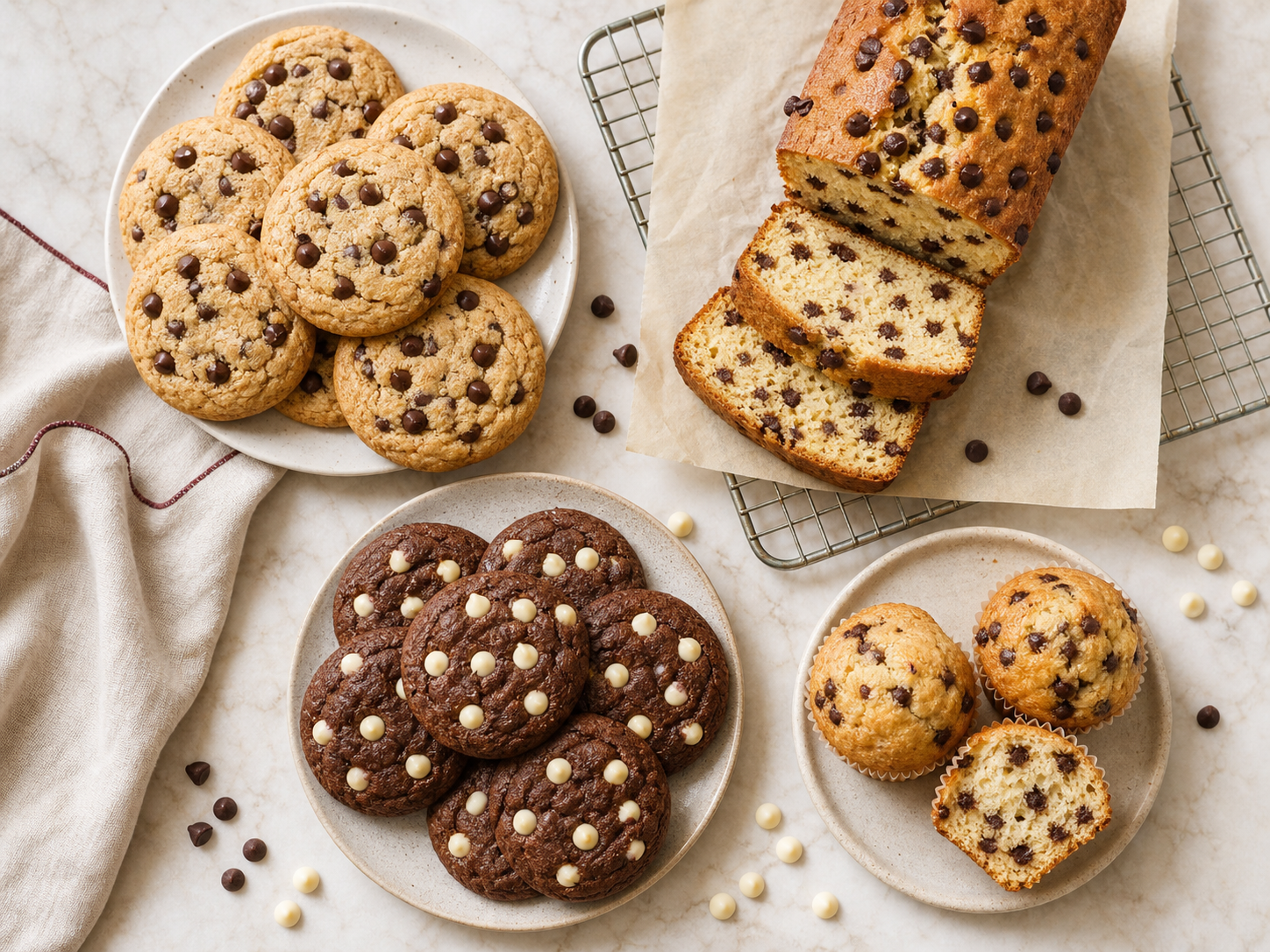
Chocolate chip cookies: the perfect base recipe
The cookie is the number one use for chocolate chips. Here are the key principles for a professional result:
- Ratio: 200 g of chips per 300 g of dough (roughly 40% of the total weight). This is the ratio that gives a generously loaded cookie without the dough falling apart
- Incorporating: add the chips last, folding them in with a spatula and mixing just enough to distribute them evenly. Over-mixing warms the dough and produces a flatter cookie
- Resting the dough: 24 to 72 hours in the refrigerator. This rest allows the flour to absorb the liquids and develops caramel-like flavors — the secret behind the best cookies
- Baking: 170–180°C (340–355°F) for 10–12 minutes. The cookie should look underdone when it comes out of the oven — it continues to cook as it cools
Muffins and cakes: achieving even distribution
The challenge with muffins and cakes is that chips tend to sink to the bottom during baking. Three techniques to prevent this:
- Coat the chips in flour: toss them in a tablespoon of flour before adding them to the batter. The flour creates traction that keeps them suspended.
- Use a thick batter: a denser batter holds chips in place more effectively. Avoid making your batter too runny.
- Add in two stages: fold half the chips into the batter, pour into the molds, then scatter the remainder on top.
Breads and viennoiseries: a baker's trick
Chocolate chips work beautifully in homemade pains au chocolat, brioche, and enriched breads:
- Pain au chocolat: arrange 2 rows of chips (or better yet, chocolate batons) on the laminated dough before rolling
- Brioche: incorporate 150 g of chips per kg of dough during the final kneading stage
- Enriched sandwich bread: add chips after the first rise, roll out the dough, scatter the chips, then roll up
Chocolate stands up well to the long fermentations of bread baking. Quality chips hold their shape even after a several-hour proof followed by a bake.
Other creative uses
Chips go well beyond the classics:
- Homemade granola: stir in the chips after the granola has baked and cooled, so they don't melt
- Crêpes and pancakes: scatter chips over the batter as soon as it hits the pan — they'll melt just enough
- Ice cream and yogurt: small chips make a perfect topping, with a satisfying crunch straight from the cold
- Trail mix: mixed with dried fruits and nuts for an energizing snack
Storing chocolate chips
Chocolate chips keep well, but a few precautions will preserve their quality.
Storage conditions
- Temperature: between 15 and 20°C (59–68°F). Avoid cabinets above the stove or near any heat source
- Humidity: normal ambient levels. Chocolate absorbs moisture, so don't store it in a damp room
- Light: keep it out of direct light, in a closed cupboard
- Odors: cocoa butter absorbs surrounding aromas. Keep your chips well away from strong spices, household products, and onions
Shelf life
- Dark chocolate: 12 to 18 months under good conditions
- Milk chocolate: 10 to 14 months (the milk solids oxidize more quickly)
- White chocolate: 8 to 12 months (the most sensitive to oxidation)
Can you freeze chocolate chips?
Yes, freezing is perfectly viable and extends shelf life by several months. A few guidelines:
- Place the chips in a well-sealed freezer bag, pressing out as much air as possible
- Thaw in the refrigerator for 24 hours, then allow to come to room temperature before opening the bag (to prevent condensation)
- Do not refreeze
Bloom: should you be concerned?
A white haze can sometimes appear on chocolate chips. This is known as "bloom," a common phenomenon:
- Fat bloom: cocoa butter migrates to the surface following a temperature change. Appears as a dull white coating
- Sugar bloom: sugar dissolves and recrystallizes on the surface after exposure to humidity. Appears grainy
In both cases, the chocolate is perfectly safe to eat and use in baking. The flavor is unaffected — only the appearance changes, and in a cookie or muffin, no one will ever notice.
Homemade chocolate chips: an alternative
If you can't find the size or type of chip you're looking for, you can make them yourself from bars or pistoles of couverture chocolate.
The chopping method
- Choose a quality couverture chocolate
- Place the bar or a block on a cutting board
- Using a large chef's knife, chop roughly into irregular pieces
- Sort by size if needed
Homemade chips have the advantage of being made from true couverture chocolate, with superior flavor. The trade-off: they will melt more than stabilized commercial chips during baking. For cookies, this is often a plus — pools of melted chocolate are absolutely delicious.
Freeze before incorporating
A useful trick to help homemade chocolate pieces hold their shape better: freeze them for 30 minutes before folding into cookie dough. Cold chocolate takes longer to melt in the oven and retains more of its structure.
G. Detou's advice
Supermarket chips clock in at 35% cacao, contain palm oil, and melt into a muddy brown puddle in the oven. A proper pastry chip starts at 50–55% minimum, uses pure cocoa butter, and holds its shape while releasing its full aroma. At G. Detou, we carry Valrhona and Barry chips in 1 kg buckets or by weight — the same products the bakeries in the 2nd arrondissement rely on for their weekend cookies.
FAQ — Chocolate chips
Chips are formulated to withstand baking and hold their shape in cookies, muffins, and cakes. Pistoles are couverture chocolate wafers designed to be melted (for ganaches, tempering, and coating). Pistoles have a higher cocoa butter content and melt more readily, which makes them less suitable as inclusions in baked goods.
The professional ratio is approximately 200 g of chips per 300 g of dough, or roughly 40% of the total weight. This yields a generously loaded cookie with a melty pocket of chocolate in every bite. Below 30%, the cookie feels light on chocolate. Above 50%, the dough struggles to hold together.
Three main culprits: the batter is too runny, the chips are too heavy, or the oven temperature is too low. The most effective fix is to toss the chips in a tablespoon of flour before adding them to the batter — this creates friction that keeps them suspended. Also avoid over-mixing the batter and get it into the oven promptly.
Chocolate chips have a long shelf life: 12 to 18 months for dark, 10 to 14 months for milk, and 8 to 12 months for white. Beyond that, the chocolate doesn't become unsafe but gradually loses its aromatic depth. A white haze on the surface (bloom) is normal and does not mean the product has gone bad — it remains perfectly usable for baking.
G. Detou, a Parisian fine food grocer since 1951, offers a selection of Dark chocolate chips, milk and white, as well as chunks for cookies worthy of the finest pastry shops. To put them to use, see our recipes for soft cookies et de cookies New York.
To go further: browse our full Chocolate & Confectionery selection.