


Glucose syrup is one of those ingredients that home bakers encounter in professional recipes without always fully understanding its role. Yet it appears in nearly every pastry chef's preparation: caramels, ice creams, ganaches, confections, mirror glazes. Its role is technical before it is gustatory — it modifies sugar crystallization, texture, and the shelf life of preparations.
This guide explains in practical terms what glucose syrup is for, how to measure it correctly, and what sets it apart from trimoline and invert sugar. Essential knowledge for anyone looking to take their pastry work to the next level.
What exactly is glucose syrup?
Glucose syrup is produced by hydrolyzing starch — most commonly corn or wheat starch. This process breaks the starch's long molecular chains down into shorter sugar molecules: glucose, maltose, and dextrins, in proportions that vary depending on the degree of hydrolysis.
DE: the key indicator
The DE (Dextrose Equivalent) measures the degree to which the starch has been hydrolyzed. The higher the DE, the more simple sugars (glucose) the syrup contains, which means:
- A sweeter taste
- A thinner, more fluid consistency
- A greater depression of the freezing point (highly useful in ice cream making)
Glucose syrup comes in several grades. The two most common in pastry are DE 38, thicker, preferred for caramels and soft confectionery, and DE 60, more fluid and sweeter, ideal for high-gloss glazes and frozen desserts. When a recipe simply calls for "glucose syrup" without specifying, it generally means one of these two grades depending on the application.
Physical properties
Glucose syrup is a viscous, transparent to pale yellow liquid with a consistency similar to thick honey. At room temperature it is difficult to pour — that's completely normal. To work with it easily, warm it gently in the microwave for a few seconds or over a bain-marie.
Its sweetening power is roughly 40 to 70% that of sucrose, depending on the DE. In other words, it sweetens less than table sugar, which allows you to add meaningful quantities without making a preparation overly sweet.
The role of glucose syrup in pastry
Anti-crystallization: the primary function
This is the fundamental reason glucose exists in pastry. Sucrose (table sugar) has a natural tendency to recrystallize as it cools after cooking. This produces grainy textures, caramels that turn white and gritty, ganaches that seize and split.
Glucose syrup prevents this crystallization by inserting itself between sucrose molecules. The different sugar types present in glucose (glucose, maltose, dextrins) disrupt the formation of regular crystals. The result: smooth, glossy, stable textures.
This is why glucose appears in:
- Caramels: to keep them supple and prevent crystallization
- Mirror glazes: to achieve a perfectly smooth, high-gloss finish
- Ganaches: for a silky texture that won't seize or grain
- Pâtes de fruits (French fruit jellies): for a clean cut and a crystal-free surface
Texture and softness
Glucose retains moisture better than sucrose. This hygroscopic property — its ability to attract and hold water — translates into:
- Cookies and cakes that stay soft for longer
- Soft caramels that maintain their chew
- Marshmallows that don't dry out
Freezing point depression
In ice cream making, glucose lowers the freezing point of the base mix. In practice, this means the finished ice cream stays scoopable straight from the freezer, with a creamier texture and better serviceability. Professional ice cream makers fine-tune their glucose levels to dial in the precise scoopability of their products.
Color development and the Maillard reaction
As a reducing sugar, glucose participates in Maillard reactions (browning) more readily than sucrose. This promotes an appealing golden color in baked goods and develops complex caramel and roasted aromas.
Glucose syrup dosages by preparation
Caramel
For a classic soft caramel:
- 200 g sugar
- 60 to 80 g glucose syrup
- 200 g hot heavy cream
- 50 g butter
- Salt
Glucose represents roughly 25 to 30% of the total sugar weight here. This proportion prevents crystallization while maintaining the fluidity needed during cooking. Add the glucose to the sugar from the start along with a splash of water, and cook without stirring.
Mirror glaze
For a chocolate mirror glaze :
- 150 g sugar
- 150 g glucose syrup
- 150 g water
- 100 g heavy cream
- 150 g chocolate
- Gelatin (per recipe)
Here the glucose matches the sucrose gram for gram. It's this high proportion that gives the glaze its flawlessly smooth surface and intense shine.
Ganache
For a classic ganache, add 10 to 15% glucose relative to the weight of cream. For example, for 200 g of cream, use 20 to 30 g of glucose. Heat the glucose with the cream, then pour over the chocolate. The glucose improves gloss, texture, and shelf life of the finished ganache.
Ice creams and sorbets
In frozen dessert making, glucose typically replaces 20 to 30% of the sucrose in the base recipe. For one liter of mix:
- Reduce sugar by 40 g
- Add 40 to 60 g of glucose syrup
- Adjust to achieve the desired texture
More glucose means a softer texture at low temperatures — but too much makes the ice cream sticky and gummy.
Confectionery: nougat, marshmallows, pâtes de fruits
In confectionery, glucose is non-negotiable:
- Nougat: 50% of total sugar weight in glucose, for suppleness
- Marshmallows: 30 to 40% of total sugar weight
- Pâtes de fruits: 15 to 25% of total sugar weight, to control crystallization and improve texture
Glucose syrup, trimoline, or invert sugar: what's the difference?
This question comes up constantly, and the confusion is understandable. All three are "technical sugars" used in pastry, but they have distinct compositions and properties.
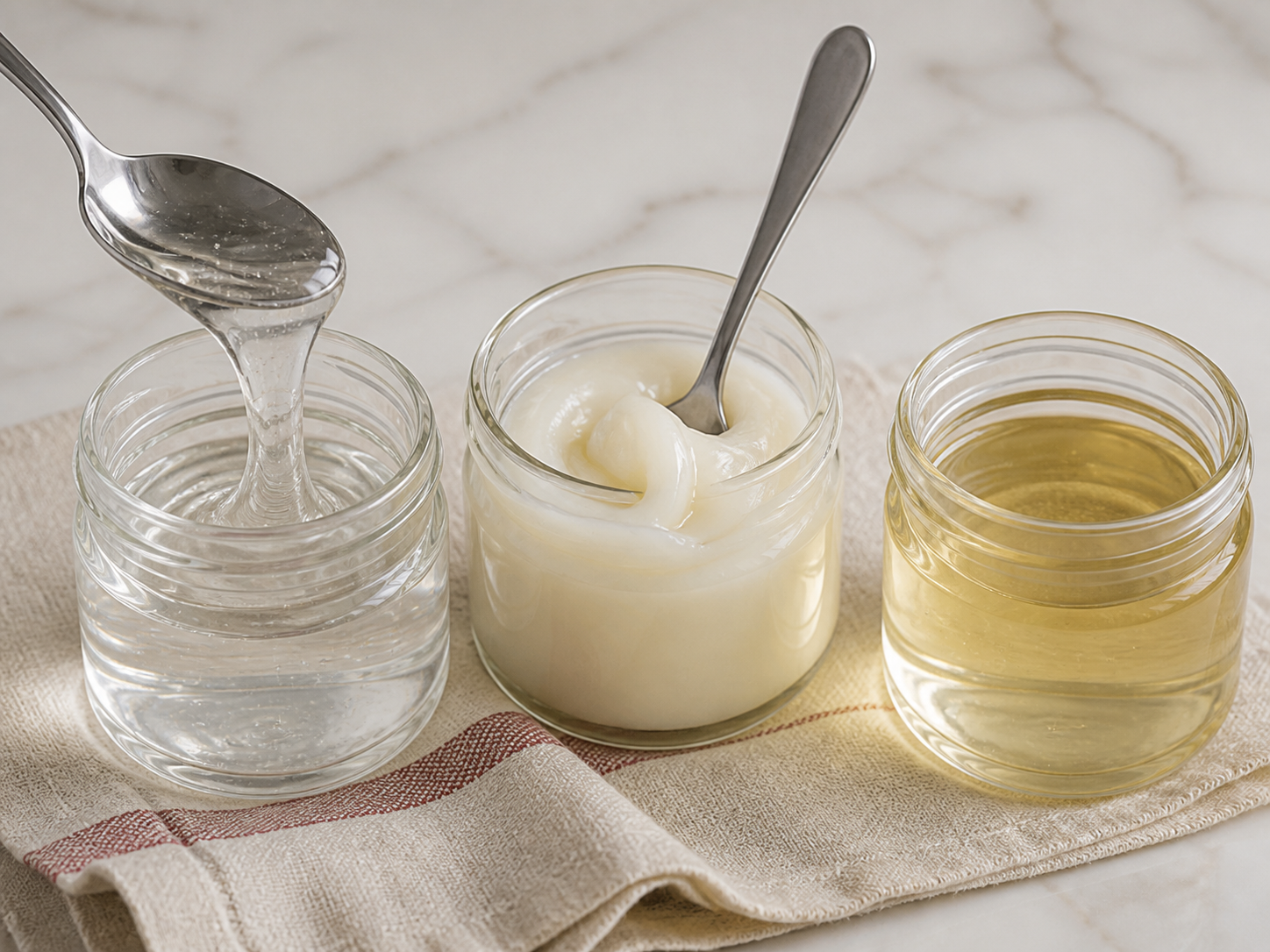
Glucose syrup
- Composition: a blend of glucose, maltose, and dextrins
- Sweetening power: 40–70% of sucrose (depending on DE)
- Texture: very viscous, nearly solid when cold
- Primary function: anti-crystallization, texture control
- Flavor: neutral to mildly sweet
Trimoline (invert sugar)
Trimoline is sucrose that has been "inverted" — meaning split into its two components: glucose and fructose, in equal proportions. Composition: 50% glucose + 50% fructose
- Sweetening power: higher than sucrose (fructose is the sweetest naturally occurring sugar)
- Texture: a creamy paste, easy to measure and portion
- Primary function: softness, moisture retention, freezing point depression
- Flavor: distinctly sweet, with a honey-like note
- When to use which?
Preparation
| Glucose | Trimoline | Yes (essential) |
|---|---|---|
| Caramel | No | Yes |
| Mirror glaze | No | Yes |
| Ganache | Possible (adds sweetness) | Ice cream |
| Yes (better anti-freeze effect) | Possible (adds sweetness) | Soft cookies & cakes |
| Possible | Yes (preferable) | Pâtes de fruits |
| Marshmallows | Possible (adds sweetness) | Yes |
| In short: glucose excels at anti-crystallization and cooked sugar work. Trimoline excels at softness, moisture retention, and frozen desserts. In most recipes, they are not interchangeable. | Possible (adds sweetness) | Yes |
Working with glucose syrup day to day
Working with glucose syrup day to day - Glucose Syrup
Glucose syrup is notoriously difficult to handle at room temperature. Here are the techniques that make measuring it far easier:
Warm the jar: 15 to 20 seconds in the microwave (lid off) is enough to loosen the glucose so it can be spooned out cleanly
- Use a wet spoon: dip your spoon in hot water before scooping — the glucose will release far more easily
- Weigh directly: place the jar on the scale, tare it, and spoon the exact quantity you need straight into the saucepan. The cleanest method by far
- Store in a piping bag: some professionals transfer glucose into a piping bag for gram-precise dosing
- Storing glucose syrup
Glucose syrup is an exceptionally stable product:
Shelf life: 18 to 24 months at room temperature
- Storage conditions: sealed jar, away from heat and humidity
- After opening: close the jar carefully after each use. Glucose absorbs moisture from the air, which gradually alters its concentration
- Freezing: unnecessary — the product keeps perfectly at room temperature
- The
Le Louis François glucose syrup in 1 kg format is the most practical size for regular use — enough for several months of baking without the hassle of smaller formats.
Common mistakes with glucose syrup
Mistake #1: confusing glucose and glucose syrup
Pure glucose (dextrose) is a white powder, while glucose syrup is a viscous liquid. In pastry, when a recipe calls for "glucose," it almost always means the syrup. If the recipe specifies "powdered glucose" or "dextrose," that's an entirely different ingredient.
Mistake #2: too much glucose in ice cream
Excess glucose — beyond 35% of total sugars — makes ice cream gummy, sticky, and too soft. The result is a product that melts almost instantly out of the freezer with an unpleasant mouthfeel.
Mistake #3: substituting honey for glucose syrup
Honey contains glucose and fructose, but also water, enzymes, and its own pronounced flavors. It doesn't have the same anti-crystallizing power as glucose syrup and will alter the taste of your preparation. In a pinch, it may work as a substitute in certain recipes, but the result will not be the same.
Mistake #4: overheating glucose in the microwave
Glucose can develop hot spots in the microwave and scorch. Work in short bursts of 10 to 15 seconds, stirring between each interval. Burned glucose takes on a bitter flavor that will taint the entire preparation.
G. Detou's advice
Glucose syrup isn't liquid sugar — it's an anti-crystallizing agent. It's what keeps your ice cream from turning into a solid block in the freezer, and your soft caramel from re-crystallizing after three days. We carry it in 500 g and 1 kg jars at G. Detou, and the question we always ask first-time buyers is: "DE 38 for softness, or DE 60 for shine?" Nine times out of ten, DE 38 is exactly what you need for home pastry work.
FAQ — Glucose syrup in pastry
In a pinch, yes — but with clear limitations. Honey has weaker anti-crystallizing properties and brings a pronounced flavor of its own. Agave syrup is primarily composed of fructose and lacks the technical properties of glucose. For caramels and mirror glazes in particular, there is no truly satisfactory substitute for glucose syrup.
The DE (Dextrose Equivalent) measures the degree of hydrolysis. A DE 38 contains more dextrins (complex sugars): it is less sweet, thicker, and ideal for caramels and soft confectionery. DE 60 is more fluid and sweeter, making it perfect for high-gloss glazes and frozen desserts. For versatile home pastry use, DE 38 covers the vast majority of needs.
The question is a valid one, since some glucose syrups are derived from wheat starch. However, the hydrolysis process destroys gluten proteins. Glucose syrups are generally considered gluten-free under European regulations (residual content below 20 ppm). If you are baking for someone with celiac disease, check the label carefully or opt for a glucose syrup made from corn starch.
Glucose syrup is one of the most stable ingredients in your pantry. Once opened, it keeps easily for 12 months at room temperature, provided you seal the jar tightly after each use. Check occasionally for mold on the surface (rare, but possible if water has been introduced into the jar) and for any off-odor.
Glucose syrup is one of those technical ingredients that separates home baking from professional-level pastry work. Without it, there's no soft caramel, no flawless mirror glaze, no silky-smooth ice cream. Available in professional format at G. Detou, Louis François glucose syrup is the essential starting point for anyone who wants to master sugar cooking and textures in pastry.
To go further: browse our full Sugars selection.