


Mirror glaze is what transforms a decent entremet into a showstopping one. That smooth, lacquer-like layer that catches the light and gives modern desserts the jewel-like finish you see in the finest pastry shops. And yet, it's also the technique home bakers struggle with most: too thick, too thin, sliding off, cracking, losing its sheen within the hour.
I need the complete text to translate. It seems your message was cut off. Could you please provide the full French text you'd like me to translate? glucose syrup, gelatin, white chocolate) to all the home pastry chefs venturing into entremets — and we often hear about their disappointments. Mirror glaze is 60% technique and 40% ingredients. We're giving you both.
What a mirror glaze really is
A professional mirror glaze isn't simply a shiny coating. It's a stable emulsion built from:
- Sugar and glucose syrup (for shine and suppleness)
- White chocolate or sweetened condensed milk (for opacity and structure)
- Gelatin and/or pectin (for the gelled texture)
- Water or a liquid base (cream, purée, milk)
- Food coloring, if desired (fat-soluble for chocolate-based glazes, water-soluble for neutral glazes)
It looks like your message got cut off! Could you please share the full French fragment you'd like me to translate? I'm ready to help once I have the complete text.
- Is poured at 32–35 °C (90–95 °F) over a frozen entremet
- Adheres in a thin, even layer
- Stays glossy for 2 to 3 days
- Cuts cleanly with a warm knife
- Holds up during transport and storage
The ingredients that matter
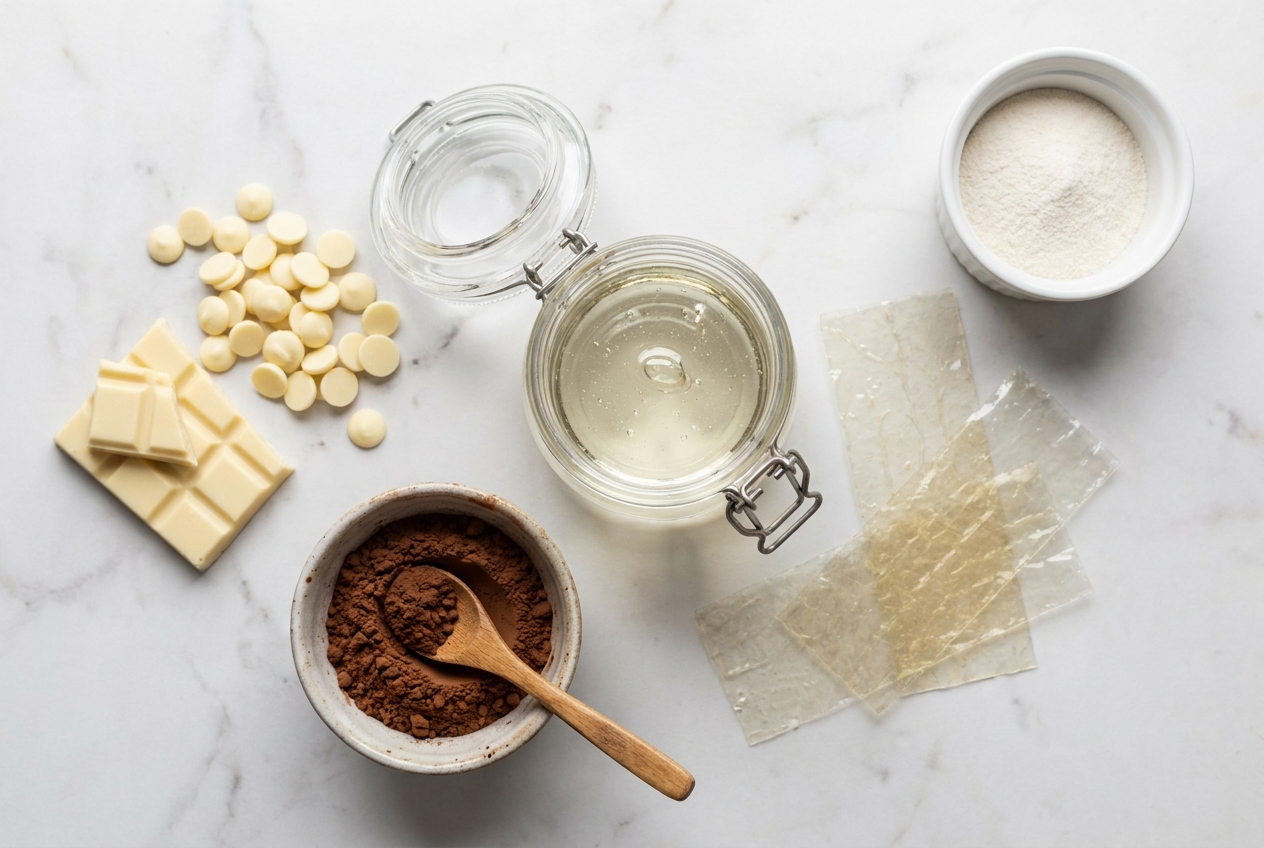
Glucose syrup
Non-negotiable. It's what delivers the shine and prevents sugar crystallization as the glaze cools. Without it, the glaze turns dull and grainy. At G. Detou, we carry glucose syrup in 500 g and 1 kg jars — one jar will see you through around fifteen entremets.
White couverture chocolate
For opaque colored glazes, use white couverture chocolate (Valrhona Ivoire 35%, Cacao Barry Zéphyr 34%). Its cocoa butter provides texture and hold; its neutral color allows for complete freedom when it comes to coloring.
For a dark chocolate glaze, start with a Valrhona Guanaja or equivalent.
Sweetened condensed milk
A surprising but essential ingredient: it brings opacity, a gentle milky sweetness, and a silky texture. It's the secret behind the modern glazes of the great pastry houses. A standard sweetened condensed milk (Nestlé or equivalent) works perfectly.
Gelatin
Pectin 325NH95 (or NH)
An option to reinforce the glaze's hold and stability during transport. Not mandatory, but highly recommended for entremets that need to travel or wait. See our
Food coloring
Fat-soluble for white chocolate glazes (they blend with fats). Water-soluble for water-based glazes. Prefer powder food coloring (more concentrated) over liquid coloring (which dilutes the glaze).
# The mirror glaze recipe
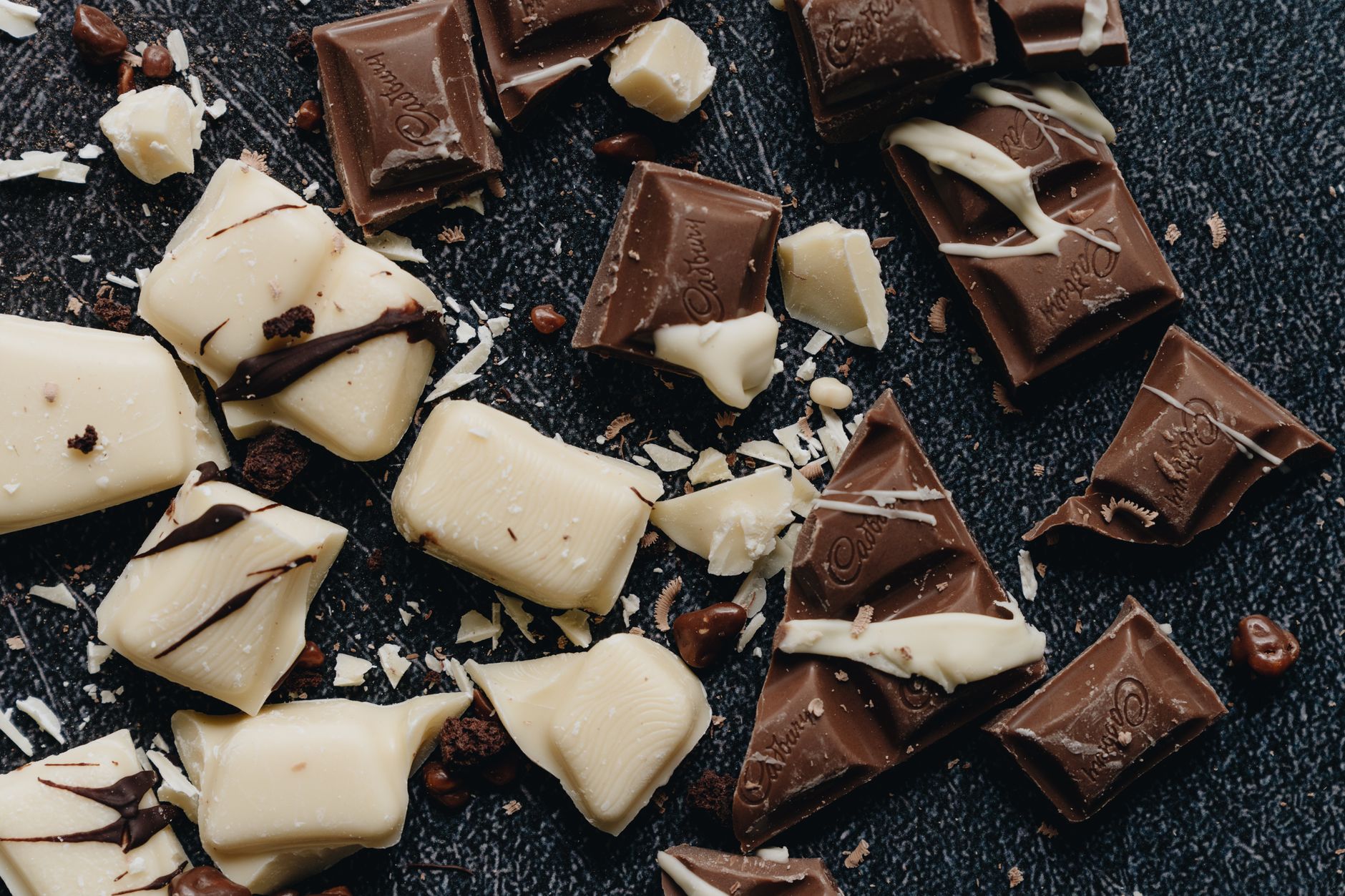
Two base recipes cover every entremet: the colored white chocolate glaze (pink, green, blue, yellow, red…) and the dark chocolate glaze for chocolate desserts.
# The colored white chocolate glaze
The go-to for modern entremets. Perfect texture, guaranteed shine.
Ingredients (for a 20 cm / 8-inch entremet, approximately 500 g of glaze):




I need more context to translate. Please provide the French HTML fragment you'd like me to translate.
Bloom the gelatin
Soak the gelatin sheets in a bowl of cold water for 15 minutes. Squeeze out the excess water.
Step 2
Cook the syrup
In a saucepan, bring the water, sugar, and glucose syrup to 103 °C (217 °F), using a thermometer.
Step 3
Add the condensed milk and gelatin
Remove from heat and stir in the sweetened condensed milk and the squeezed gelatin. Mix to combine.
Step 4
Emulsify over the chocolate
Pour over the chopped white chocolate or chocolate callets. Let sit for 30 seconds, then emulsify with a spatula using concentric circular motions.
Step 5
Color and blend
Add the titanium dioxide and food coloring. Blend with an immersion blender (Bamix) for 1 to 2 minutes, keeping the head fully submerged to avoid incorporating air.
Step 6
Strain through a fine-mesh sieve
If needed, strain through a fine-mesh sieve to remove any air bubbles.
Step 7
Rest for 12 hours
Press plastic wrap directly onto the surface and refrigerate for 12 hours. This resting step is essential.
Step 8
Reheat to pouring temperature
The next day, gently reheat to 32–35 °C (90–95 °F) in a double boiler or in the microwave in short bursts.
Step 9
Pour over the frozen entremet
Pour immediately over the entremet straight from the freezer.
# The dark chocolate glaze
For chocolate entremets, this is the classic choice.
Ingredients (for 500 g):

I need more context to translate. Please provide the French HTML fragment you'd like me to translate.
Bloom the gelatin
Soak the gelatin sheets in cold water.
Step 2
Cook the syrup
In a saucepan, bring the water, sugar, and glucose syrup to a boil.
Step 3
Add the cocoa
Rain in the cocoa powder while whisking vigorously. Bring to a gentle simmer and cook for 1 minute.
Step 4
Add the hot cream
Incorporate the heavy cream, which you will have heated separately.
Step 5
Add the gelatin
Remove from heat and stir in the squeezed gelatin sheets.
Step 6
I need more text to translate. Could you please provide the French fragment you'd like me to translate from French to English?
Blend with an immersion blender for 1 to 2 minutes, then strain through a fine-mesh sieve.
Step 7
Rest for 12 hours
Press plastic wrap directly onto the surface and refrigerate for 12 hours.
Step 8
Reheat to pouring temperature
Reheat to 95–100°F (35–38°C): the dark chocolate glaze is poured slightly warmer than the colored white chocolate version.
Step 9
Pour over the frozen entremet
Pour over the entremet straight from the freezer.
Pouring temperature
It seems like your message got cut off! Could you share the full fragment you'd like me to translate? I'm ready to help as soon as you provide the French text.
- Too hot (>37 °C / 99 °F): the glaze slides off the entremet and leaves bare patches.
- Too cold (<30 °C / 86 °F): the glaze is too thick, sets in clumps, and gives an uneven finish.
- The sweet spot: 32–35 °C (90–95 °F) for the colored white chocolate glaze, 35–38 °C (95–100 °F) for dark chocolate — a thin, smooth, even layer.
Invest in a reliable probe thermometer. It's the single biggest difference between a perfect glaze and a failed one.
I need the actual French text fragment to translate. Could you please provide the French HTML content you'd like me to translate?
I need more context to translate. Please provide the French HTML fragment you'd like me to translate.
It looks like your message may be incomplete — I don't see any French HTML fragment to translate. Could you please share the text you'd like me to translate from French to English?
The entremet must be completely frozen — at least 4 hours, ideally 12 hours in the freezer.
Step 2
Place on a wire rack
Set it on a wire rack placed over a clean tray or sheet pan to catch the excess glaze.
Step 3
Remove from the freezer at the last moment
Take it out of the freezer just before glazing — if it starts to thaw, the glaze won't flow properly.
The pour
I need more context to translate. Please provide the French HTML fragment you'd like me to translate.
Pour in one continuous motion
Pour the glaze in a single, fluid movement — start at the center, spiral outward, then cover the sides.
Step 2
Don't go over them again
Never run a spatula over the glaze once it has been poured — it marks immediately.
Step 3
Please provide the French HTML fragment you'd like me to translate.
After 30 seconds, slide a spatula under the base of the entremet to detach the drips.
Step 4
Transfer to the serving dish
Lift onto the serving platter using a large flat spatula.
The finishing touches
- The glaze sets in 5 minutes at room temperature.
- The entremet must thaw in the refrigerator, not at room temperature — this prevents condensation, which dulls the glaze.
- Allow 4 hours of thawing in the refrigerator before serving.
- Add the decorations at the last moment (flowers, gold leaves, fresh fruits).
It looks like your message contains only "Variations and riffs" without any French HTML content to translate. Could you please share the French fragment you'd like me to translate?
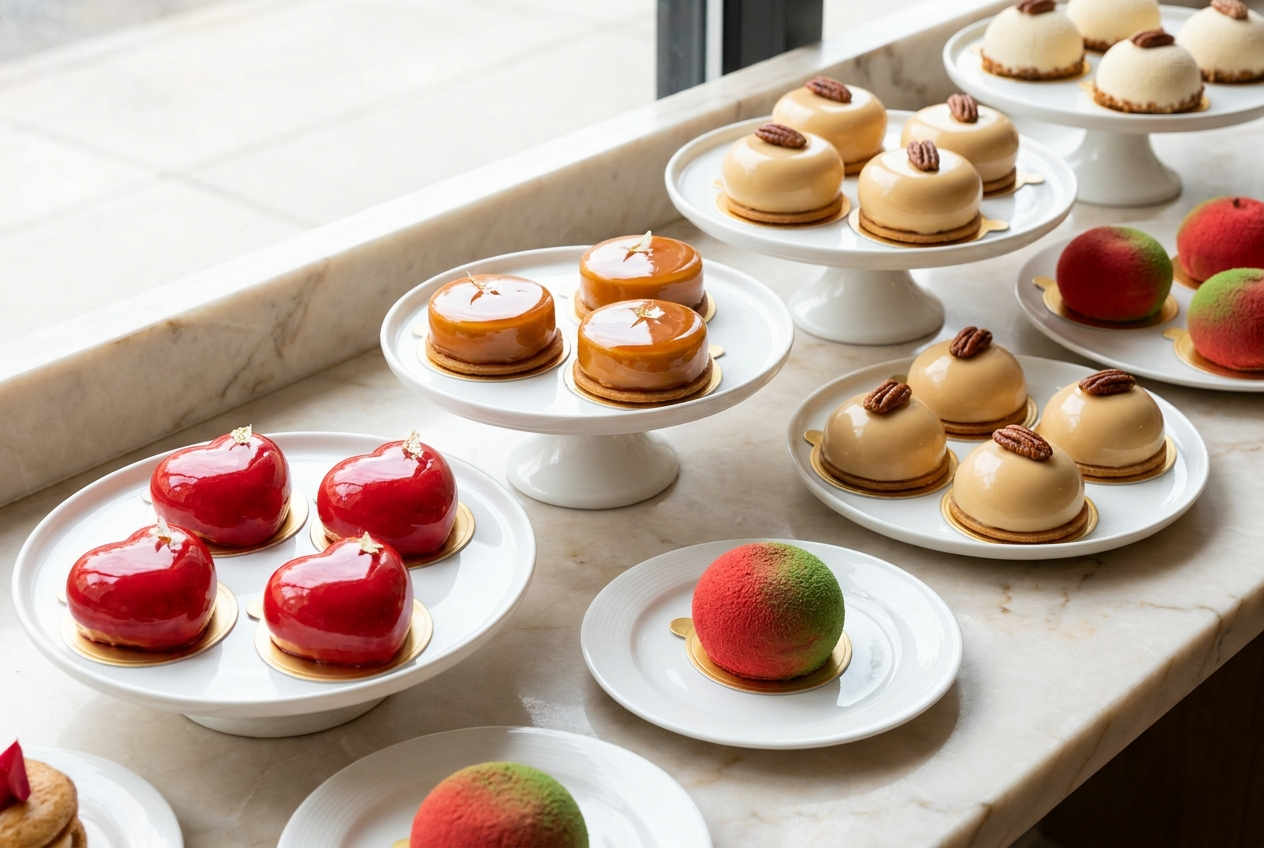
Red Passion Fruit Mirror Glaze
Same recipe as the colored glaze, but replace 50 g of passion fruit purée with 50 g of water. Paired with a red food coloring, it yields an intensely fruity glaze.
Caramel mirror glaze
Remplacez 100 g de sirop de glucose par du caramel beurre salé maison. Couleur ambre naturelle, goût caramel discret.
Here is the English translation: Dulcey mirror glaze
Use Valrhona Dulcey instead of Ivoire. It offers a naturally golden-blonde color with the characteristic biscuit-caramel flavor of Dulcey. No food coloring needed.
Velvet spray finish
This is not a mirror glaze but a spray finish: melt white chocolate and cocoa butter at a 50/50 ratio, then spray at 104 °F onto a frozen entremet. This creates that matte velvet effect seen on
The classic mistakes
- Glazing an entremet that isn't frozen through to the core. The glaze melts the surface and slides right off. A minimum of 4 hours in the freezer is required, 12 hours being ideal.
- Pouring at the wrong temperature. A thermometer is not optional. 90–95 °F for white chocolate, 95–100 °F for dark chocolate.
- Skipping the 12-hour resting period. The texture is not stable right after preparation. The wait is non-negotiable.
- Incorporating air with the immersion blender. Keep the head fully submerged and slightly tilted. Once incorporated, bubbles are nearly impossible to eliminate entirely.
- Run the spatula over the glaze. It marks every time. Pour it in one smooth motion and don't touch it again.
Storage
Prepared glaze that has not been used can be stored for 10 to 15 days in the refrigerator, covered with plastic wrap pressed directly onto the surface and kept in an airtight container. Reheat in a double boiler or in the microwave in short bursts.
A frozen entremet keeps for 48 hours in the refrigerator, but it is best within 24 hours for optimal shine.
Freezing: a glazed entremet can be refrozen after glazing — a technique that professionals call the "double" method when preparing in advance. Thaw in the refrigerator for 12 hours.
What it costs
For 500 g of homemade mirror glaze, expect to pay $5 to $9 depending on the quality of the ingredients (primarily the white chocolate and glucose syrup). It's one of the least expensive steps in a professional-level entremet — but the most technically demanding.
Where to find the ingredients
At G. Detou, 58 rue Tiquetonne, Paris 2nd arrondissement:
- Glucose syrup in 500 g or 1 kg packaging
- White Chocolate Valrhona Ivoire and Dulcey
- Valrhona cocoa powder unsweetened
- 200-bloom gelatin in sheets, pastry quality
- Pectin NH / 325NH95 for stabilized versions
- Fat-soluble and water-soluble colorants food-grade
- Titanium dioxide (for intense white opacity in glazes)
For sweetened condensed milk, a standard Nestlé works perfectly.
I need the actual French text fragment to translate. Could you please provide the French content you'd like me to translate?
Mirror glaze relies on two precise variables: pouring temperature (32–35 °C / 90–95 °F for a white chocolate-based colored glaze, 35–38 °C / 95–100 °F for dark chocolate) and consistency, which depends entirely on glucose syrup. A glaze without glucose spreads flat; a glaze with 30% glucose flows down in a shiny 2 mm-thick curtain. On Rue Tiquetonne, we carry Louis François DE 38 glucose syrup in 500 g jars — more than enough to glaze 20 entremets. The ultimate test: if you can see your reflection in the glaze, you've nailed it.
FAQ — Mirror glaze
Two likely causes: the glaze was too hot (>98.6 °F), or the entremet was not frozen enough. Check your thermometer and freeze for at least 12 hours.
The 12-hour resting period was likely skipped, or there wasn't enough glucose syrup. Both of these elements are essential for the shine. The glaze can be rewarmed and reworked with additional glucose if needed.
Yes, some are reliable — Sosa offers a dependable one, and Valrhona offers "Absolu Cristal." That said, homemade glazes win hands down in both flavor and texture. The ready-to-use option is a handy shortcut when time is short.
At least 4 hours to allow the entremet to thaw in the refrigerator. For optimal shine, serve within 24 hours — beyond that, the gloss starts to dull due to refrigerator humidity.
No. A glazed entremet put back in the freezer will lose its shine and may crack. Thawing in the refrigerator is the only method that preserves the appearance of the glaze.
Keep the immersion blender head completely submerged and slightly tilted. Never lift it out of the mixture while blending. Pass through a fine-mesh strainer after blending. Let the glaze rest for 10 minutes before pouring so that any remaining bubbles can rise to the surface.
Better to avoid it. The glaze must be poured in one continuous motion to form an even layer. Ladling it creates an uneven thickness that is just as noticeable when slicing as it is when tasting.
Mirror glaze is the technique that elevates your homemade entremets to the level of desserts worthy of a pastry shop display case. It takes practice — the first two or three attempts are rarely perfect — but once the method is mastered, it never gets old.
Retrouvez notre # Glucose Syrup Guide Glucose syrup is a thick, viscous liquid sweetener derived from the hydrolysis of starch (most commonly corn, wheat, or potato starch). It plays a crucial role in professional confectionery and pastry-making, and understanding how to use it properly can elevate your recipes significantly. --- ## What Is Glucose Syrup? Glucose syrup is a purified concentrated aqueous solution of nutritive saccharides obtained from starch. Unlike table sugar (sucrose), glucose syrup is composed primarily of glucose (dextrose), maltose, and higher saccharides. Its sweetness level is lower than that of sucrose, typically ranging from 30% to 50% relative sweetness depending on its DE (Dextrose Equivalent) value. --- ## The DE Value (Dextrose Equivalent) The **DE value** measures the degree of hydrolysis of the starch: - **Low DE (28–38):** Thicker, less sweet, higher viscosity — ideal for confectionery (caramels, nougat, Turkish delight). - **Medium DE (38–55):** All-purpose glucose syrup — the most common in pastry kitchens. - **High DE (55–70+):** More fluid, sweeter, closer in behavior to liquid sugar. The standard glucose syrup sold at G. Detou typically falls in the **medium DE range (DE 40–42)**, which is the classic choice for most pastry and chocolate applications. --- ## Key Properties & Why Chefs Use It ### 1. **Anti-Crystallization** Glucose syrup interferes with the crystallization of sucrose. Adding it to sugar syrups, caramels, and ganaches prevents unwanted graininess and extends shelf life. ### 2. **Humectancy (Moisture Retention)** Glucose syrup attracts and retains moisture, keeping confections soft and preventing them from drying out. This is especially valuable in: - Marshmallows - Soft caramels - Ganaches and chocolate truffles ### 3. **Texture & Body** It adds viscosity and a smooth, glossy texture to sauces, glazes (miroir glacages), and fillings. ### 4. **Freezing Point Depression** In ice cream and sorbet, glucose syrup lowers the freezing point, resulting in a softer, creamier scoop straight from the freezer and reducing ice crystal formation. ### 5. **Boiling Point Elevation** Glucose syrup raises the boiling point of sugar solutions, which is useful when cooking sugar to specific stages for confectionery work. --- ## Common Uses in the Professional Kitchen | Application | Role of Glucose Syrup | |---|---| | **Caramel** | Prevents crystallization, improves texture | | **Nougat & Marshmallow** | Provides elasticity, retains moisture | | **Ganache** | Extends shelf life, adds smoothness | | **Mirror Glaze (Glacage Miroir)** | Adds shine and prevents cracking | | **Ice Cream & Sorbet** | Softens texture, reduces ice crystals | | **Fondant** | Controls crystal size for smooth texture | | **Marzipan & Praliné-based fillings** | Binds and retains moisture | | **Pâte de fruit** | Improves texture and shelf life | --- ## How to Measure & Handle Glucose Syrup Glucose syrup is notoriously sticky and difficult to measure accurately by volume. Here are some professional tips: - **Always weigh it** on a digital scale — volume measurements are unreliable. - **Warm it slightly** (to around 95–105°F / 35–40°C) before use to make it more fluid and easier to pour or scrape. - **Spray your spatula or spoon** with a light coat of neutral oil to prevent sticking. - Store at **room temperature** in a tightly sealed container, away from direct light and humidity. --- ## Glucose Syrup vs. Corn Syrup American corn syrup (like Karo light corn syrup) is often suggested as a substitute, but there are key differences: | | **Professional Glucose Syrup** | **Light Corn Syrup** | |---|---|---| | Viscosity | Higher | Lower | | Sweetness | Lower | Higher (vanilla often added) | | Purity | Higher | May contain additives/vanilla | | DE Value | ~40–42 | ~42 (similar) | For most professional applications, **they can be substituted 1:1 by weight**, but be aware that corn syrup may slightly alter flavor and texture. --- ## Glucose Syrup vs. Inverted Sugar (Trimoline) Both are anti-crystallizing agents and humectants, but they behave differently: | | **Glucose Syrup** | **Inverted Sugar / Trimoline** | |---|---|---| | Composition | Glucose + maltose + higher saccharides | Glucose + fructose (equal parts) | | Sweetness | ~40% relative to sucrose | ~120% relative to sucrose | | Humectancy | Good | Excellent | | Best for | Caramels, nougat, ice cream | Ganaches, soft cakes, ice cream | In many ganache recipes, the two are used **together** to maximize shelf life and texture. --- ## Typical Usage Rates - **Caramel / Toffee:** 10–20% of total sugar weight - **Ganache:** 5–15% of total recipe weight - **Ice Cream / Sorbet:** 5–15% of total mix weight (replacing part of sucrose) - **Mirror Glaze:** 15–25% of total recipe weight - **Marshmallow:** 20–40% of total sugar weight --- ## Storage - **Shelf life:** Up to 2 years when stored properly - **Temperature:** Room temperature (59–77°F / 15–25°C) - **Container:** Airtight, food-safe container - **Note:** If glucose syrup develops surface mold (rare but possible in humid conditions), discard the affected portion — it has likely been contaminated through improper handling. --- ## Quick Reference: Troubleshooting | Problem | Likely Cause | Solution | |---|---|---| | Caramel crystallizes | Too little glucose | Increase glucose to 15–20% of sugar weight | | Ganache is too firm | Insufficient humectant | Add or increase glucose/inverted sugar | | Ice cream too hard | Low glucose content | Replace 20–30% of sucrose with glucose | | Mirror glaze cracks | Insufficient glucose | Ensure glucose is at least 20% of recipe | | Nougat is too sticky | Too much glucose | Reduce glucose ratio slightly | --- Glucose syrup is one of those **foundational professional ingredients** that, once understood, becomes indispensable. Whether you're making a silky ganache, a perfectly set caramel, or a flawlessly smooth mirror glaze, glucose syrup is almost certainly part of the formula. et notre gelatin vs. agar-agar comparison.
At G. Detou, we offer all the technical ingredients for a professional-quality glaze in small quantities suited to home pastry enthusiasts — no need to buy 5 kg to make your first entremet.
To go further: browse our full White Chocolate selection.