

Color in pastry-making is about far more than aesthetics — it shapes flavor perception, appetite appeal, and the visual identity of a creation. But at a time when consumers scrutinize ingredient labels and the clean-label movement has gone mainstream, the choice between natural food coloring and synthetic dyes is no longer trivial. It has become a genuine point of differentiation for pastry chefs, cooks, and even discerning home bakers.
This guide covers everything you need to know: origins, types, applications, regulations, and — most importantly — how to choose the right natural food coloring for each use.
Natural vs. Synthetic Food Coloring: What's the Difference?
The Origin of Pigments
The fundamental distinction lies in where the pigment comes from:
- Natural colorings are extracted from plant, animal, or mineral raw materials. Examples include beet red (E162), turmeric yellow (E100), chlorophyll green (E140), and spirulina blue. These pigments exist in nature and are extracted using gentle physical or chemical processes.
- Synthetic (or artificial) colorings are manufactured through chemical synthesis in a laboratory. Allura red (E129), tartrazine yellow (E102), and brilliant blue (E133) do not exist in nature in this form. They are engineered to replicate — and often surpass — the intensity of natural pigments.
Stability and Intensity
This is where things get complicated for the professional. Synthetic colorings offer undeniable technical advantages:
- Superior intensity: a tiny amount delivers a vivid, clean color.
- Heat stability: they hold up better during baking, which is critical in pastry work.
- Light stability: they do not (or barely) fade under light exposure.
- pH stability: they maintain their hue in both acidic and alkaline environments.
Natural colorings, on the other hand, tend to be more sensitive:
- Beet red turns brown above 80 °C (176 °F).
- Chlorophyll green can yellow under intense lighting.
- Spirulina blue is sensitive to acidity.
- Turmeric yellow can impart a perceptible flavor at high doses.
This does not mean natural colorings are impractical — far from it. It simply means you need to understand them in order to use them well.
Health Impact and Consumer Perception
Several synthetic colorings have been at the center of health controversies. Since 2010, European regulations have required a warning on products containing certain azo dyes (E102, E104, E110, E122, E124, E129): "May have an adverse effect on activity and attention in children."
Natural colorings, by contrast, enjoy a far more favorable image among consumers. In an era where ingredient transparency has become a selling point, using colorings of natural origin can make a real commercial difference.
The Main Types of Natural Food Colorings
Natural Food Coloring in Powder Form
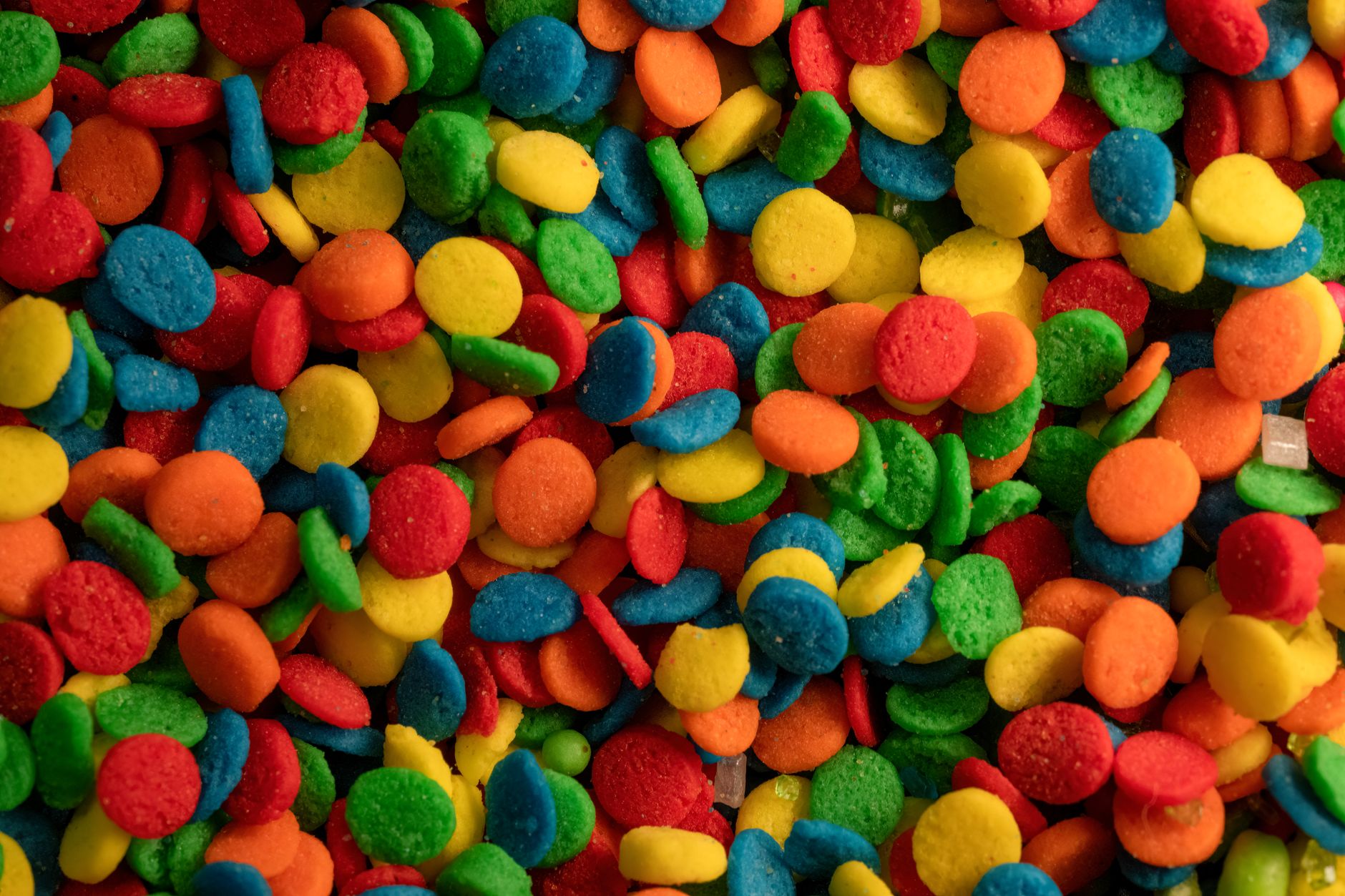
Le colorant en poudre is the most versatile format. It comes as a fine, concentrated powder obtained by drying and grinding the coloring raw material.
Advantages:
- Long shelf life when kept away from moisture and light.
- Precise dosing down to the gram.
- Does not alter the texture of the preparation (no added liquid).
- Ideal for chocolate work, sugar art, and macarons.
Primary uses:
- Tinting cocoa butter for chocolate molds.
- Incorporating into macaron shells.
- Decorative dusting on sugar showpieces.
- Coloring meringues and pâte sablée (shortcrust pastry dough).
Natural Food Coloring in Liquid Form
Liquid coloring is an aqueous solution of natural pigment. It is the easiest format to dose for a beginner, thanks to its drop-by-drop application.
Advantages:
- Easy, incremental dosing.
- Homogeneous dispersion in liquid and semi-liquid preparations.
- Ready to use, no dilution required.
Limitations:
- Less concentrated than powder — more is needed to achieve vivid shades.
- The added liquid can affect the consistency of certain preparations (meringue, ganache).
- Shorter shelf life once opened.
Primary uses:
- Cake batters and pastry creams.
- Glazes and fondants.
- Beverages and cocktails.
Natural Food Coloring in Gel Form
Concentrated gel is an interesting middle ground between liquid and powder. It delivers good color intensity without adding significant water to the preparation.
Advantages:
- Highly concentrated — a few knife-tip amounts are sufficient.
- Barely alters texture.
- Blends easily into thick batters and doughs.
Primary uses:
- Fondant and sugar paste.
- Buttercreams and ganaches.
- Colored cake batters (rainbow cakes).
- Royal icings.
Fat-Soluble vs. Water-Soluble Colorings
This technical distinction is fundamental, yet frequently overlooked:
- Water-soluble (hydrosoluble): the coloring dissolves in water and water-based preparations (creams, batters, glazes). This is the most common type.
- Fat-soluble (liposoluble): the coloring dissolves in fats (cocoa butter, chocolate, heavy creams). Essential for tinting chocolate or cocoa butter without causing crystallization or seizing.
If you add a water-soluble coloring to melted chocolate, the result will be disastrous: the chocolate will thicken, seize, and become unusable. That is why there are colorants liposolubles specifically designed for fat-based applications.
The Main Sources of Natural Colorings
Plant-Based Pigments
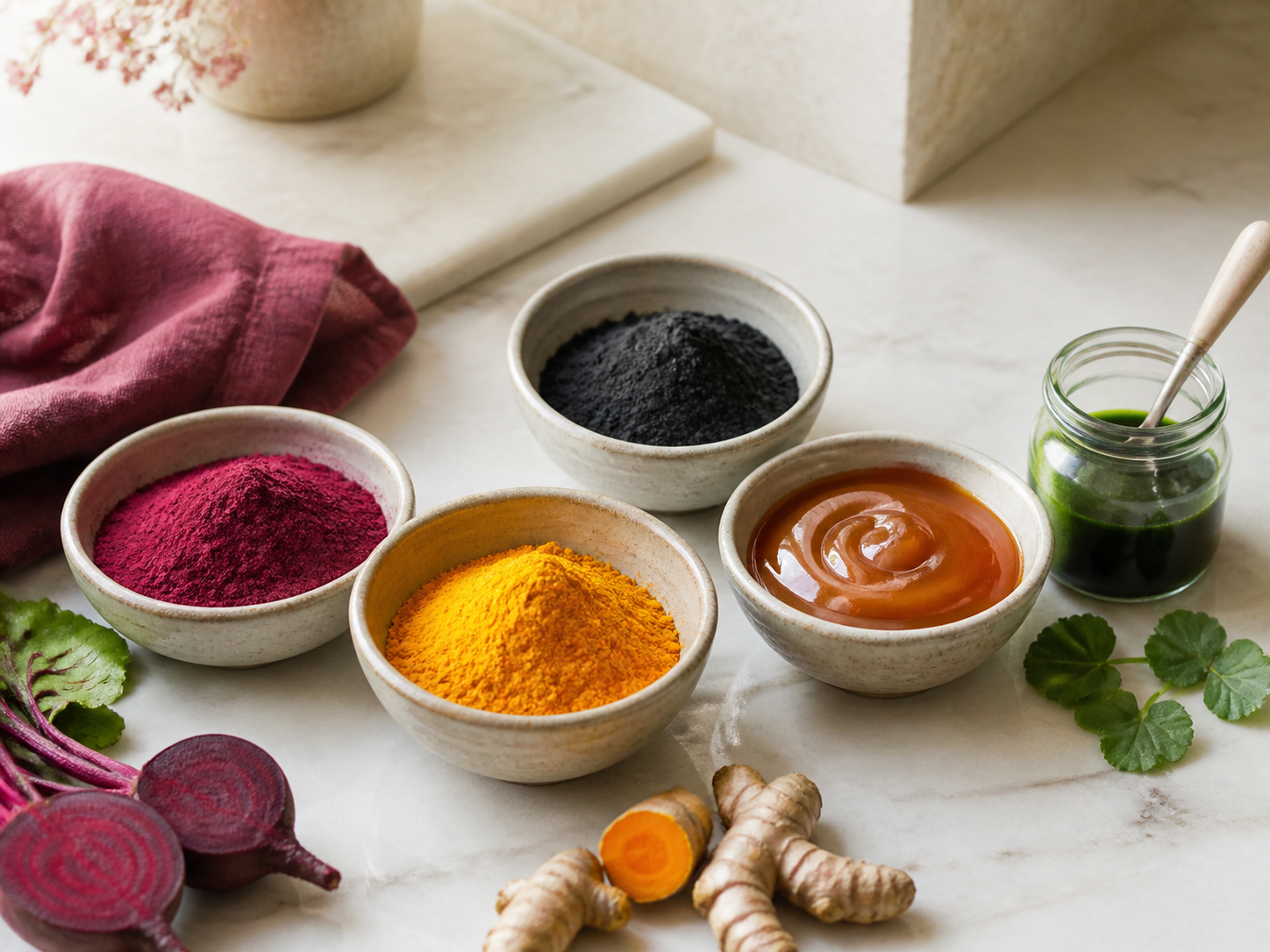
The majority of natural colorings used in pastry work come from plant sources:
| Color | Source | E Code | Heat Stability |
|---|---|---|---|
| Red | Beet | E162 | Moderate (< 80 °C / 176 °F) |
| Red-pink | Cochineal carmine | E120 | Good |
| Yellow | Turmeric | E100 | Good |
| Yellow-orange | Annatto (rocou) | E160b | Good |
| Orange | Paprika | E160c | Moderate |
| Green | Chlorophyll | E140 | Moderate |
| Green | Spirulina + turmeric | — | Variable |
| Blue | Spirulina (phycocyanin) | — | Low (pH-sensitive) |
| Brown-black | Caramel | E150 | Excellent |
| Black | Vegetable charcoal | E153 | Excellent |
The Special Case of Carmine (E120)
Carmine deserves particular attention. This intense, stable red is extracted from cochineal, an insect that parasitizes cacti. It is the highest-performing natural red coloring in terms of resistance to heat, light, and pH. However, its animal origin raises two issues:
- It is not compatible with vegan or vegetarian diets.
- Some individuals are allergic to it (rare but documented reactions).
For these reasons, many professionals are turning to plant-based alternatives such as beet red or radish red, despite their lower stability.
Vegetable Charcoal (E153)
Black is a particularly sought-after color in contemporary pastry-making (black macarons, black mirror glazes, charcoal bread). The charbon végétal charcoal is the natural solution par excellence: it is extremely stable, has no perceptible taste at the doses used, and delivers a deep, matte black.
European Regulations on Food Colorings
The Legal Framework
In Europe, all food colorings — natural and synthetic — are governed by Regulation (EC) No. 1333/2008. Each approved coloring is assigned an E number and precise conditions of use:
- Maximum permitted doses defined by food product category.
- Labeling requirements: the coloring must appear in the ingredient list.
- Regular reassessments by EFSA (the European Food Safety Authority).
Natural Colorings and the "No Artificial Colors" Claim
A product that uses exclusively natural-origin colorings may carry the claim "no artificial colors" on its label. This has become an increasingly powerful commercial argument for both artisan producers and industrial manufacturers.
One important caveat: a coloring of "natural origin" is not necessarily "organic." To use an organic label claim, the coloring must be derived from certified organic raw materials and its extraction process must comply with organic certification standards.
The Most Widely Used Natural Colorings in Professional Pastry Work
In the day-to-day reality of a pastry kitchen, these are the natural colorings most frequently reached for:
- Vegetable charcoal — for deep blacks.
- Turmeric — for golden yellows.
- Beet — for pinks and reds (cold applications).
- Caramel — for browns and caramel tones.
- Spirulina — for blues and greens (combined with turmeric).
The Clean-Label and Vegan Movement: Why Natural Colorings Are Taking Over
The clean-label trend — short ingredient lists, recognizable components, zero unnecessary additives — is no longer a niche movement. It has become a dominant purchasing criterion that is reshaping the choices of both professionals and home cooks.
Clean Label: An Expectation That Has Become the Standard
Consumers are paying closer and closer attention to what goes into their food, and reading ingredient labels has become second nature. In this context, a macaron colored with E129 (allura red) sends a very different signal than one colored with beet.
For artisan pastry chefs, the claim "no artificial colors" has become a powerful commercial asset — sometimes as important as flavor itself. Shops and restaurants that embrace this transparency consistently report a positive impact on customer trust.
Natural Colorings and Vegan Pastry: A Natural Convergence
Vegan pastry-making has seen sustained growth in France over the past several years. For pastry chefs committed to this approach, the choice of colorings is an important point of vigilance:
- Carmine (E120), one of the best-performing natural colorings, is of animal origin (cochineal) and is incompatible with a vegan offering.
- Plant-based alternatives have improved considerably: beet red, radish red, and purple sweet potato extracts now deliver satisfactory results for most applications.
- Spirulina (blue) and turmeric (yellow), used in combination, produce convincing greens without relying on any animal-derived colorings.
Recent Innovations in Natural Colorings
Manufacturers are investing heavily in plant-based and organic colorings. Among the notable developments:
- Certified organic natural coloring ranges are multiplying.
- Improved spirulina-based colorings offer better stability at varying pH levels and temperatures — historically their main weakness.
- Vegetable charcoal and other plant-derived blacks remain the most stable and most sought-after natural colorings for contemporary cake design.
- Manufacturers are developing natural colorings with improved heat stability, steadily closing the performance gap with synthetic dyes.
For professionals, transitioning to natural colorings represents an upfront investment (they are generally more expensive and require higher dosages), but it is an investment that aligns with where the market is heading — and one that can become a genuine commercial differentiator.
How to Choose Your Natural Food Coloring
Identify the Application
The choice of coloring depends above all on what you are coloring:
- Chocolate and cocoa butter: fat-soluble powder coloring exclusively. The colorants en poudre liposolubles available at G. Detou are specifically designed for this use.
- Macaron shells: water-soluble powder or gel coloring. Powder is preferred as it does not affect the moisture balance of the batter.
- Buttercream: gel or powder coloring.
- Mirror glaze: water-soluble liquid or powder coloring, pre-diluted.
- Fondant and sugar paste: gel coloring (liquid will soften the paste).
Check Heat Stability
If your preparation will be baked (cookies, meringues, pâte sablée), opt for naturally heat-stable colorings: turmeric, vegetable charcoal, caramel. Avoid beet, which will brown at high temperatures.
Dosing Natural Colorings
Natural colorings generally require higher doses than their synthetic counterparts to achieve the same intensity. Here are some useful benchmarks:
- Powder: 0.5 to 2 g per 1 kg of preparation (depending on desired intensity).
- Liquid: 5 to 15 ml per 1 kg of preparation.
- Gel: 2 to 5 g per 1 kg of preparation.
These figures are guidelines. It is always advisable to test on a small batch before coloring an entire lot.
G. Detou's Advice
Natural colorings have one weakness that manufacturers tend to gloss over: they are sensitive to heat, pH, and light. A beautiful fuchsia beet color turns brown after six minutes in a 356 °F (180 °C) oven, and spirulina blue shifts to gray in an acidic environment (lemon juice, vinegar). At G. Detou, we stock Louis François natural colorings for the applications they are genuinely suited to: cold glazes, ganaches, macaron batters, shortbreads. For vivid colors that need to withstand baking, we are upfront about it — we also carry synthetic colorings. We think that's the honest approach.
FAQ — Natural Food Coloring
Yes. Natural colorings approved in Europe (identified by an E number) have been assessed by EFSA and are considered safe within authorized usage levels. They are derived from food-grade raw materials — beet, turmeric, spirulina, vegetable charcoal — and carry none of the controversies associated with synthetic azo dyes. The one exception is carmine (E120), which can trigger rare allergic reactions in sensitive individuals.
Almost. Reds, yellows, oranges, greens, browns, and blacks are well covered by available natural colorings. Blue remains the trickiest: phycocyanin from spirulina does yield a blue, but it is sensitive to acidity and heat. For a vivid, stable blue, some professionals apply a specific treatment alongside the spirulina or accept a compromise on intensity. Purple can be achieved by blending red (beet) and blue (spirulina).
In powder form, a natural coloring stored away from moisture and light will easily keep for 12 to 24 months. Liquid and gel formats have a shorter shelf life, typically 6 to 12 months after opening. Always check the expiration date printed on the packaging and follow the recommended storage conditions.
Yes, but not at the same quantity. Natural colorings are less concentrated, so you will need to increase the dose to achieve comparable intensity. You also need to account for the heat stability and pH of the preparation. A synthetic coloring that holds up to baking cannot always be directly swapped for a natural equivalent without adjusting the process — for instance, by adding the coloring after baking rather than before.
G. Detou carries a complete range of colorants alimentaires naturels — in powder, gel, and liquid form — suited to all pastry and culinary applications. Browse the full selection in-store on rue Tiquetonne or at gdetou.com.
To go further: browse our full Food Colorings selection.