


In New York, nothing in the cookie world is the same anymore. These enormous 150 g discs — crispy on the outside, molten at the center, packed with chocolate chunks — have become the global standard in just a few years. TikTok talks about them every day, Parisian bakeries are jumping on the trend, and searches for "chewy cookies" exceed 8,000 monthly queries in France.
The good news: that texture is no mystery. It comes down to the sugar-to-butter ratio, chilling the dough, and a short bake at high heat. Here is the exact recipe we tested upwards of twenty times at G. Detou, using the right chocolates and the right techniques. The result: a thick cookie, golden at the edges, molten at the center, with chunks that melt with every bite. Levain-style, made at home.
The ingredients that make a great cookie
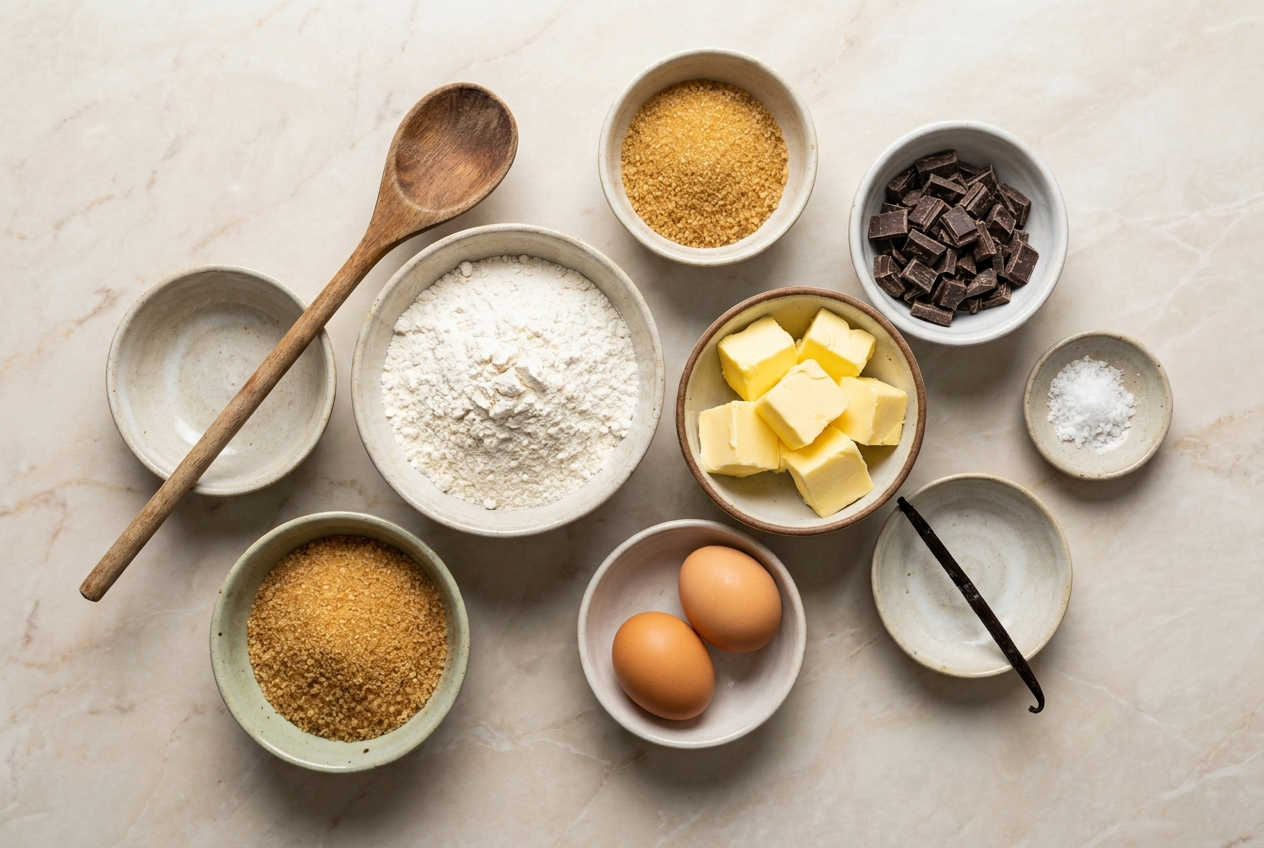
Chocolate chunks (not chips)
Chunks are irregular pieces of couverture chocolate, larger and more melt-in-your-mouth than standard industrial chips. Regular chips are stabilized so they don't melt — they hold their shape but deliver a drier result.
At G. Detou, we recommend:
- Callebaut milk chocolate callets 823 : melt perfectly, smooth rounded flavor
- Callebaut dark chocolate callets 811 55%: for a more grown-up cookie
- Valrhona chunks (Guanaja 70% or Jivara 40%): the premium choice
For an exceptional cookie, roughly chop a block of couverture chocolate with a knife — the irregular shards create unexpected molten pockets throughout.
Butter
Use AOP (Protected Designation of Origin) unsalted butter from Charentes-Poitou or Isigny, melted and cooled — not softened. Melted butter produces a chewier, more tender cookie than room-temperature creamed butter. That's the Levain technique.
Sugars (brown and white)
The secret to softness lies in the brown sugar to white sugar ratio. Brown sugar (cassonade or vergeoise — both French brown sugars made from cane or beet respectively) contains molasses, which retains moisture and creates tenderness. White sugar gives you crispy edges. We use a 60% brown / 40% white split.
French cassonade works very well. Vergeoise brune gives a pronounced caramel note, perfect for a bold cookie.
Flour
Standard T55 all-purpose flour. No specialty blends, no complicated mixtures. A good pastry-grade wheat flour is all you need. Some American recipes call for bread flour (T65) for extra structure — marginally interesting, but not essential.
Eggs and salt
One whole egg plus one additional egg yolk. The extra yolk adds fat and tenderness. Finish the dough with fleur de sel (French sea salt), and sprinkle a little more on top just before baking — that sweet-salty contrast is what makes modern cookies so irresistible.
Step-by-step recipe (makes 12 cookies, 80 g each)






The method
Step 1
Melt the butter
Melt the butter gently in the microwave or in a small saucepan. Let it cool back to room temperature — it should be liquid but no longer warm. Butter that is too hot will cause the sugar to crystallize when combined.
Step 2
Cream the butter and sugars
In a large bowl, whisk the cooled melted butter with the brown sugar and white sugar for 1 to 2 minutes. The mixture should turn creamy and slightly pale: this emulsification is what gives the cookie its structure.
Step 3
Add the eggs and vanilla
Mix in the whole egg, then the yolk, then the vanilla. Whisk for another 30 seconds — the batter should be smooth and slightly airy.
Step 4
Incorporate the dry ingredients
In a separate bowl, combine the flour, baking soda, baking powder, and pinch of fleur de sel. Add to the wet mixture and fold in with a spatula until just combined: overmixing develops the gluten and produces tough cookies.
Step 5
Fold in the chunks
Add the chocolate chunks and fold in quickly with the spatula. Set aside about fifteen chunks to press on top before baking.
Step 6
Chill the dough
Cover the bowl with plastic wrap and refrigerate for at least 1 hour, ideally 12 hours, up to 72 hours maximum. This resting step makes all the difference: - flavors develop (delayed Maillard effect) - the butter re-solidifies, so the cookies hold their shape in the oven instead of spreading - the texture becomes just right — crispy outside, gooey inside
Step 7
Shape the dough balls
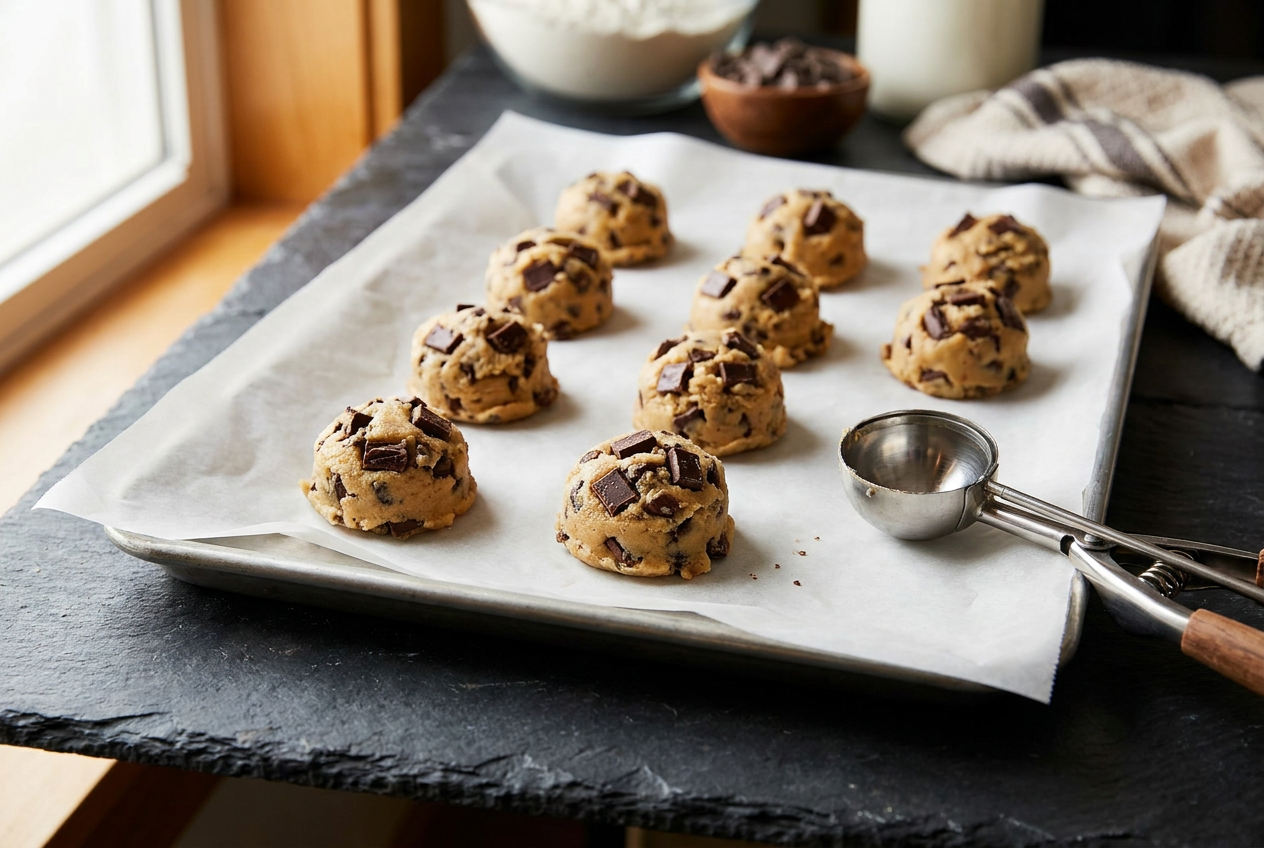
Preheat the oven to 400 °F (200 °C), convection setting. Portion the dough into 80 g balls and space them generously on a parchment-lined baking sheet (6 to 8 per sheet, as they will spread). Press a few reserved chunks into the top of each ball and finish with a pinch of fleur de sel.
Step 8
Bake hot and fast
Bake for 8 to 10 minutes at 400 °F (200 °C). The edges should be golden, while the center remains pale and slightly domed. Pull them out when they still look underdone: they will continue cooking on the hot pan and set into something wonderfully soft as they cool. Leave them on the baking sheet for 10 minutes before moving.
True enthusiasts make the dough in the evening, let it rest overnight, and bake the next day — the difference in flavor is spectacular.
Variations worth trying
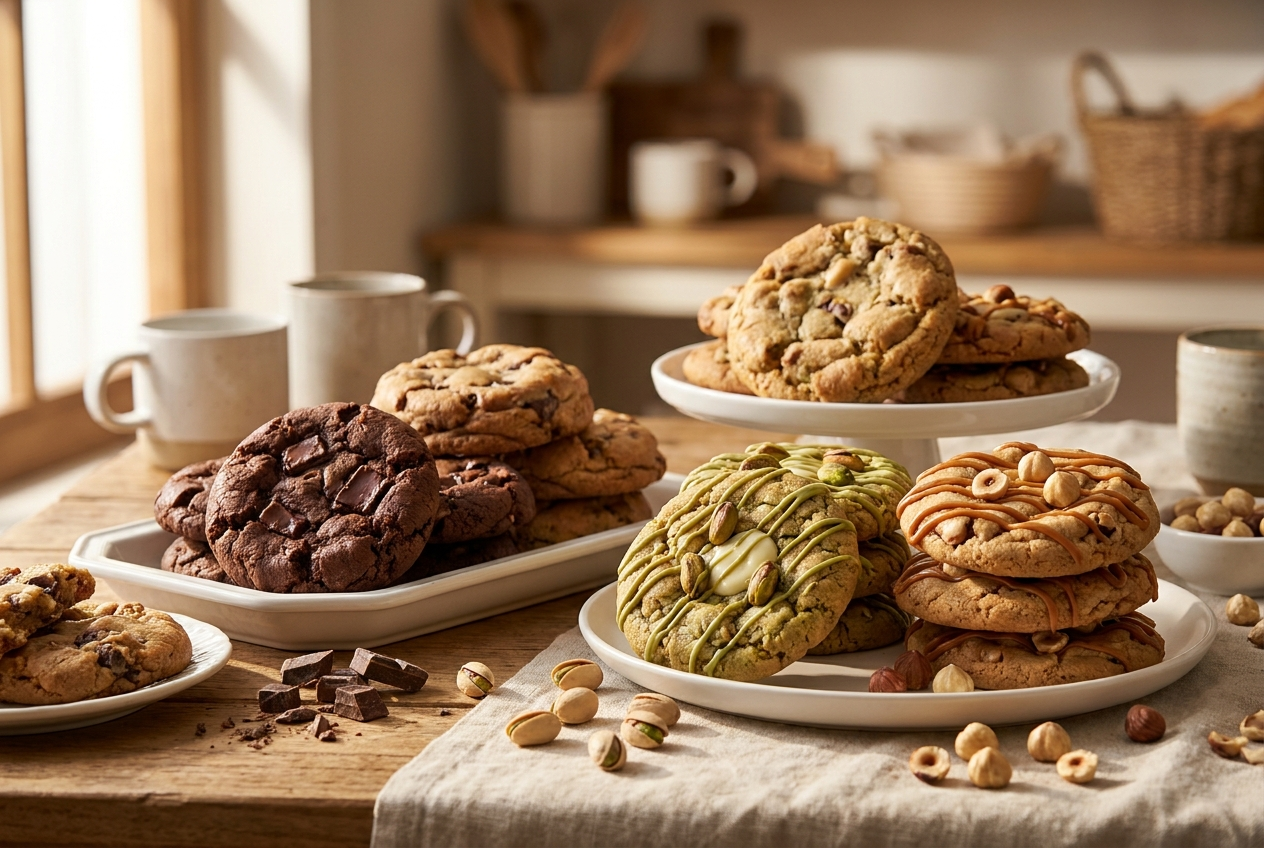
Double chocolate cookie
Replace the 40 g of flour with 40 g of unsweetened cocoa powder (Valrhona-type). Keep the chunks (or switch to white chocolate for contrast). It's an intense, dark cookie — absolutely to die for.
Pistachio and white chocolate cookie
Replace 80 g of chunks with 80 g of pistaches concassées non salées. Keep 170 g of chunks, but use Callebaut W2 white chocolate. A visual and flavor contrast that works beautifully.
Hazelnut and caramel cookie
Replace 100 g of chunks with 100 g of noisettes torréfiées concassées grossièrement. Ajoutez une cuillère à soupe de caramel beurre salé maison au cœur de chaque boule (enfoncez-la avant cuisson). Effet « cœur coulant » garanti.
Levain-style cookie (XL)
Portion the dough into 150 g balls instead of 80 g. Lower the oven to 190 °C (375 °F) and bake for 12 to 14 minutes. You get the full New York monster cookie — perfect for sharing or serving as a dessert.
Mistakes to avoid
- Skipping the dough rest. You will end up with flat, thin, bland cookies: the butter has not had time to re-solidify.
- Adding butter that is still too warm. It causes the sugar to crystallize and the cookies will spread too much.
- Using store-bought chocolate chips. The texture stays dry and you lose that melty quality.
- Overbaking. 10 minutes is the absolute maximum — cookies keep cooking off the heat. Overbaked cookies turn dry and crumbly.
- Overmixing the dough. The more you work the dough, the more gluten develops, and the tougher your cookies will be.
- Making the balls too small. Below 60 g, you have a standard cookie; below 40 g, you have a biscuit.
Storage
Cookies keep well for 3 to 4 days in an airtight container. They tend to dry out slightly over time — a useful trick: a wedge of apple placed in the container helps maintain moisture and keeps them soft.
Raw dough keeps for 72 hours in the refrigerator, or can be frozen as individual balls (ideal for baking a fresh cookie on demand). Bake straight from frozen, adding 2 extra minutes to the baking time.
What it costs
Approximately 6 to 8 € for 12 homemade cookies, using quality chocolate chunks and AOP butter. Compare that to the 3–4 € per cookie charged by Parisian bakeries selling New York-style XL cookies, or the 15–20 € for half a dozen at a high-end pâtisserie.
Where to find the right ingredients
At G. Detou, you will find everything you need for professional-level cookies:
- Couverture chocolate callets : Callebaut 823 milk chocolate, 811 dark chocolate, or Valrhona Jivara and Guanaja
- Noisettes et pistaches entières for the variations
- Cacao en poudre Valrhona for the double chocolate version
- Fleur de sel de Guérande
- Quality bourbon vanilla extract
For cassonade, vergeoise brune, and T55 flour, any well-stocked grocery store will do.
G. Detou's tip
The secret to a soft cookie that stays tender for days is the sugar. The base recipe calls for 60% brown sugar, but if you want lasting softness, push it to around 70% cassonade or muscovado — brown sugar holds onto moisture through its molasses content. On rue Tiquetonne, we carry pure muscovado from Mauritius: a cookie made with that sugar is distinguishable in a blind tasting from one made with plain white sugar. Pair it with real couverture chocolate chunks, and you have at home the kind of cookie that sells for a small fortune at the New York-style bakeries now scattered across Paris.
FAQ — Soft cookies
Three likely culprits: butter that was still too warm when mixed, no dough resting time, or an oven that wasn't hot enough. The combination of a proper chill and 200 °C (400 °F) solves 99% of cases.
Either you overmixed the dough (too much gluten development) or overbaked them. 8 to 10 minutes at 200 °C (400 °F) is the absolute maximum. They should look slightly underdone when you take them out of the oven.
Cassonade is a light brown sugar made from sugar cane, similar to what Americans know as light brown sugar. Vergeoise is a darker brown sugar derived from sugar beet, with a more pronounced caramel character. Both work well in this recipe. Vergeoise gives a slightly deeper, more amber-toned, caramel-flavored cookie.
It works, but the cookies will be slightly drier. The extra yolk contributes fat and tenderness. If you only have one egg, compensate by adding 10 g of melted butter.
1 hour in the refrigerator. Any less, and the butter won't have time to re-solidify, causing the cookies to spread. 12 to 24 hours is the sweet spot for both flavor and texture. Beyond 72 hours, the dough starts to oxidize.
Absolutely. Let them cool completely, freeze them in a single layer on a baking sheet, then transfer to a freezer bag. Thaw for 30 minutes at room temperature, or microwave for 20 seconds for that just-baked effect.
Absolutely. Kids love rolling the dough into balls and pressing in the chunks. Let them handle the mixing, shaping, and decorating. Keep the hot pan to yourself.
Once you have tasted a truly soft, homemade cookie, it's very hard to go back to the packaged kind. The difference comes down to three things: real couverture chocolate chunks, a dough rest that genuinely changes everything, and a short bake at high heat.
Jetez un œil à notre guide to chocolate chips and chunks qui compare les différentes marques. Chez G. Detou, on a souvent quelques cookies en dégustation en boutique — passez voir.
To go further: browse our full Chocolate & Confectionery selection.