


Tarte Tatin is one of the most iconic French pastries — and also one of the most poorly executed in the blogosphere. The real thing, the one made by sisters Stéphanie and Caroline Tatin at Lamotte-Beuvron (since 1898), calls for a pâte brisée (a short-crust pastry, not puff pastry), a deep amber caramel (not a pale syrup), and above all, apples cooked low and slow until they release their juices and become almost candied. The final flip — that slightly nerve-wracking moment when you invert the tart — reveals a golden, glistening dome of apples arranged like a rosette.
Over the years at G. Detou, we've seen every version imaginable — from the rushed tart thrown together with Granny Smiths, to the Michelin-starred rendition with vanilla, calvados, and artisan ice cream. What follows is the classic recipe, one that honors the original technique, along with three or four variations genuinely worth trying.
This appears to be just a title/heading without any French content to translate. Could you please provide the French text you'd like me to translate?
The official story goes that in 1898, at the Hôtel Tatin in Lamotte-Beuvron, Stéphanie Tatin (or Caroline, depending on the version) forgot to line the pan with pastry before adding the apples. To salvage the situation, she laid the dough over the already-caramelizing apples and put the whole thing in the oven as-is. When it came time to serve, she flipped the tart. The guests were delighted. The tarte Tatin was born.
Historically speaking, similar recipes already existed under other names in the Berry region ("pâte aux pommes retournée," or upside-down apple tart). The Tatin sisters are credited above all with popularizing the modern version and lending it their name.
The three pillars of a proper tarte Tatin
It looks like the fragment you'd like me to translate is just a title or heading — "Choosing the right apples" — which is already in English. Could you please share the full French HTML fragment you'd like translated? I'll be happy to help!
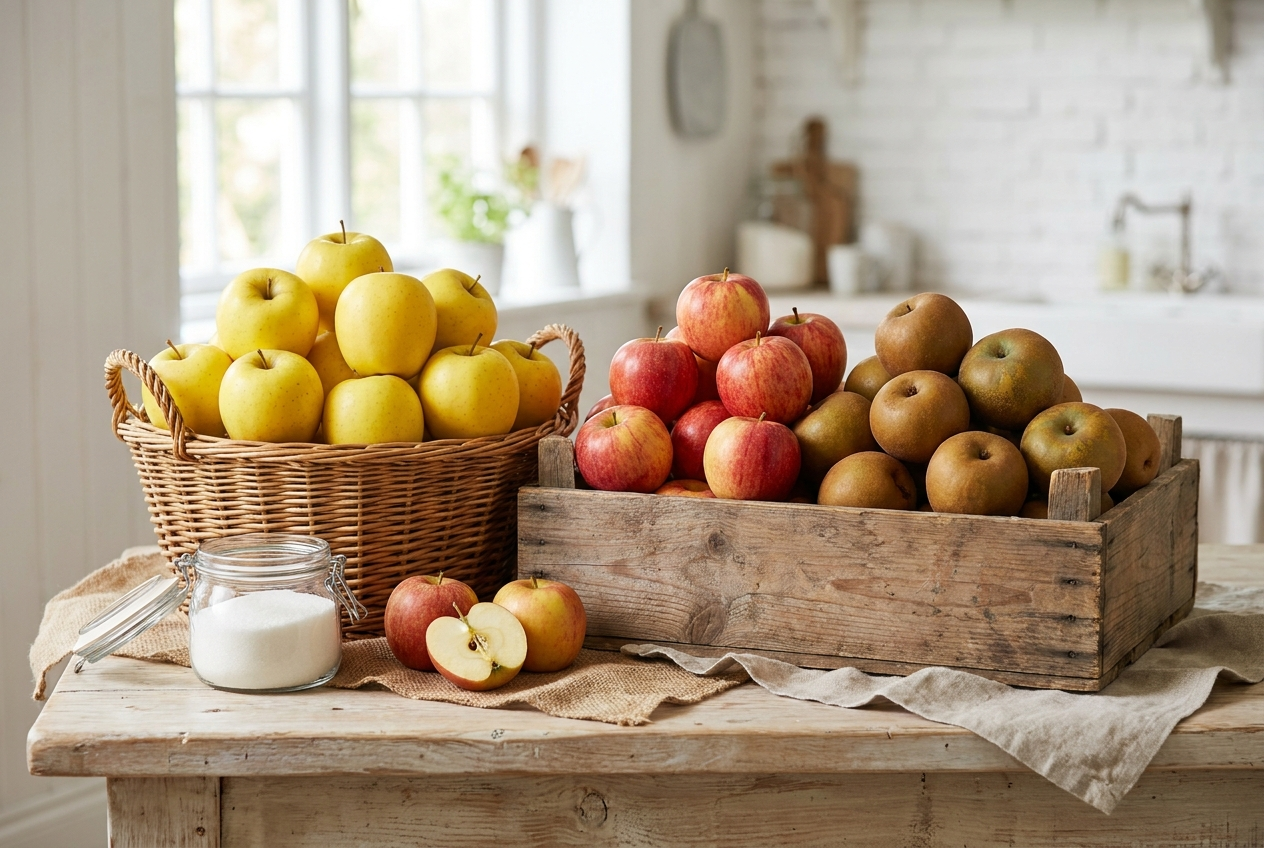
Mistake #1: using apples that turn to mush when cooked (Golden Delicious, Gala). They give you applesauce, not a tarte Tatin. You need firm, tart varieties that hold their shape through cooking while readily absorbing the caramel.
The go-to varieties: - Reinette du Canada: the professional's choice. Tart, firm, holds its shape beautifully. - Reinette grise du Canada: rarer, more aromatic — ideal when you can find it. - Boskoop: tart, firm, perfect texture. - Chantecler: versatile, holds up well to cooking.
Avoid: Golden Delicious, Gala, Pink Lady — too sweet and too soft.
The caramel
A proper tarte Tatin caramel is deep amber, complex — not a pale blond syrup. It's made directly in the pan (not separately), with sugar, butter, and sometimes a touch of vanilla. The cooking process develops notes of beurre noisette (brown butter) that give the tart its characteristic depth.
The pastry
Pâte brisée (short-crust pastry) is the most traditional choice, and what we recommend for an authentic Tatin. It absorbs less liquid than puff pastry and stays true to the original texture. Puff pastry appears in modern interpretations — crispier, more dramatic, but less faithful to the original.
I need the actual French text/HTML fragment to translate. Could you please share the French content you'd like me to translate?
The apples
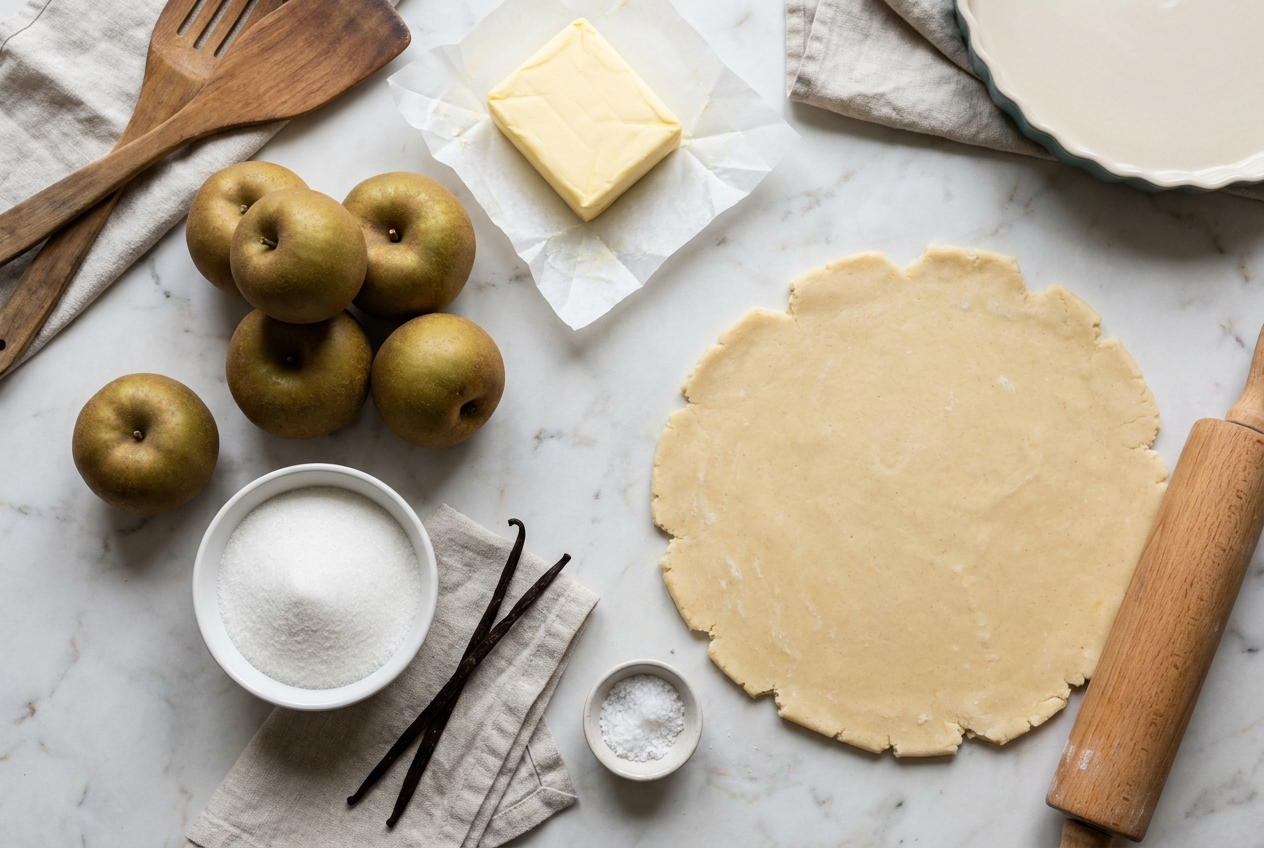
6 to 8 medium Reinette apples. Plan on roughly 1.2 to 1.4 kg (2¾–3 lb) of apples for a 24 cm (9½-inch) pan. The apples will shrink by about half during cooking — pack them in tightly.
The butter
AOP-certified French butter (Charentes-Poitou or Isigny), 80 to 100 g (3–3½ oz). The butter is an integral part of the caramel's flavor.
The sugar
Plain white granulated sugar, 150 to 180 g (¾–1 cup). Some bakers add a little brown sugar for a more pronounced caramel note.
Vanilla (optional)
Half a vanilla Bourbon vanilla adds an extra dimension. Not present in the original recipe but now a classic in modern versions.
Fleur de sel
A pinch of fleur de sel In the caramel elevates everything. An elegant modern touch.
The pastry
Pâte brisée (recipe below) or all-butter puff pastry (store-bought or homemade).
Tarte Tatin recipe (24 cm / 9½-inch pan, serves 8)
Prep: 40 min (+ 30 min pastry rest) · Baking: 45 to 55 min
I need the actual French text/HTML fragment to translate. Could you please share the French content you'd like me to translate?





For the pâte brisée


Equipment
- Copper Tatin pan (ideal) or cast-iron skillet that can go in the oven
- Probe thermometer (recommended)
- Vegetable peeler
- Wooden spatula
# The Pâte Brisée
I need more context to translate. Could you please provide the French text (Fragment FR) that you'd like me to translate?
Cut in the butter
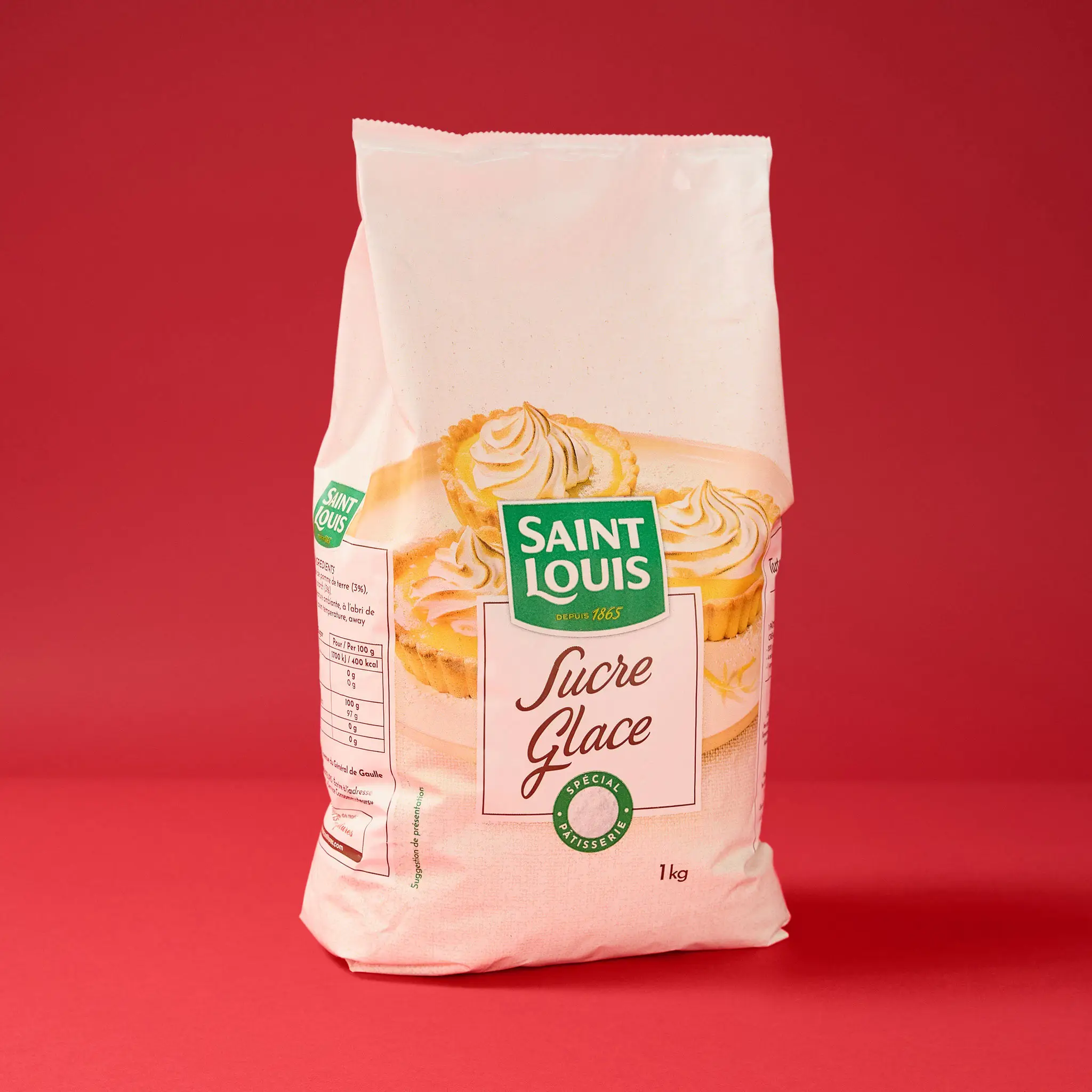
Work the flour, cold diced butter, confectioners' sugar, and pinch of salt together by hand or in a stand mixer until you get a rough, crumbly texture.
Step 2
Bring the dough together
Add the egg yolk and cold water. Mix just until a ball forms — don't overwork it.
Step 3
Rest in the refrigerator
Wrap in plastic wrap and refrigerate for at least 30 minutes (ideally 1 hour).
I need the French text to translate. Could you please provide the French fragment you'd like me to translate?
I need more context to translate. Could you please provide the French text (Fragment FR) that you'd like me to translate?
Peel the apples
Peel the apples and remove the cores with a knife or apple corer.
Step 2
Cut into wedges
Cut into quarters or sixths, depending on size.
Step 3
Set aside
Place in a bowl. No need to add lemon juice — they won't oxidize during preparation.
Making the caramel in the pan
I need more context to translate. Could you please provide the French text (Fragment FR) that you'd like me to translate?
Add the sugar
Pour the sugar into the Tatin pan set over medium heat.
Step 2
Add the vanilla
Add the vanilla seeds (and pod) if using.
Step 3
Let it caramelize
Allow to melt without stirring. The sugar will liquefy, then begin to turn golden.
Step 4
Add the butter
When the caramel reaches a deep amber color (around 356°F / 180°C), add the diced butter.
Step 5
Stir together
Stir with the spatula — watch out for splattering. The butter will cause the caramel to bubble vigorously.
Step 6
Season
Remove from heat. Add the pinch of fleur de sel (if using).
It looks like the text you'd like me to translate is missing or incomplete. Could you please provide the French HTML fragment you'd like translated?
I need more context to translate. Could you please provide the French text (Fragment FR) that you'd like me to translate?
Arrange in a rosette
Arrange the apple wedges in the hot caramel in a tight rosette pattern, rounded side down for the first layer. Fill any gaps with a second layer as best you can.
Step 2
Pack them in
Press down firmly — the apples will shrink considerably during cooking, so you really do need a lot of them.
Step 3
Fill to the rim
Remplissez le moule jusqu'au bord, voire légèrement au-dessus.
Pre-cooking the apples
I need more context to translate. Could you please provide the French text (Fragment FR) that you'd like me to translate?
Cook over medium heat
Return the pan to medium heat for 20–25 minutes.
Step 2
"Let the apples confit"
The apples will release their juice and gradually candy in the caramel.
Step 3
Could you please provide the French text fragment you'd like me to translate? It seems the content didn't come through in your message.
The juices will reduce. By the end, there should be very little liquid remaining and the apples should look translucent and caramelized.
A critical point: this pre-cooking step is non-negotiable. It makes all the difference between a mediocre Tatin and an exceptional one. Skip it, and the apples will release their juices in the oven, turning the pastry soggy.
Adding the pastry and baking
I need more context to translate. Could you please provide the French text (Fragment FR) that you'd like me to translate?
Preheat the oven
Preheat the oven to 200 °C (390 °F), conventional (static) heat.
Step 2
Roll out the pastry
Roll the dough to a thickness of 3–4 mm, into a disc slightly larger than the pan.
Step 3
Cover the apples
Lay the pastry over the apples, tucking the edges inward between the apples and the sides of the pan — this creates a "rim" that will contain the juices when you flip the tart.
Step 4
It looks like your message may be incomplete — I don't see a French fragment to translate here. Could you please share the French HTML text you'd like me to translate?
Prick the pastry lightly with a fork in 5–6 places to allow steam to escape.
Step 5
Bake
Bake for 25–30 minutes, until the pastry is well golden.
I need the French text to translate. Could you please provide the French fragment you'd like me to translate?
I need more context to translate. Could you please provide the French text (Fragment FR) that you'd like me to translate?
Let it rest
Take the tart out of the oven. Let it rest for 5 minutes — no more, no less.
Step 2
Place a serving dish on top
Set a large serving plate upside down over the pan.
Step 3
Flip in one confident move
Invert in a single decisive motion, holding the pan and plate firmly together.
Step 4
Unmold
I notice this text appears to already be in English. However, since you've asked me to translate French to English, and the text provided seems to already be in English (or perhaps was accidentally submitted), here it is as-is: Gently lift the pan away — the apples should stay on the plate, blanketed in golden caramel.
If a few apples have stuck to the pan, carefully lift them out and place them back on the tart. A spoonful of warm caramel smoothed over the top and no one will notice a thing.
Serving
Tarte Tatin is best served warm, ideally 15–20 minutes after flipping. Accompany with:
- Heavy crème fraîche (the rustic classic)
- Homemade vanilla ice cream (the restaurant version)
- Lightly sweetened whipped cream
- Crème anglaise (a poured custard sauce) for the purists
It seems like you've sent an English title rather than a French fragment to translate. Could you please provide the French HTML fragment you'd like me to translate?
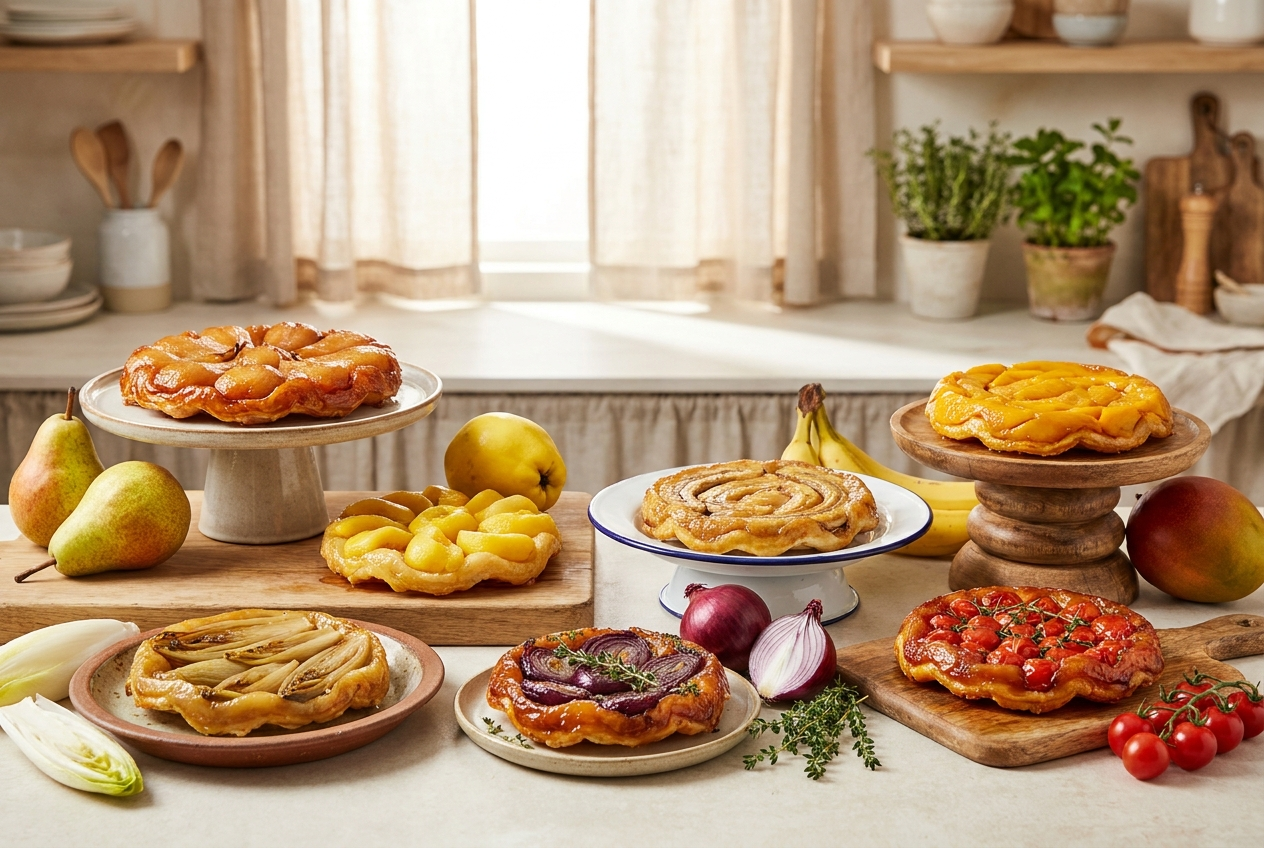
Pear Tatin
Swap the apples for firm Williams or Comice pears. The cooking time is slightly shorter (15–20 minutes). The flavor is gentler, more tender — magnificent in season (October through December).
Quince Tatin
Use peeled, cored quinces, cut into wedges. They require a longer pre-cook (35–40 minutes) because of their density. The result has a distinctive rosy hue and an unmatched fragrance. Season: September through November.
Banana-rum Tatin
Firm bananas cut into thick rounds. The caramel is spiked with dark rum (1 tablespoon added off the heat). An exotic variation with real crowd appeal.
Mango Tatin
Firm, slightly underripe mangoes cut into wedges. Caramel scented with vanilla and Timut pepper. A contemporary take.
Savory Tatin (endives, tomatoes, onions)
For savory applications: braised endives with Parmesan, or cherry tomatoes with thyme, or caramelized red onions. Use balsamic vinegar in place of plain sugar in the caramel. A sophisticated and original starter.
Common mistakes to avoid
- Using apples that fall apart. Guaranteed applesauce. Reinette, Boskoop, or Canada varieties only.
- Skipping the pre-cook in caramel. The apples will release their juices in the oven and leave you with a soggy crust. A minimum of 20 minutes over medium heat is essential.
- Flipping immediately after baking. The tart is too hot and the caramel is still sticking. Wait 5 minutes.
- Waiting too long before flipping. The caramel sets and the tart won't release from the pan. Flip between 5 and 10 minutes after baking — no later.
- Using a pan without a flat base. The caramel won't form evenly. A proper Tatin pan or a cast-iron skillet is non-negotiable.
# How to rescue a tart that's stuck in the pan
It happens. The caramel cooled too quickly and the tart won't release.
The fix: return the pan to low heat for 2–3 minutes. The caramel will melt again and the tart will release. Try flipping again.
If any apples are still stuck in the pan, lift them out with a wooden spatula and reposition them on the tart. A spoonful of hot caramel over the top and the repair is invisible.
Storage
Tarte Tatin is best eaten the same day, ideally within 2 hours of baking. Beyond that, the pastry begins to soften as it absorbs the caramel.
If you need to prepare ahead, pre-cook the apples the day before, refrigerate overnight, then top with pastry and bake on the day of serving.
Reheating: 10 minutes at 150 °C (300 °F) to bring the tart back to the ideal warmth. Avoid the microwave — it turns the pastry limp.
I'm here to translate French→English content for the G. Detou blog. Could you please provide the French HTML text you'd like me to translate?
A homemade tarte Tatin for 8 comes in at roughly $8–$12 depending on the apples and the quality of the butter — compared to $35–$45 for an average bakery version.
Where to find the ingredients
At G. Detou, 58 rue Tiquetonne, Paris 2nd arrondissement:
- Bourbon vanilla beans from Madagascar to flavor the caramel
- Fleur de sel de Guérande I need the French fragment to translate. Could you please provide the French text you'd like me to translate?
- Timut pepper for the exotic variations
- Dark rum for the banana-rum Tatin
For Reinette apples, look to a good greengrocer in the Montorgueil neighborhood. For AOP butter, the fromagerie next door does the job perfectly.
I need the French fragment you'd like me to translate. Could you please share the text?
A proper tarte Tatin rests on three pillars — let any one of them fail and you'll end up with something closer to a compote. First: the apple — Reinette du Canada or Boskoop, never a Golden Delicious, which simply dissolves. Second: the caramel, made directly in the pan with butter, cooked all the way to deep amber (not a pale blond syrup). Third: a well-chilled pastry that won't go soft, and the apple pre-cook that drives off the excess juice before the tart ever sees the oven. We always keep AOP Charentes-Poitou butter at rue Tiquetonne — the kind the pastry chefs come to us for. It's that butter, pushed to the edge of beurre noisette (brown butter), that gives the caramel its depth.
FAQ — Tarte Tatin
Yes — it's actually a very common variation. The result is crispier and more dramatic, if less traditional. Choose an all-butter puff pastry; pastry made with palm oil produces a flat, characterless crust.
No. A bitter caramel can't be saved. Start over — and this time, watch the color closely. The moment it turns deep amber, pull it off the heat.
Either the pre-cook wasn't long enough (allow a full 20–25 minutes in the caramel before the oven), or the apples were too unripe. The ideal Reinette has just a hint of maturity to it.
Insufficient pre-cooking of the apples, or a pan that isn't tight enough. The apples must have fully released and reduced their juices before the pastry goes on top.
Not ideal. The caramel doesn't thaw well and the texture suffers. Instead, pre-cook the apples the day before and refrigerate overnight, then bake with the pastry on the day of serving.
The main hazard: the pan and the caramel are both extremely hot. Use thick oven mitts and commit to the move. One single, confident flip — no hesitation.
Absolutely — use 10 cm (4-inch) pans or ramekins. Pre-cook for 10 minutes instead of 20, and bake for 20 minutes instead of 30. Great for plated desserts, and considerably less stressful to flip.
Homemade Bourbon vanilla (using a G. Detou pod) remains the unbeatable classic. For a more original twist: salted butter caramel ice cream, gingerbread ice cream in winter, or quince sorbet if you're making a quince Tatin.
Tarte Tatin is the kind of dessert that separates those who truly love French pastry from those who merely admire it from a distance. Master the apple pre-cook, the deep caramel, and the flip — and you'll have a timeless classic in your repertoire, one that draws unanimous praise at the table and sells for $40 at a serious pâtisserie.
At G. Detou, Tatin season runs all autumn and winter long. We always have exceptional vanilla beans and the right fleur de sel on hand — come find us.
To go further: browse our full Vanilla selection.