


Mycryo butter is one of the best-kept secrets among professional pastry chefs. This pure cocoa butter powder, developed by Cacao Barry, transforms chocolate tempering — the most dreaded technical step for home bakers — into a precise, repeatable process. No more perfect temperature curves, no more tabling on marble. Just add 1% Mycryo, and your chocolate is tempered.
At the counter of 58 rue Tiquetonne, we've seen dozens of enthusiasts go from "I can't get my chocolate tempered" to "I make my Easter eggs stress-free" simply by adopting this powder. Here's everything you need to know to master it.
What is Mycryo butter?
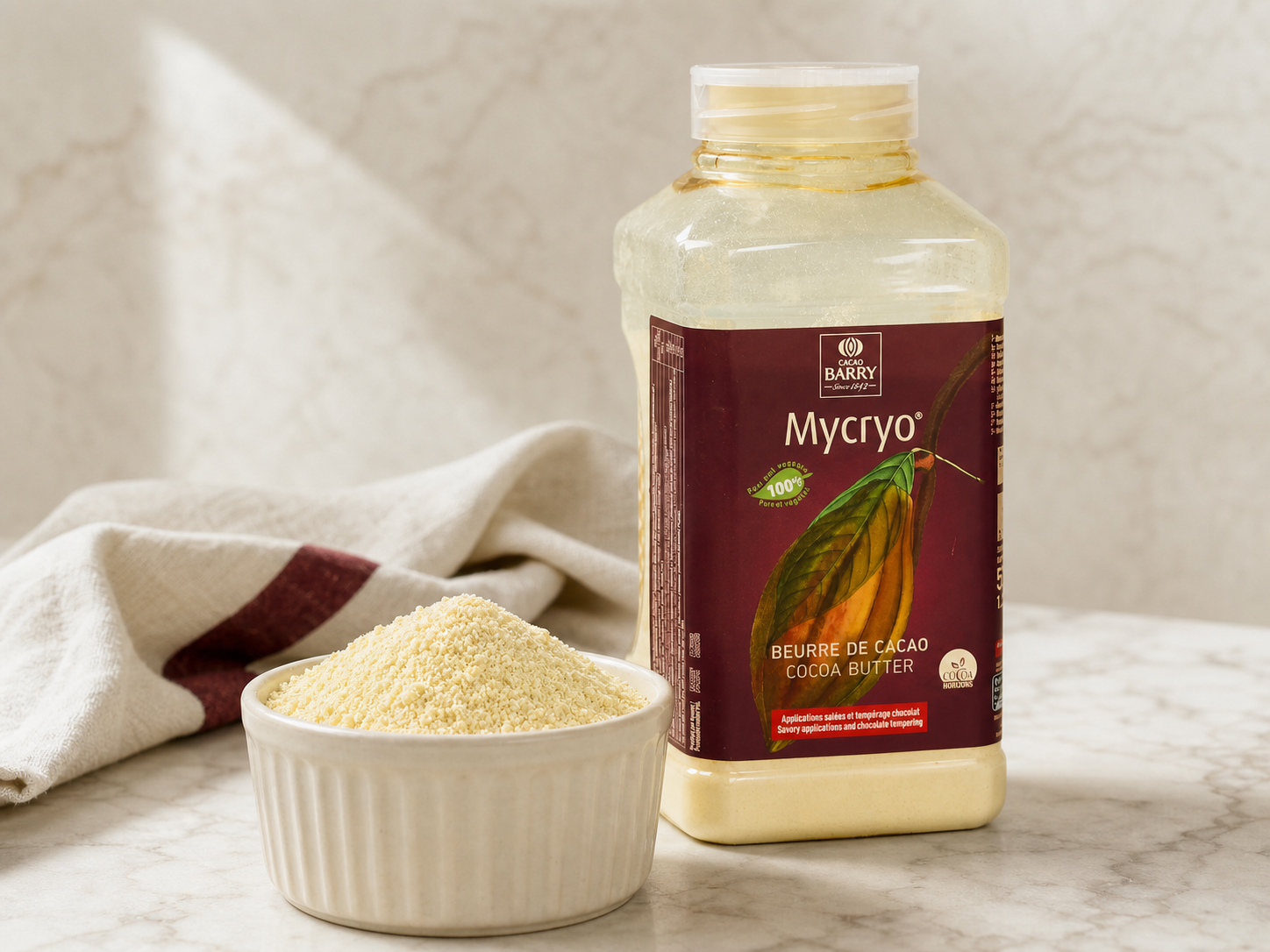
Mycryo is 100% pure cocoa butter, atomized into a fine powder and crystallized in its stable beta V form. That last step is what makes all the difference: by pre-crystallizing the cocoa butter before use, Mycryo "transmits" its crystal structure to melted chocolate within minutes.
Developed by Cacao Barry in the early 2000s, Mycryo (a contraction of "mycro" = fine powder and "cryo" = cold-crystallized) was designed to solve one of chocolate-making's oldest challenges: how to achieve glossy, snappy chocolate without the constraints of tabling on a cold marble slab — a messy, time-consuming technique that takes years to master.
Mycryo powder comes in 600 g bags (professional format) or 100 g bags (home use), with a distinctive pale yellow color. Stored in a dry place at room temperature, it keeps for several years.
How chocolate tempering works
Before getting into Mycryo, it helps to understand why tempering exists in the first place.
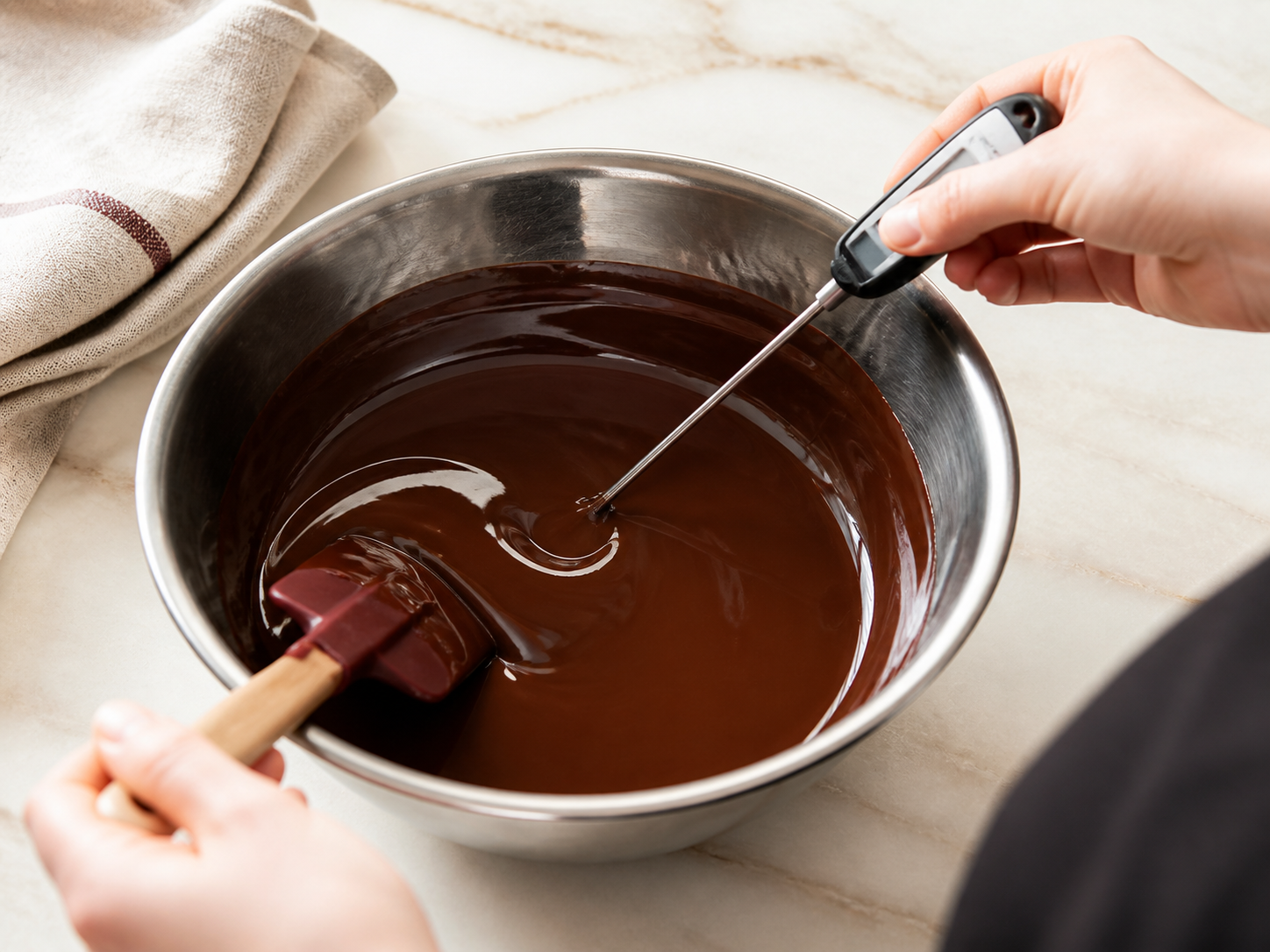
Cocoa butter can form several crystal structures (labeled I through VI), each developing at different temperatures. Only Form V (beta V) delivers the properties we expect from chocolate: gloss, a clean snap, melt-in-the-mouth texture at 91–93 °F (33–34 °C), and long-lasting stability without blooming.
Classic tempering involves:
- Melting the chocolate to 113–122 °F (45–50 °C) to destroy all existing crystal forms
- Cooling to 81–82 °F (27–28 °C) to allow all crystal types to re-form
- Rewarming to 88–90 °F (31–32 °C) to eliminate all but the desired Form V crystals
It's an exacting process. A half-degree error in either direction and the chocolate blooms or loses its shine. That's why most home cooks fail at tempering on their first try.
Mycryo short-circuits the whole process: you're introducing the right crystals (Form V) directly, in powder form. Melt your chocolate to 104–113 °F (40–45 °C), let it cool to 93–95 °F (34–35 °C), stir in 1% Mycryo, and it's tempered. No complex temperature curve, no marble slab.
Step-by-step method
Equipment you'll need
- A stainless steel or glass mixing bowl
- A probe thermometer (widely available at kitchen and baking supply stores)
- A scale accurate to the gram
- A silicone spatula (maryse)
- A saucepan for a double boiler (bain-marie), or a microwave
The steps
- Weigh the ingredients. For 500 g of couverture chocolate: 5 g of Mycryo (1% of the weight).
- Melt the chocolate. Use a double boiler or microwave (medium power, in 30-second intervals, stirring between each). Target temperature: 104–113 °F (40–45 °C) for dark chocolate, 104–108 °F (40–42 °C) for milk, 100–104 °F (38–40 °C) for white.
- Let it cool. Remove from heat and stir regularly to prevent premature crystallization. Wait until the chocolate reaches 93–95 °F (34–35 °C) for dark, 91–93 °F (33–34 °C) for milk, 88–90 °F (31–32 °C) for white.
- Add the Mycryo. Sprinkle the 5 g of Mycryo over the chocolate at the correct temperature. Gently fold with the spatula until fully dissolved (1–2 minutes).
- Check the temper. Dip the tip of a knife into the chocolate and set it on a cool surface. After 3–4 minutes, the chocolate should have set: a matte-to-glossy surface with no white streaks, and it should release cleanly from your finger.
- Work within the window. Your tempered chocolate is now ready for molding, enrobing, or pouring. You have roughly 15–20 minutes before it becomes too thick to work with. If needed, bring it back briefly over the double boiler to return it to 90–91 °F (32–33 °C).
Compared to other methods
| Method | Difficulty | Time | Reproducibility |
|---|---|---|---|
| Marble tabling | ★★★★★ | 30–45 min | Variable (highly technique-dependent) |
| Seeding (solid chocolate) | ★★★ | 20 min | Good (but a narrow margin for error) |
| Mycryo | ★★ | 10–15 min | Excellent |
| Electric tempering machine | ★ | 10 min (plus 30 min warm-up) | Excellent |
For a home cook who wants to make Christmas chocolates or Easter eggs without investing $900+ in a tempering machine, Mycryo is by far the best option.
Uses beyond chocolate
While its primary purpose is chocolate tempering, Mycryo butter has other compelling applications:
- Searing meats and fish: dusted onto sea bass or duck breast before cooking, Mycryo creates a buttery, caramelized crust without the spattering of liquid fat.
- Coating fruit before dipping: for chocolate-dipped strawberries, dust the fruit with Mycryo before dipping — the natural moisture of the fruit no longer breaks the chocolate coating.
- Stable ganaches: adding 0.5% Mycryo to a whipped ganache (ganache montée) improves both its hold and its sheen.
- Creams and emulsions: used to stabilize complex emulsions in advanced pastry work.
These applications are routine in Michelin-starred kitchens, yet largely unknown to the general public. In more ways than one, Mycryo is a hidden gem.
Common mistakes
- Using too much Mycryo (2% or 3%). The instinct is to think "more is better"; in practice, the opposite is true. Too much powder makes the chocolate thick, pasty, and difficult to work with. Stick strictly to 1%.
- Adding Mycryo when the chocolate is too hot (>100 °F / 38 °C). The Mycryo crystals melt and lose their stable form. Always respect the 88–95 °F (31–35 °C) window depending on chocolate type.
- Adding Mycryo when the chocolate is too cold (<88 °F / 31 °C). The crystals won't disperse evenly and will clump. Gently rewarm the chocolate first, then incorporate.
- Not stirring long enough. The first grains initiate crystallization, but you need to stir for a full 1–2 minutes to achieve an even distribution. Otherwise, some areas set and others don't — resulting in a streaky, blotchy surface.
- Storing Mycryo in the refrigerator. Unnecessary and counterproductive. The powder absorbs moisture and loses its effectiveness. Keep it at room temperature in an airtight bag, away from light.
Cost and where to buy
Cacao Barry Mycryo butter is priced approximately as follows:
- 100 g bag: $20–25 (≈ $90/oz) — ideal for occasional home use
- 600 g bag: $65–85 (≈ $50–57/oz) — suited for regular bakers and pastry enthusiasts
At that price, a 100 g bag is enough to temper 10 kg of chocolate — more than enough to cover a full season of Easter eggs, bonbons, and homemade chocolate bars. The cost per use is negligible.
At G. Detou, we carry Mycryo in store at 58 rue Tiquetonne and on gdetou.com, in 100 g and 600 g bags. Some of our professional chocolatier customers buy several kilos a month.
G. Detou's take
Mycryo is the invention that brought professional chocolate tempering into the home kitchen. Before it existed, you needed a marble slab, a precise thermometer, and 30 minutes of tabling per kilo — a genuine ordeal for home cooks. We've carried Mycryo at G. Detou since it first came on the market, and the difference is undeniable: customers who make the switch succeed with their bonbons and Easter egg molds on the very first try. For just 1% of your chocolate's weight, you save 25 minutes.
FAQ — Mycryo butter
Yes, in the vast majority of cases. There are certain highly technical applications — chocolate sculpture, some very thin molds — where top-level chocolatiers still prefer tabling for absolute precision and control. But for everything else — molds, enrobing, chocolate bars, bonbons — Mycryo delivers equivalent or better results in half the time.
, Weiss, Barry of course, Callebaut, and even lower-quality chocolates. The richer the chocolate is in cocoa butter (couvertures at 38% and above), the cleaner the result. With a baking chocolate at 22% cocoa fat, the result will be acceptable but less glossy.
When the temper is successful (Form V crystals dominant), the chocolate retains its gloss and snap for several months at 61–64 °F (16–18 °C), away from light. Under proper storage conditions, expect 6 months with no visible change in appearance, and up to 12 months before gradual blooming begins.
No. It's pure cocoa butter — the same ingredient that already makes up 31–40% of couverture chocolate. At 1%, the addition is completely imperceptible on the palate.
Yes. If you let your chocolate set and then remelt it, you can re-temper by adding another 1% Mycryo. However, after 3–4 cycles, the chocolate starts to thicken and lose fluidity. Beyond that point, it's best used for preparations where shine isn't critical (mousses,
Cacao Barry offers both a standard and an organic version (slightly more expensive). Check the packaging: the organic certification is clearly labeled. In terms of flavor, there's no difference — just the assurance of certified sourcing.
A handful of brands have released their own versions — Weiss, Sosa Ingredients, Cluizel — under different names. The principle is identical and the practical differences are minimal. Cacao Barry remains the market reference and is the most widely available through pastry suppliers.
Technically, yes: take a block of cocoa butter, crystallize it very slowly at cold temperature (24–48 hours), then pulverize it while still cold. In practice, this requires specialist equipment for controlled crystallization — it's not something achievable in a home kitchen. You're far better off buying quality commercial Mycryo.
Mycryo is the invention that democratized professional chocolate work. For the price of a 100 g bag, you gain the ability to temper chocolate like a pro — without investing in a $900 tempering machine or spending years learning to table on marble. For professional pastry chefs working at volume, it's also a time-saver that translates directly into lower operational costs.
If you're new to working with chocolate, Mycryo is our top recommendation. If you're an experienced baker who's still on the fence, try it with a kilo: you'll be convinced.
Further reading
- How to temper couverture chocolate: a complete guide to the 3 methods — the classic method for comparison
- Chocolat de couverture : guide complet et comparatif Valrhona, Barry, Weiss — quel chocolat choisir avant de tempérer
- Homemade chocolate Easter eggs — the first classic application of Mycryo
- Chocolate Yule Log — Using Mycryo for a Shiny Decoration
And if you stop by 58 rue Tiquetonne in Paris (2nd arrondissement) or 12 rue du Plat in Lyon, we often have an open bag of Mycryo on the counter for a live demonstration.
To go further: browse our full Chocolate & Confectionery selection.