

Pectine is the gelling agent that separates skilled pastry chefs from the rest. It rarely gets airtime on mainstream cooking shows because it's technical — but the moment you step into a professional kitchen, or want to make a proper tart glaze, a glaçage miroir that truly shines, a clean pâte de fruits — you need it. The problem is that several varieties exist, each with its own uses, dosages, and quirks. And most blog recipes just say "pectin" without specifying which kind, leading to inconsistent results.
At G. Detou, we carry most of the pectins used in professional pastry work. We've put together this guide so you know exactly what you're buying, how to use it, and when.
What exactly is pectin?
Pectin is a natural fiber extracted primarily from apples and citrus fruits (especially the peel). It's a polysaccharide with the ability to gel when heated in the presence of sugar and an acidic medium (fruit juice, citric acid).
Contrairement à la gélatine (which comes from animal collagen), pectin is 100% plant-based, suitable for vegetarian and vegan diets. It gels when hot (during cooking) and stays stable after cooling — gelatin, by contrast, sets only as it cools.
There are several families of commercial pectin, each with distinct properties:
- HM Pectin (High Methoxyl): requires a high sugar content and acidity to gel. The classic choice for jams and pâtes de fruits.
- LM Pectin (Low Methoxyl): gels with less sugar, compatible with reduced-sugar recipes. Less common in pastry work.
- NH Pectin: derived from LM pectin, specifically engineered for modern pastry. Sets when heated, re-melts when reheated.
- Yellow pectin: artificially colored, used specifically for traditional pâtes de fruits.
- X58 Pectin: a fast-acting variant, used for quick glazes and mirror coatings.
The four pectins you need to know
1. NH Pectin (or NH95)
The essential pectin for modern pastry.
Primary uses:
- Fruit tart glazes (apricot, strawberry, etc.)
- Mirror glazes for tartlets, éclairs, and entremets (French layered mousse cakes)
- Gelled inserts for entremets
- Modern low-sugar jams
What makes it special: NH pectin is thermoreversible. Heat it, and it sets as it cools. Reheat it, and it melts again — then re-sets when cooled. This is precisely what allows you to make glazes you can warm up and spread as needed.
Standard dosage: 1 to 1.5% of the total weight of the glaze (10 to 15 g per kilogram).
How to use it:
- Combine NH pectin dry with 5 to 10 times its weight in sugar (this prevents lumps)
- Rain the dry mixture into the liquid (juice, coulis, purée) at 104°F (40°C), whisking constantly
- Bring to a full rolling boil for 1 to 2 minutes
- Use immediately while hot, or set aside for later
Price: €40–€70/kg in professional packaging.
2. Yellow pectin
For traditional pâtes de fruits.
This is an HM pectin that has been artificially colored yellow for pastry use (the coloring is its only additive). It sets slowly and requires heat + high sugar content (70–75%) + acidity to gel. It is the industry standard for all classic pâtes de fruits.
Primary uses:
- Pâtes de fruits (raspberry, apricot, pear, lemon, etc.)
- Traditional high-sugar jams
Dosage: 1 to 2% of total weight. Always used in combination with citric acid added at the end of cooking to trigger setting.
Price: €30–€50/kg.
3. X58 Pectin
For quick glazes and instant coatings.
A fast-acting variant of LM pectin, frequently used in professional pastry kitchens to glaze tarts straight out of the oven, or to smooth the surface of entremets.
Primary uses:
- Neutral or colored glazes that set within minutes
- Transparent coatings for thin fruit tarts
- Setting fragile garnishes (sliced fruit, fresh herbs)
Application is similar to NH pectin, but at a slightly lower dosage (0.5 to 1%). It sets faster than NH, so don't let it sit too long before use or it will begin to firm up.
Price: €50–€80/kg.
4. 325NH95 Pectin (and related grades)
For entremets mirror glazes.
This pectin combines properties of NH and HM pectins to produce exceptionally shiny mirror glazes with outstanding stability — holding up well through transport and freezing.
Primary uses:
- Mirror glazes for bûches de Noël (French Christmas log cakes), entremets, charlottes
- Opaque colored glazes
- Gelled inserts with cold-stable structure
Dosage: 1 to 1.5%. Mix with 10 times its weight in sugar before incorporating.
Price: €60–€90/kg.
Quick comparison chart
| Pectin | Primary use | Dosage | Setting speed | Thermoreversible |
|---|---|---|---|---|
| NH / NH95 | Tart glazes, mirror coatings, gelled inserts | 1–1.5% | Fast | Yes |
| Yellow | Pâtes de fruits, high-sugar jams | 1–2% | Slow | No |
| X58 | Quick glazes, garnish setting | 0.5–1% | Very fast | Partial |
| 325NH95 | Entremets mirror glazes | 1–1.5% | Fast | Yes |
Alternatives to pectin
Gelatin (sheets or powder)
Gelatin sheets (200–250 bloom) are the most widely used gelling agent in French pastry. Animal-derived (bovine or porcine), they set only upon cooling and are not thermoreversible (once reheated, the gel will not re-set on its own).
Dosage: 1 to 2 sheets (2 to 4 g) per 100 ml of liquid, depending on desired texture.
Advantages: easy to measure, widely available, predictable results. At G. Detou, we carry professional-pack gelatin sheets.
Agar-agar
Derived from seaweed, 100% plant-based. It sets firmer than gelatin but yields a more brittle, less supple texture. Perfect for jellies such as vegan panna cotta, less suited to glazes (too firm). See our gelatin vs. agar-agar comparison guide for full details.
Grocery store pectin
Sold under names like "Vitpris" or "Alsa pour confitures," these are standard HM pectins. They work for homemade jam, but won't deliver professional results — no shiny glazes, no mirror finishes. Fine for occasional home use.
Classic mistakes to avoid
- Pouring pectin directly into a hot liquid. It immediately clumps into lumps that cannot be dissolved. Always blend it dry with sugar first.
- Not bringing it to a full boil. Pectin needs to reach at least 212°F (100°C) for 1 to 2 minutes to fully activate its gelling properties.
- Using the wrong pectin for the job. You cannot make a pâte de fruits with NH pectin, nor a mirror glaze with yellow pectin. Always double-check before you start.
- Under-dosing for a more "natural" result. An under-dosed glaze stays liquid. Stick to the 1–1.5% guideline.
- Ignoring acidity. HM pectin (yellow pectin in particular) requires acidity — citric acid or lemon juice — to gel. Without it, the mixture simply won't set.
Practical recipes by application
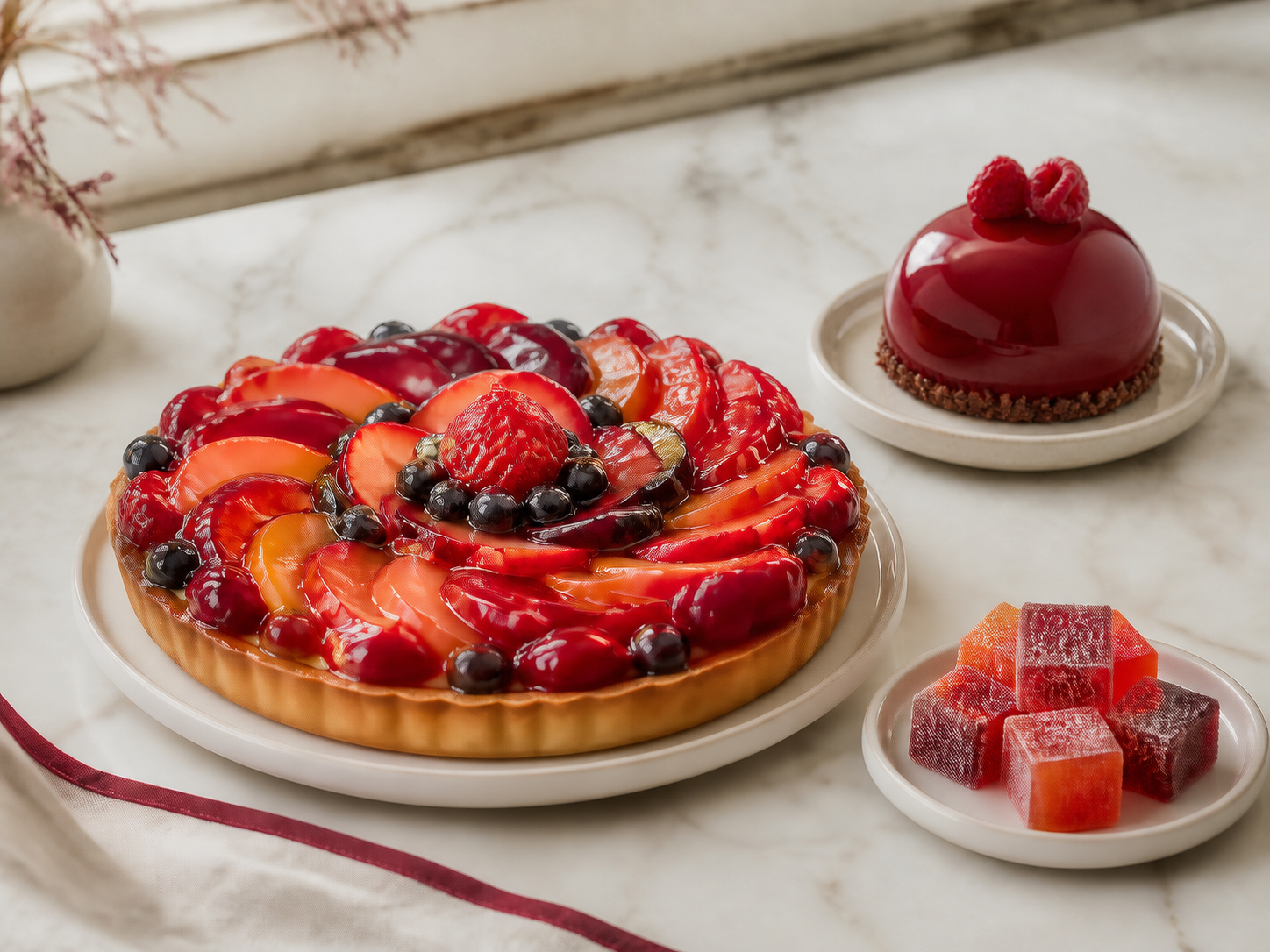
Shiny fruit tart glaze
Makes 250 g of glaze:
- 200 g fruit purée (apricot, strawberry, or raspberry)
- 30 g sugar
- 3 g NH pectin (1.2%)
Combine NH pectin and sugar dry. Heat the purée to 104°F (40°C). Rain in the dry mixture while whisking. Bring to a boil for 1 minute. Glaze the tart while still hot.
Raspberry pâte de fruits
Makes 1 kg:
- 500 g raspberry purée
- 450 g sugar
- 10 g yellow pectin (1%)
- 10 g sugar (to mix with the pectin)
- 15 g citric acid dissolved in 15 ml water
- 10 g glucose syrup
Combine yellow pectin with 10 g sugar, dry. Heat the raspberry purée. Rain in the pectin-sugar mixture while stirring. Add the remaining sugar and the glucose. Cook to 221–225°F (105–107°C). Remove from heat, stir in the citric acid solution. Pour into a frame mold, allow to set for 12 hours, then cut into pieces.
Red mirror glaze for entremets
Makes 500 g of glaze:
- 100 g water
- 200 g sugar
- 200 g glucose syrup
- 50 g sweetened condensed milk
- 15 g 325NH95 pectin (or NH)
- Fat-soluble red food coloring and white opacifier
Same process: blend pectin with sugar dry, cook to 217°F (103°C), incorporate the colorings. Apply at 90–95°F (32–35°C) over a frozen entremet.
Where to buy pectin
At G. Detou, we carry several types of pectin in formats suited to both professionals and serious home bakers:
- NH pectin : for tart glazes and coatings
- Yellow pectin: for pâtes de fruits
- 325NH95 pectin: for entremets mirror glazes
- Gelatin sheets 200 bloom for complementary applications
- Citric acid: essential for activating yellow pectin
If you're unsure which type fits your project, come see us in store — we're happy to guide you.
G. Detou's advice
Pectin is the classic stumbling block for the home baker: NH pectin (thermoreversible, for glazes) and yellow pectin (permanent set, for pâtes de fruits) are not interchangeable — not even close. A pâte de fruits made with NH pectin will never set properly; a glaze made with yellow pectin turns rubbery and stiff. At G. Detou, we carry all four Louis François varieties in clearly labeled 100 g jars — and we'll tell you exactly which one to reach for, right at the counter.
FAQ — Pectins
Not really. Grocery store pectin (Vitpris, Alsa) is standard HM pectin and won't deliver the same results for glazes and coatings. It works fine for homemade jam — but not for a pastry-quality tart finish.
Its main benefit is allowing you to reduce the sugar content while still achieving a good set. Traditional jams made without added pectin require at least 55–65% sugar to gel (relying on the fruit's naturally occurring pectin). With yellow pectin, you can bring that down to 45–50%; with NH pectin, you can go as low as 30%.
At least 2 years, stored away from moisture and heat. It's a very stable powder. Check for clumping — if it has formed lumps, it has absorbed ambient moisture and lost some of its gelling strength.
Two likely culprits: the pectin wasn't heated enough (bring it back to a rolling boil for 1–2 minutes), or the dosage was too low (add 0.5% more pectin, pre-mixed with sugar, and stir in). Lack of acidity can also be the issue when working with low-acid fruits like pear or banana — a pinch of citric acid should do the trick.
No. Pectin and gelatin produce very different textures. Gelatin gives a soft, melt-in-the-mouth set; pectin gives a firmer, more jam-like consistency. For a panna cotta, stick with gelatin (or switch to agar-agar). For a fruit tart glaze, NH pectin is the right call.
NH95 is a subtype of NH pectin with a gelling power of 95% (versus 100% for pure NH). In most recipes, the two are interchangeable without any significant adjustment.
Yes on both counts. It's extracted from fruit (apples and citrus) and contains no gluten whatsoever. Perfectly suited to vegan, vegetarian, and gluten-free diets.
Yes — using gelatin alone, combined with sugar and glucose syrup. But the result will be less stable during transport and storage. For a professional-grade finish, pectin (325NH95 or NH) remains the superior choice.
Pectin is one of those technical ingredients that marks the transition from home cooking to professional pastry. Once you've mastered it, there's no going back — brilliant glazes, flawless mirror finishes, perfectly set pâtes de fruits: all of these techniques depend on it.
To go further, take a look at our gelatin vs. agar-agar comparison guide for other gelling agents, and at our glucose syrup guide which is often used alongside pectin in professional glazes.
At G. Detou, we often recommend NH pectin as the first pectin to keep in your pantry: it's the most versatile and the most straightforward to use.
To go further: browse our full Gelling Agents selection.