

Pink pralines are among the most iconic confections in French gastronomy. Instantly recognizable by their vivid pink hue and caramelized crunch, they are inseparable from Lyonnaise brioche and tarte aux pralines. But behind their apparent simplicity — almonds coated in colored sugar — lies a precise confectioner's craft and a history stretching back several centuries.
This guide covers the essentials: the history of pink pralines, a recipe for making them at home, classic uses, and the criteria for choosing them well.
The history of pink pralines: from Montargis to Lyon
The origins of the praline
The praline was invented in the 17th century by Clément Jaluzot, head confectioner to Marshal du Plessis-Praslin. The story — likely embellished over time — holds that Jaluzot created this confection by coating almonds in caramelized sugar to delight the Marshal's guests. The name "praline" derives directly from "Praslin."
The town of Montargis, in the Loiret département, claims the title of birthplace of the praline. The house of Mazet, founded in 1636, still produces praslines (spelled with an "s," in the historical tradition) there using traditional methods.
How the praline turned pink in Lyon
The original praline was not pink. It was brown — simply coated in caramelized sugar. It was in Lyon, probably during the 19th century, that the praline acquired its characteristic pink color through the addition of food coloring (originally cochineal carmine, now plant-based dyes).
Lyonnaise confectioners turned this colorful variation into a true institution. The pink praline became the heart of several regional specialties: the brioche aux pralines, the tarte aux pralines, and the Saint-Genix. Today, when people in France refer to pink pralines, it is almost always in reference to the Lyonnaise tradition.
Lyon, capital of the pink praline
The Auvergne-Rhône-Alpes region accounts for the majority of pink praline production and consumption in France. In Lyon, brioche aux pralines roses is a fixture in every bakery — found in virtually every window display, from the neighborhood boulangerie to the most prestigious establishments.
The Fête des Lumières (December 8th) is traditionally a peak period for pink praline consumption, in the form of brioches and tarts. But pink pralines are enjoyed year-round — they are an everyday product, not merely a festive one.
Homemade pink pralines: the recipe
Making pink pralines at home is perfectly achievable, but requires patience and attention. The process rests on a simple principle: coating almonds in cooked sugar, layer by layer, until a thick, crunchy shell forms.
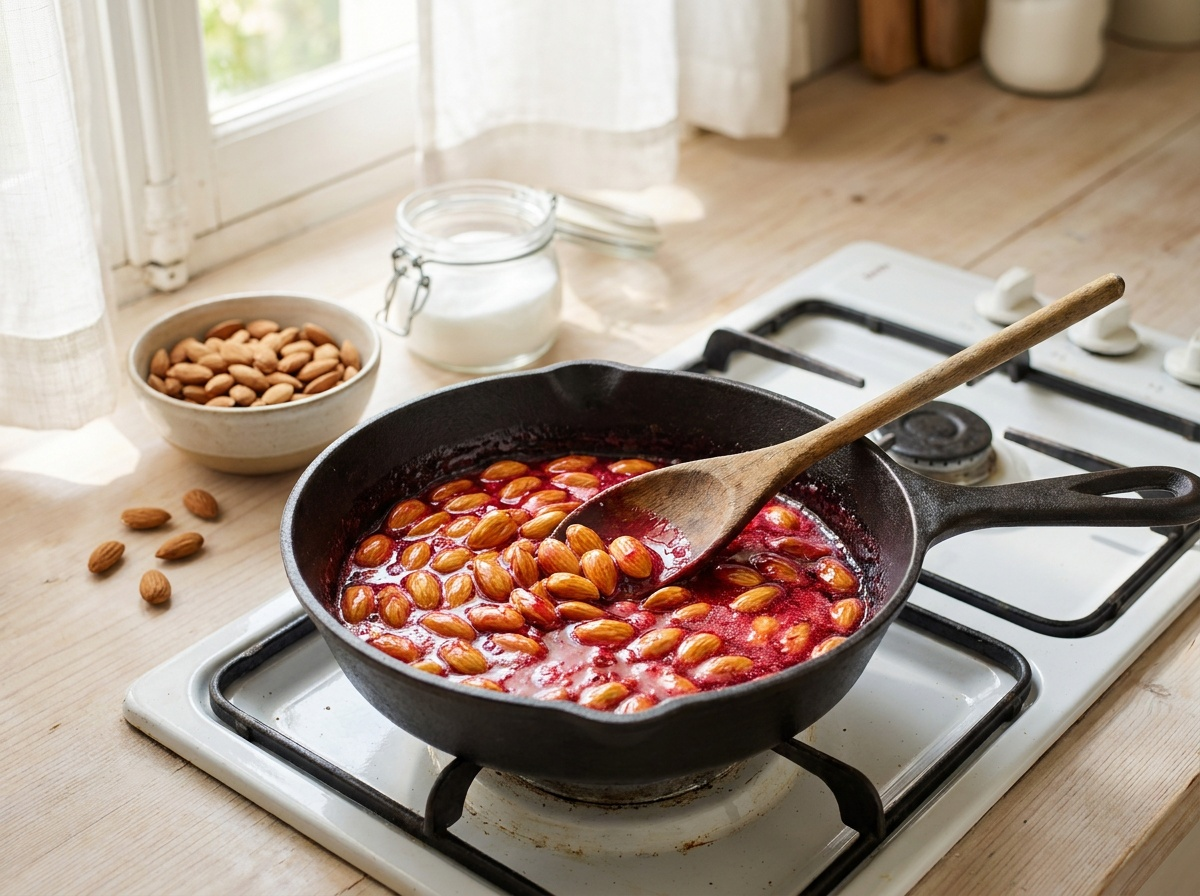
Ingredients
Makes approximately 1 lb 2 oz of pink pralines:
- 9 oz whole almonds, skin-on (unpeeled)
- 250 g granulated sugar
- 75 ml water
- Red or pink food coloring (a few drops are sufficient)
- 1 teaspoon vanilla extract (optional)
Step-by-step method
Step 1
Prepare the syrup
In a heavy-bottomed saucepan (copper is ideal), combine the sugar, water, food coloring, and vanilla. Heat over medium heat, stirring until the sugar has fully dissolved, then bring to a boil.
Step 2
Add the almonds
Pour the almonds into the boiling syrup. Stir constantly with a wooden spatula. The syrup will gradually be absorbed by the almonds and crystallize around them.
Step 3
The sablage (sandy stage)
This is the critical step. The sugar will first crystallize visibly — the almonds become coated in a white, powdery layer. This is known as the sablage (the sandy stage). Do not stop here.
Step 4
Caramelization
Continue stirring over medium heat. The crystallized sugar will slowly re-melt and caramelize around the almonds. It is this second cooking stage that gives the pralines their smooth, glossy, crunchy shell. The process takes 15 to 25 minutes — patience is key.
Step 5
Finishing
Once the almonds are evenly coated in a smooth, shiny layer of sugar, pour them onto a baking sheet lined with parchment paper. Quickly separate any almonds sticking together (work fast — the sugar sets rapidly).
Step 6
Cooling
Allow to cool completely at room temperature. The pralines become perfectly crisp as they cool.
Common mistakes to avoid
- Heat too high: the sugar burns on one side of the pan while the almonds remain uncoated. Keep the heat at medium and stir continuously.
- Stopping at the sablage stage: the first crystallization (white, powdery appearance) is not the finished result. Continue cooking to achieve full caramelization.
- Too much food coloring: a few drops are all you need. Excess coloring imparts a chemical taste and an overly saturated hue.
- Damp almonds: the almonds must be perfectly dry. Any residual moisture will prevent the sugar from crystallizing properly.
Whole pink pralines vs. crushed pralines
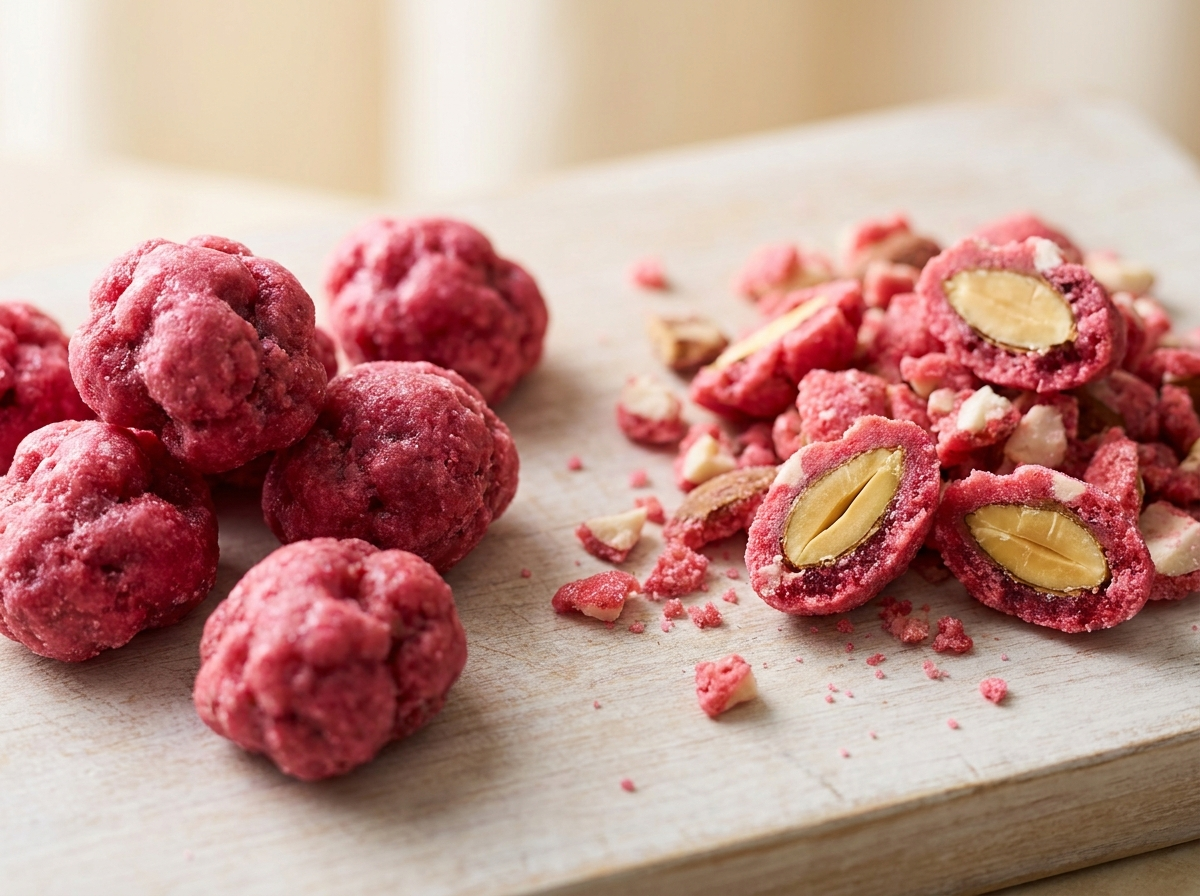
Whole pink pralines
Whole pink pralines are sugar-coated almonds left intact in their original form. They are used:
- As a snack: eaten as a confection on their own
- As decoration: placed on top of cakes, tarts, and brioches
- In brioches: folded whole into the dough before baking — they hold their shape and create pockets of molten caramelized sugar within the crumb
- In confectionery: in chocolate assortments and gift boxes
Crushed pralines
Whole crushed pralines are pink pralines broken into irregular pieces. Their advantage: they distribute more evenly throughout preparations and melt more readily during baking.
They are used for:
- Tarte aux pralines: the crushed pralines melt in the oven with the cream to create that signature pink, molten, caramelized filling
- Brioche aux pralines: the pieces distribute more uniformly throughout the dough
- Creams and ganaches: melted into warm cream for dessert creams or fillings
Pink praline paste
La pâte de pralines is the third format available. It is essentially finely ground pink pralines reduced to a thick, smooth paste with an intense pink color.
It allows you to:
- Flavor creams, mousses, and bavarois without any pieces
- Create pink praline glazes
- Fill macarons or confectionery
- Make pink praline ice cream with a perfectly smooth texture
The classic recipes using pink pralines
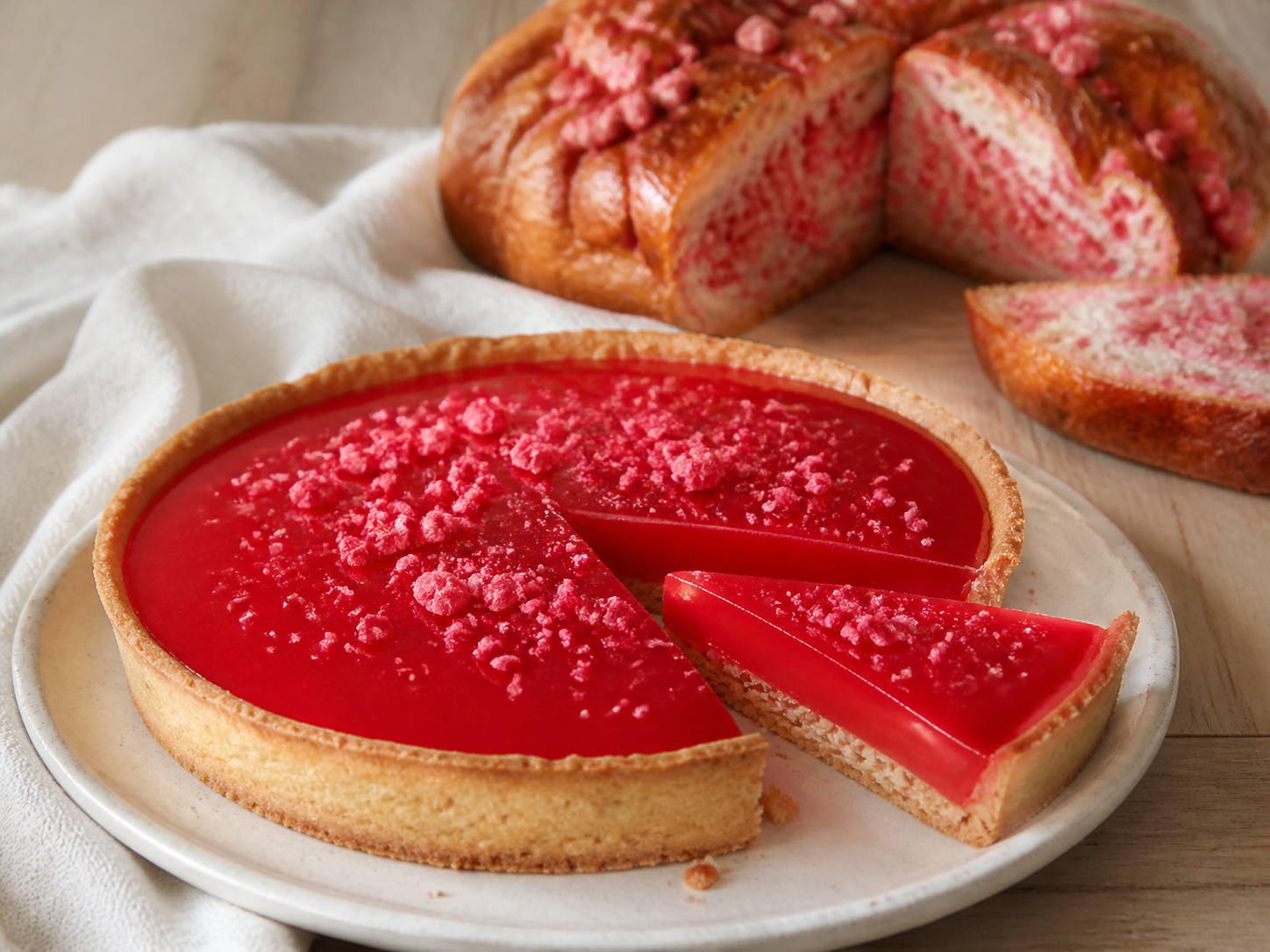
Brioche aux pralines roses
This is the definitive recipe — the one that defines Lyon's culinary identity.
Ingredients for 1 brioche:
- 300 g T45 flour (or all-purpose flour)
- 5 g salt
- 40 g sugar
- 6 g fresh yeast
- 3 eggs
- 150 g soft butter
- 150 to 200 g whole or crushed pink pralines
Method:
- Knead the flour, salt, sugar, yeast, and eggs for 10 minutes in a stand mixer fitted with a dough hook
- Add the soft butter in pieces and knead for another 10 minutes until the dough is smooth and pulls away from the sides of the bowl
- Fold in the pink pralines at low speed — just enough to distribute them, without crushing them
- Leave to rise for 1 hour 30 minutes at room temperature (the dough should double in size)
- Knock back the dough, shape the brioche, and place in a buttered mold
- Leave to rise for a further 1 hour
- Bake at 170 °C (338 °F) for 30 to 35 minutes
- Unmold while still warm
The secret: the pralines partially melt during baking, creating pink, caramelized veins running through the golden crumb. The outside of the brioche takes on a pink blush wherever pralines reach the surface.
Tarte aux pralines roses
A quintessential Lyonnaise specialty, the tarte aux pralines is deceptively simple.
Ingredients:
- 1 pâte sablée (shortcrust pastry) or pâte brisée (plain shortcrust)
- 250 g crushed pink pralines
- 200 ml heavy cream (full-fat)
Method:
- Line a tart pan with the pastry and blind-bake for 15 minutes at 180 °C (356 °F)
- Meanwhile, gently heat the cream with the crushed pralines over low heat, stirring regularly, until the pralines are completely melted (10–15 minutes)
- Pour the praline cream over the pre-baked tart shell
- Bake for a further 10 minutes at 170 °C (338 °F)
- Allow to cool completely — the filling sets as it cools, developing a dense, melt-in-the-mouth texture
The tarte aux pralines is best enjoyed at room temperature or slightly warm. Refrigeration makes the filling too firm.
Saint-Genix
This brioche cake, originating from Saint-Genix-sur-Guiers in the Savoie region, is the cousin of the brioche aux pralines, with one distinguishing feature: pralines are pressed into the outside of the brioche as well, creating a crackly crust of caramelized pralines on the surface.
The base recipe is identical to the brioche aux pralines, but the shaping differs: the brioche is formed into a ball, and whole pralines are pressed into the surface before the final rise.
Other uses
Pink pralines lend themselves to a wide range of creations:
- Crème brûlée with pink pralines: steep crushed pralines in warm cream, strain, then prepare the crème brûlée in the classic way
- Pink praline ice cream: melt pralines into the ice cream base for a uniquely Lyonnaise flavor
- Pink praline cookies: replace chocolate chips with pieces of crushed pralines
- Cheesecake: fold praline paste into the cheesecake batter for a Lyonnaise-inspired twist
- Crêpes: spread praline paste over warm crêpes
How to choose your pink pralines wisely
Quality criteria
Not all pink pralines are created equal. Here is what to look for:
Almond content: a good praline contains at least 40 to 50% almonds. Below that, you are essentially eating colored sugar. Artisan-quality pralines reach 50% almond content.
Almond variety: almonds from Provence or Sicily produce pralines with a finer, more nuanced flavor than Californian almonds, which tend to be more neutral. Some pralines are made with hazelnuts — that is a different product, and not the traditional pink praline.
Coloring: artisan pralines use natural coloring (carmine, beet). Industrial pralines often contain synthetic dyes. Color does not affect flavor but may be a deciding factor for some consumers.
The finish: a well-made praline has a smooth, glossy, evenly colored shell. An irregular surface with pale or whitish patches indicates poor cooking technique or inadequate storage.
Storing pink pralines
Pink pralines keep very well thanks to their high sugar content:
- In an airtight container: 3 to 6 months at room temperature, away from moisture
- Keep them dry: humidity is the main enemy — it causes pralines to clump together and partially dissolves the sugar shell
- Avoid the refrigerator: condensation softens the pralines
- Freezing: possible for whole pralines, for up to 12 months. Thaw at room temperature in a sealed container to prevent condensation
G. Detou's advice
A true Lyonnaise pink praline is an Avola almond coated multiple times in cooked sugar and colored with carmine. The candy-floss fluorescent pink you see in train station gift shops? That's industrial praline, dyed with synthetic coloring. Genuine artisan pink pralines are a softer shade — almost salmon — and their texture snaps cleanly without crumbling to powder. We always keep some in the shop for Sunday brioche aux pralines: Parisians who grew up in Lyon come looking for them on rue Tiquetonne.
FAQ — Pink Pralines
A praline is a confection: a whole almond (or hazelnut) coated in caramelized cooked sugar. Praliné (a smooth paste) is made by finely grinding pralines — almonds and caramelized sugar reduced to a smooth, unctuous mass. Praliné is used as an ingredient (in ganaches, confectionery fillings, creams), while pralines are eaten as they are or used in pieces within recipes.
Technically yes — the coating process is the same. But authentic Lyonnaise pink pralines are made exclusively with almonds. Hazelnuts coated in colored sugar are a different product, with a more pronounced roasted-nut flavor and a slightly different texture. Worth trying, but don't call them "pink pralines" in front of a Lyonnais.
You stopped at the sablage stage — the first crystallization of the sugar. This is the most common mistake. You need to keep cooking over medium heat, stirring constantly. The crystallized sugar will gradually re-melt and caramelize around the almonds, producing the characteristic smooth, glossy shell. Allow 15 to 25 minutes in total.
For a standard-sized brioche (300 g of flour), plan on 150 to 200 g of pink pralines. That represents a praline-to-dough ratio of roughly 50 to 65% — generous by any measure, and that generosity is precisely what defines a Lyonnaise brioche. Under 150 g, the pralines get lost in the crumb.
Pink pralines may seem like a simple product, but they deserve to be chosen with care. The quality of the almonds, mastery of the cooking process, and respect for proportions in recipes make all the difference between an ordinary brioche and a brioche aux pralines that brings a smile with the very first bite. The pink pralines — whole, crushed, or as a paste — available at G. Detou allow you to work with professional-quality ingredients, the same ones used by Lyon's bakers and pastry chefs.
To go further: browse our full Chocolate & Confectionery selection.