


Powdered food coloring is the coloring tool of choice among professional pastry chefs. Where liquid coloring adds water and gel can sometimes alter texture, powder blends seamlessly into a preparation without affecting the recipe in any way. That said, it pays to understand the differences between powder types, how to dose correctly, and which coloring to choose for each application.
This guide covers everything you need to know to master powdered food colorings: types, dosages, techniques, and professional tips.
Why use powdered coloring instead of liquid or gel
No added water
This is the fundamental advantage. In pastry, water is a critical variable. A few extra milliliters in a macaron batter and the shells will crack. A touch too much liquid in a royal icing and it simply won't set. Powdered coloring eliminates that risk entirely: it colors without altering the hydration of the preparation.
That's why professionals use powder almost exclusively for:
- Macaron shells
- Chocolate and cocoa butter
- Sugar work (pulled, blown, and poured sugar)
- Meringues
- Colored pâte sablée (shortcrust pastry)
Superior concentration
Weight for weight, powdered coloring is significantly more concentrated than its liquid counterpart. That means you need far less to achieve the same color intensity. In practical terms, where you might need 10 ml of liquid coloring, 0.5 to 1 g of powder will often do the job.
This high concentration also makes it possible to achieve vivid, fully saturated colors — something that's difficult, if not impossible, with liquid forms without compromising the recipe.
Extended shelf life
A powdered coloring that's properly stored — in an airtight container, away from moisture and direct light — will keep for 18 to 24 months with no significant loss of intensity. Liquid colorings, once opened, degrade within 6 to 12 months. For a professional managing a stock of 15 to 20 different shades, that longevity represents a real economic advantage.
Water-soluble vs. fat-soluble powder coloring: the essential distinction
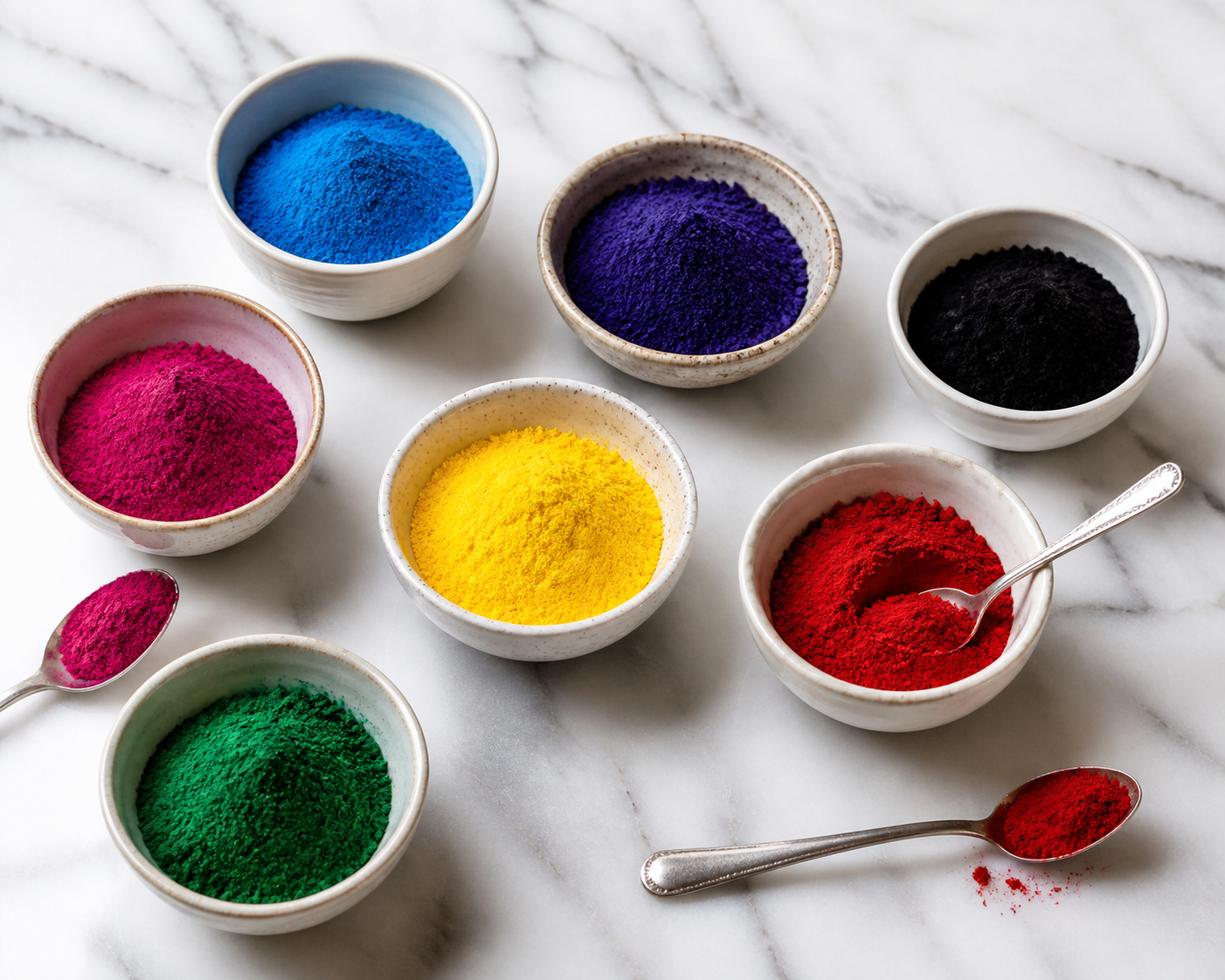
What is a water-soluble coloring?
A water-soluble coloring dissolves in water and water-based preparations. It's the most common and most versatile type, suitable for the vast majority of pastry applications:
- Cake batters
- Pastry creams and buttercreams
- Meringues (French, Italian, and Swiss)
- Glazes and fondants
- Fondant icing (sugar paste) and marzipan
- Macarons (incorporated into the shell batter)
The water-soluble powder coloring is the essential format every pastry chef should have in their kitchen.
What is a fat-soluble coloring?
A fat-soluble coloring dissolves in fats: cocoa butter, melted chocolate, oil, butter. It's a specialized product — and an indispensable one the moment you start working with chocolate.
Why can't you use a water-soluble coloring in chocolate? Because chocolate is an emulsion of fats and dry solids. Even the slightest trace of water triggers what chocolatiers call "seizing": the chocolate thickens suddenly, turns grainy, and loses all fluidity. And it's irreversible.
The fat-soluble powder coloring dissolves perfectly in melted cocoa butter or chocolate without causing this phenomenon. It is essential for:
- Coloring cocoa butter to decorate chocolate molds
- Tinting white chocolate for colored glazes
- Creating colored velvet effects with a spray gun
- Decorating chocolate bonbon shells
Comparison table
| Criterion | Water-soluble | Fat-soluble |
|---|---|---|
| Dissolves in | Water, water-based preparations | Fats, cocoa butter |
| Primary use | General pastry work | Chocolate work, velvet finishes |
| Compatible with chocolate | No | Yes |
| Compatible with meringue | Yes | No |
| Price | Standard | Higher |
| Color range | Very wide | Wide |
Available colors in powder form
The essential colors
Any powdered food coloring range will include at minimum the following shades:
- Red — from bright poppy red to deep burgundy.
- Yellow — from lemon yellow to golden yellow.
- Blue — from sky blue to midnight blue.
- Green — from soft lime green to deep forest green.
- Orange — typically one standard shade.
- Purple / Mauve — from soft mauves to deep violets.
- Pink — from pale blush to fuchsia.
- Black — essential for contemporary designs.
- White — used to opacify translucent preparations.
- Brown — for chocolate, caramel, and earthy tones.
Specialty colors
Some manufacturers offer more sophisticated ready-to-use shades:
- Gold and silver — metallic powders for luxurious finishes (note: these are surface powders, not standard colorings).
- Flesh / skin tone — for cake design and character modeling.
- Ivory — more subtle than yellow, perfect for wedding cake-style icings.
Mixing colors
Just as with paint, powdered colorings can be blended together to create custom shades. The basic mixing rules:
- Red + yellow = orange
- Red + blue = purple
- Blue + yellow = green
- Red + blue + yellow = brown
- Any color + black = darker version
- Any color + white = pastel version
Professional tip: always mix your powders dry before incorporating them into the preparation. This guarantees an even, consistent shade. If you add colors separately to the preparation, you risk creating unintentional marbling effects.
Powdered food coloring in practice
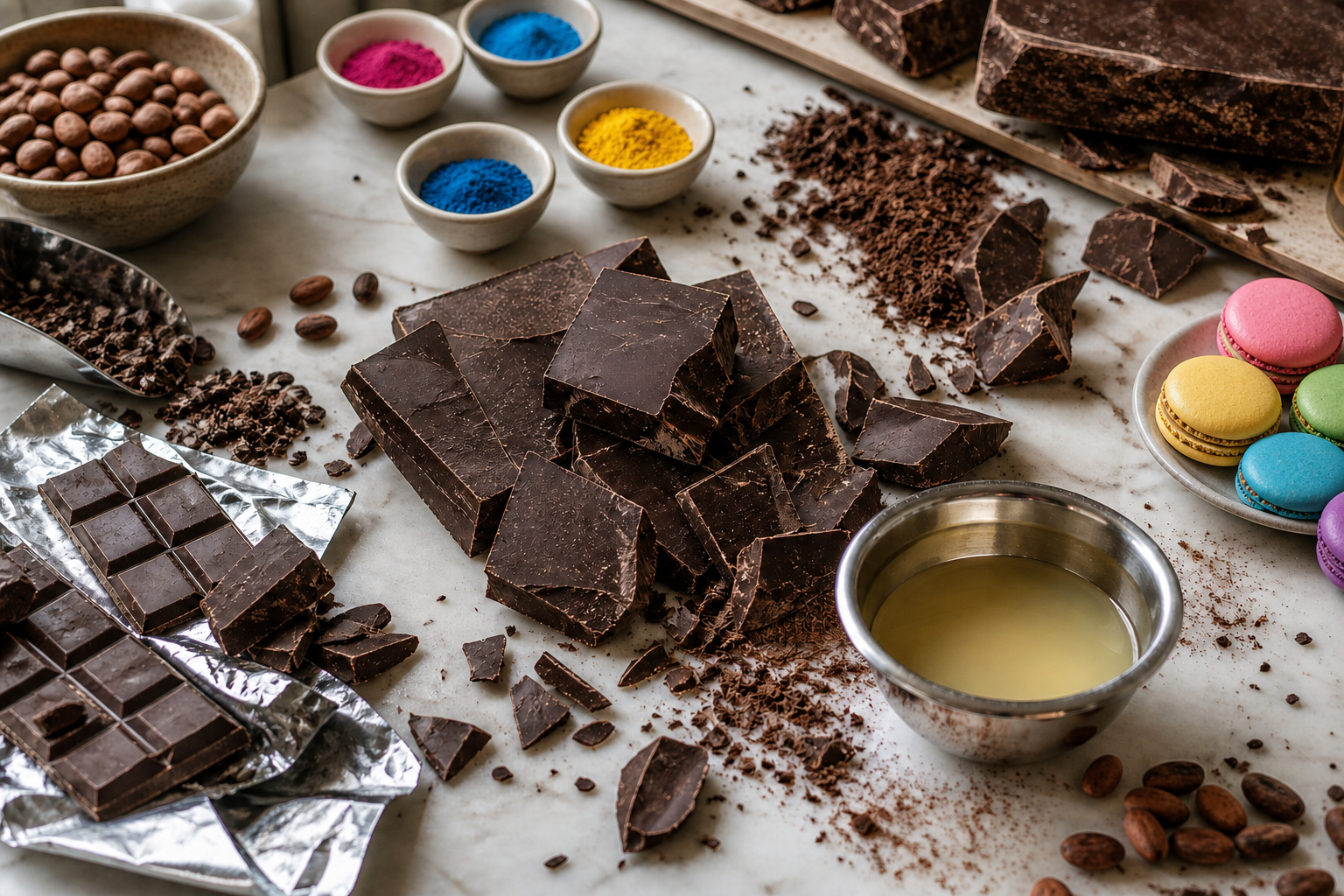
Coloring chocolate and cocoa butter
This is the flagship application for fat-soluble powder coloring. The basic technique:
- Melt the cocoa butter to 104–113 °F (40–45 °C).
- Add the fat-soluble powder coloring (approximately 1 to 3% of the cocoa butter weight).
- Blend with an immersion blender to fully disperse the pigment.
- Apply with a spray gun or brush to decorate chocolate molds.
This technique makes possible the most spectacular effects in contemporary chocolate work: multicolored bonbons, galaxy finishes, gradients, geometric patterns.
For professionals who work with chocolate on a daily basis, having a complete range of fat-soluble powder colorings is an essential investment.
Coloring macarons
The macaron is arguably the pastry where color matters most. A macaron is, first and foremost, a color — then a flavor. The technique:
- Sift the powder coloring together with the almond flour and powdered sugar.
- Proceed with the macaronnage (the folding process) as normal.
- The coloring distributes perfectly evenly without altering the batter's texture in any way.
Typical dosage for a well-colored macaron: 1 to 2 g of powder coloring per 300 g of almond flour. For pastel shades, reduce to 0.3–0.5 g.
The advantage of powder over gel for macarons is decisive: no water content whatsoever, so no risk of altering the consistency of the batter. The shells remain smooth, glossy and well-formed.
Sugar work: pulled and blown sugar
Sugar work is one of the most demanding disciplines in pastry. Coloring cooked sugar requires a coloring that can withstand temperatures of 302–338 °F (150–170 °C). Water-soluble powder coloring is added directly into the sugar as it cooks.
Key points to watch:
- Add the coloring when the sugar reaches approximately 284 °F (140 °C).
- Use professional-grade colorings formulated to withstand high temperatures.
- Dosages are very small: a knife-tip's worth is enough to color 500 g of sugar.
- Some colors are more heat-stable than others above 320 °F (160 °C) — red is often the most fragile.
Surface decoration and finishing
Powder coloring also works beautifully as a finishing touch, applied directly to the surface rather than incorporated into the preparation:
- With a brush: diluted in a small amount of alcohol (vodka, kirsch) or vanilla extract, powdered coloring becomes an edible "paint" ideal for fine detail work — brushstrokes on sugar paste flowers, golden highlights, depth effects.
- With a spray gun: dispersed in melted cocoa butter, it creates stunning colored velvet finishes on frozen entremets (French mousse cakes).
- Dusted on: applied dry, the powder settles on the surface to create pearlescent, sparkling, or matte effects depending on the type of powder used.
Colored meringues and pavlova
Meringue is an ideal application for powder coloring. Since meringue batter is essentially a foam of water and sugar stabilized by egg proteins, it is extremely sensitive to any added liquid. Sift the powder coloring into the powdered sugar before incorporating it.
To achieve two-tone or multicolored meringues, powder coloring can be brushed along the inside walls of the piping bag before filling it with white batter. Each meringue will emerge with its own unique streaks of color.
Dosing powdered food coloring
General guidelines
Dosage depends on three factors:
- The desired intensity: pastel, medium, or vivid.
- The base color of the preparation: a white base (meringue) will take on color more readily than a yellow one (butter-rich pâte sablée).
- The type of coloring: a synthetic powder coloring is 3 to 5 times more concentrated than a natural powder coloring.
Reference dosage table
| Application | Pastel | Medium | Vivid |
|---|---|---|---|
| Macarons (per 300 g tant-pour-tant, equal parts almond flour and powdered sugar) | 0.3 g | 1 g | 2 g |
| Meringue (per 200 g egg whites) | 0.2 g | 0.5 g | 1 g |
| Royal icing (per 500 g) | 0.5 g | 1.5 g | 3 g |
| Cocoa butter (per 100 g) | 1 g | 2 g | 3 g |
| Fondant icing / sugar paste (per 500 g) | 0.3 g | 1 g | 2 g |
| Cooked sugar (per 500 g) | Knife tip | 0.3 g | 0.5 g |
These dosages are given for concentrated synthetic colorings. For natural colorings, multiply by 2 to 3.
The importance of testing first
Every professional follows this rule: always test on a small quantity before coloring an entire batch. Here's why:
- The dry powder color doesn't always match the final color once incorporated into a wet preparation.
- Some preparations shift the shade — the acidity of a coulis, for instance, can turn blue into purple.
- Drying or baking can alter the final color.
Prepare a 50 g sample, record the exact dosage, and fine-tune before scaling up to production.
Clean label and vegan: the impact on choosing powdered colorings
The clean label movement is profoundly reshaping the food coloring market. Professional pastry chefs and discerning home bakers alike are increasingly incorporating natural powder colorings into their everyday practice — and this shift has very real practical implications.
Titanium dioxide (E171): restrictions and alternatives
Titanium dioxide, long used as a white coloring to opacify icings, fondant, and coatings, is now subject to significant restrictions. As of 2022, it has been banned as a food additive in the European Union, following an EFSA opinion that could not rule out genotoxic risks.
This ban has accelerated the search for natural white alternatives:
- Micronized rice starch provides reasonable opacity
- Calcium carbonate is a mineral-based option
- Some manufacturers offer white preparations derived from decolorized cocoa butter concentrate
None of these alternatives matches the covering power of titanium dioxide, but formulations are improving year on year.
Natural vs. synthetic powder colorings: the vegan question
For pastry chefs building a vegan offering, the choice of powder coloring warrants careful attention:
- Synthetic colorings are technically vegan (no animal-derived ingredients), but they don't align with the clean label ethos that vegan consumers typically expect.
- Among natural colorings, carmine (E120) is the only one of animal origin — all others (beet, turmeric, spirulina, vegetable charcoal, chlorophyll) are plant-based and fully vegan-compatible.
- Les natural powder colorings of plant origin allow you to check both boxes: clean label and vegan.
The commercial case
For artisan producers, displaying "naturally sourced colorings" or "no artificial coloring" in their shop window and on their marketing materials has become a genuine point of differentiation. Macarons, chocolate bonbons, and decorated cakes are the product categories where this messaging resonates most powerfully with consumers. Investing in professional-quality natural colorings pays for itself through perceived value and customer trust.
How to properly store your powder colorings
The enemies of powder coloring
Three factors will degrade your powder colorings:
- Moisture: powder absorbs ambient humidity, clumps, and loses intensity. In a pastry kitchen where steam is ever-present, this is the primary risk.
- Light: UV rays break down pigments, especially in natural colorings.
- Heat: storage above 77 °F (25 °C) accelerates degradation.
Best storage practices
- Store in airtight containers — not in the original bag once opened.
- Keep in a closed cabinet, away from light.
- Maintain a stable temperature, ideally between 59 and 68 °F (15–20 °C).
- Always use a dry spoon to measure — never your fingers, never a damp utensil.
- Label each container with the date it was opened.
G. Detou's advice
Concentrated powder coloring unlocks shades that liquid colorings simply can't deliver: a vivid raspberry red without thinning out your macaron batter, a deep royal blue without waterlogging a mousse. The rule we always share at the shop: 0.5 g of powder per 500 g of preparation, and never more on a first attempt — it's ten times more concentrated than liquid coloring. We sell it in 25 g jars on rue Tiquetonne, and one jar will see you through 50 batches of macarons.
FAQ — Powdered food coloring
Yes, water-soluble powder coloring can be added directly to a cake batter. For optimal distribution, sift it together with the flour, or dissolve it in a tablespoon of liquid from the recipe (milk or water) before adding it. This prevents concentrated spots of color in the batter. For a rainbow cake, it's the most effective approach.
Standard powder coloring colors the entire preparation from within — it's incorporated and tints the mass evenly. Luster dust (also called pearl dust or shimmer powder) is a finishing product: it's applied to the surface to create a shiny, metallic, or pearlescent effect. Luster dusts contain light-reflecting particles (food-grade mica) and are not designed to be mixed into batters. These are two complementary products — not interchangeable ones.
Synthetic powder colorings are used in such tiny quantities that they contribute no perceptible flavor whatsoever. Some natural powder colorings can impart a faint taste at high doses — turmeric has a spiced note, and vegetable charcoal can give a very slight bitterness. At the recommended dosages, these flavors remain completely undetectable in the finished product.
Black is one of the most difficult colors to achieve in pastry. For a deep black, use black powder coloring (vegetable charcoal for a natural option) in sufficient quantity. The pro trick: start with a base of brown or midnight blue coloring before adding the black. This yields a deeper, richer black than using black alone. Plan on 3 to 5 g of powder per 500 g of preparation for an intense black.
Discover the full range of powdered food colorings at G. Detou — water-soluble and fat-soluble, natural and classic — in store on rue Tiquetonne or at gdetou.com.
To go further: browse our full Food Colorings selection.