

If we had to choose a single brand of couverture chocolate, it would probably be Valrhona. The house of Tain-l'Hermitage, founded in 1922, has become the absolute reference in French and international pastry. A large proportion of Michelin-starred chefs use Valrhona in their kitchen — not out of snobbery, but because the brand's consistency of quality, aromatic palette, and technical mastery have no real equivalent.
That said, Valrhona spans more than 50 references: couvertures, pistoles, pralinés (caramelized nut pastes), cocoa powders, and cocoa butters. Enough to feel overwhelmed when you're just starting out. What follows is our curated selection — the one we've been recommending for 70 years from the counter at 58 rue Tiquetonne, now available at fair prices on gdetou.com.
Why Valrhona
Before diving into specific references, a few words on what sets this house apart.
Direct sourcing. Valrhona builds long-term partnerships with its cacao growers in Madagascar, the Caribbean, Ecuador, Côte d'Ivoire, the Dominican Republic, and Ghana. Each "single-origin" chocolate (sourced from one distinct geographic zone) tells its own story: terroir, local fermentation methods, a distinctive aromatic profile. Think of it as the chocolate equivalent of a classified-growth wine.
Technical mastery. Valrhona trains chocolatiers and pastry chefs through L'École Valrhona in Tain — one of the most influential pastry schools in the world. This pedagogical approach permeates the entire chain: the chocolates are designed to temper well, mold well, and work well in ganache. When you buy Valrhona, you're also buying a technical guarantee.
Price. Let's be honest: Valrhona is not the most affordable brand. Expect to pay $27–45/kg for pastry couvertures (vs. $13–20 for standard industrial couvertures). But in the context of a recipe, the chocolate line item is relatively small — and the difference in results is anything but.
The 8 Essential References to Know
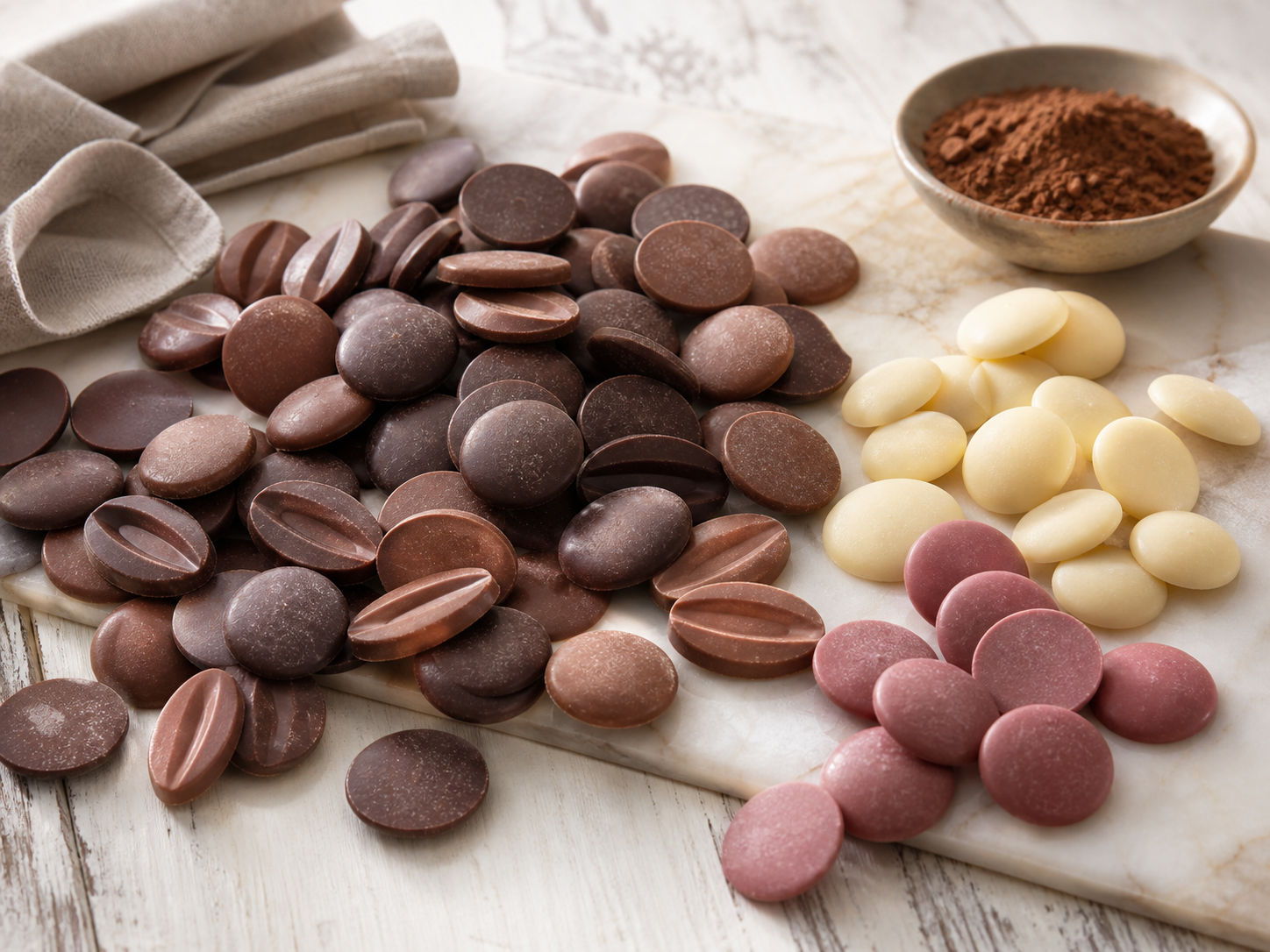
1. Caraïbe 66% — the all-purpose dark couverture
Our all-time best-seller. A beautifully balanced profile with notes of roasted cacao and dried fruits, and a fluidity that works equally well for molding and ganache (the cream-and-chocolate emulsion used in countless pastry applications). If you're only going to keep one dark chocolate in your pantry, make it Caraïbe.
Uses: entremet ganaches (layered mousse cake fillings), mousses, molded chocolates, bars, bonbon coatings. Caraïbe is also the one we recommend to beginners attempting their first temper: it's far more forgiving than a 70%.
Format: pistoles 1 kg ou 3 kg.
2. Manjari 64% — the fruity Madagascar single-origin
A Madagascar single-origin with vivid red-fruit notes — raspberry, blackcurrant — and a bright acidity that wakes up the palate. Its aromatic intensity makes it a chocolate best showcased in minimalist recipes: a pure bar, a clean bonbon ganache, a royal icing glaze.
Uses: signature ganaches, single-origin chocolate bars, contemporary desserts where chocolate is meant to take center stage.
Format: pistoles 1 kg ou 3 kg.
3. Guanaja 70% — noble intensity
Guanaja has been Valrhona's iconic dark chocolate since the 1980s. At 70% cacao, it's intense without being bitter, with a remarkable finish and notes of toasted spice. This is the chocolate you'll find in the whipped ganaches of grand hotel patisseries, in the molten chocolate cakes of starred restaurants, and in the chocolate sorbets of top-tier kitchens.
Uses: premium ganaches, chocolate tarts, sorbets, grown-up mousses. Reach for Guanaja when a recipe demands character.
Format: pistoles 1 kg ou 3 kg.
4. Jivara 40% — the professionals' milk chocolate
If you find supermarket milk chocolate cloying, Jivara will be a revelation. At 40% cacao (versus 30–35% for most industrial standards), it retains the smooth, milky roundness of classic milk chocolate while delivering real cacao depth. No flatness, no heaviness.
Uses: filled bonbon ganaches, milk chocolate mousse, ice cream, homemade milk chocolate bars, nougat coatings.
Format: pistoles 1 kg ou 3 kg.
5. Dulcey 35% — the iconic blonde chocolate
Launched in 2012 by Frédéric Bau, Dulcey is technically a white chocolate… slowly baked until the cocoa butter takes on a deep golden color. The result is something entirely its own: notes of caramelized shortbread, brown butter, and Breton sablé (a rich, buttery French shortbread). It caused a sensation in contemporary pastry, prompting virtually every other brand to release its own "blonde" version in its wake.
Uses: modern whipped ganaches, signature chocolate bars, entremet inserts, Dulcey sablé cookies, ice cream. A genuinely distinctive register in any pastry chef's palette.
Format: pistoles 1 kg ou 3 kg.
6. Ivoire 35% — the benchmark white chocolate
The white chocolate of choice for vanilla whipped ganaches, entremet inserts, and colored glazes. The flavor profile is milky and gentle, with a discreet vanilla note. More delicate to temper than dark chocolate (maximum melting temperature: 100–104°F / 38–40°C), but the result is incomparably better than the overly sweet white chocolates found in grocery stores.
Uses: vanilla whipped ganache, mirror glaze white, colorings (an excellent color base), entremet inserts, macarons.
Format: pistoles 1 kg ou 3 kg.
7. Opalys 33% — the less sweet white chocolate
Opalys is the modern evolution of Ivoire: less sweet, creamier, with a more natural milky taste. It has become the go-to reference for contemporary pastry chefs when it comes to "white" desserts, elegant inserts, and whipped ganaches for strawberry cakes or strawberry-pistachio cakes.
Uses: everything you'd do with Ivoire, in a "less sweet, more modern" register. Many pastry chefs have gradually replaced Ivoire with Opalys altogether.
Format: pistoles 1 kg ou 3 kg.
8. Valrhona Cocoa Powder
An absolute pantry staple for chocolate sponges, enriched ganaches, fondants, and finishing dustings. 100% cacao, alkalized, with a deep, dark color and none of the harsh bitterness that plagues lesser powders.
Format: sachet 1 kg.
How to Choose by Recipe
| If you're making… | Reach for… |
|---|---|
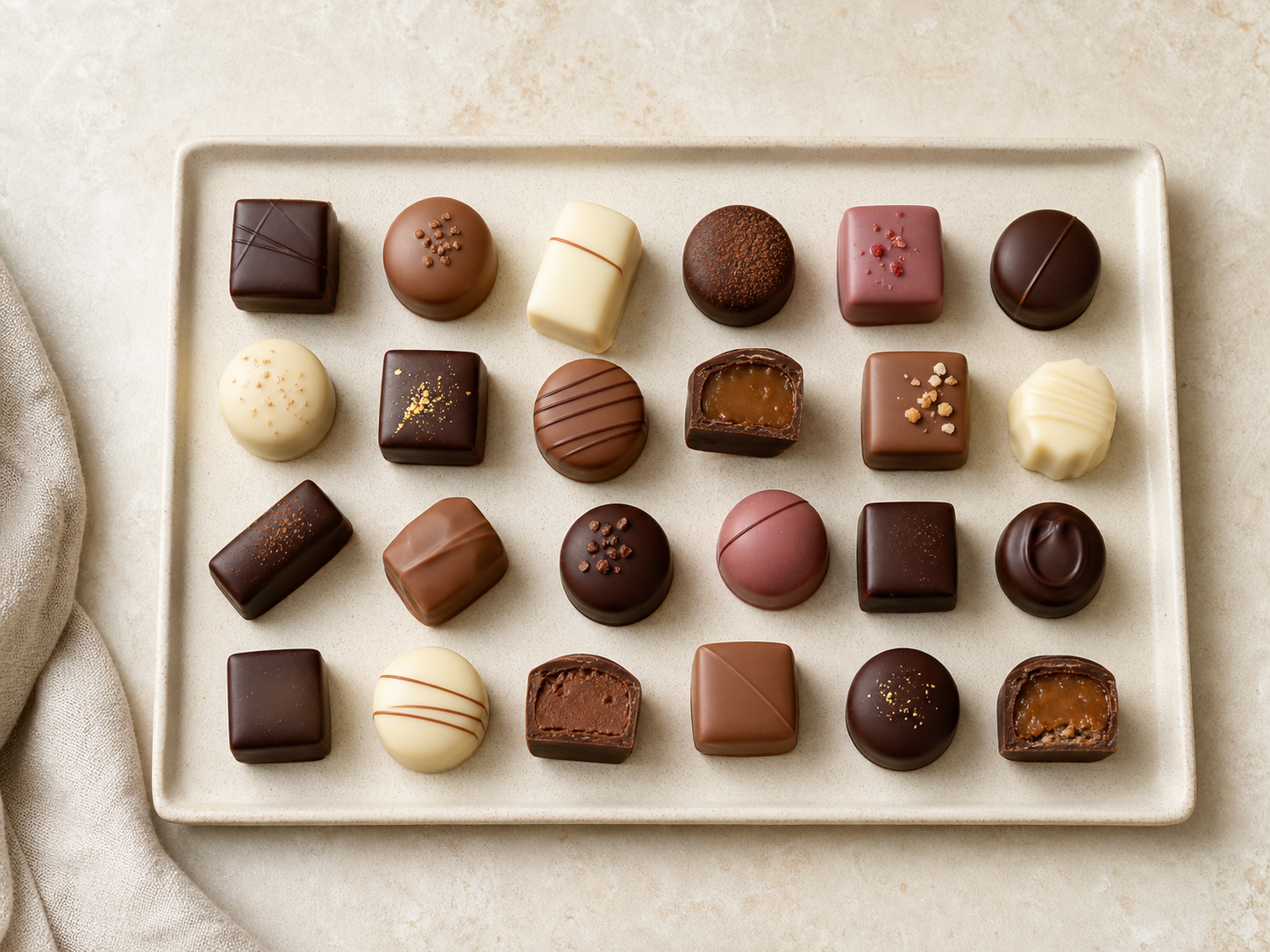
| Enrobed filled bonbons | Caraïbe 66% (dark) or Jivara 40% (milk) |
| A chocolate tart | Manjari 64% or Guanaja 70% depending on desired intensity |
| A fraisier with vanilla whipped ganache | Ivoire or Opalys + Bourbon vanilla |
| A signature chocolate bar | Manjari or Guanaja (dark) or Dulcey (blonde) |
| A chocolate macaron | Caraïbe + Cocoa Powder in the shell |
| A mirror glaze | Ivoire / Opalys + food coloring for colored versions |
| A chocolate sorbet | Guanaja (the richness is essential for proper texture) |
| A dark chocolate mousse | Caraïbe for a crowd-pleasing result, Guanaja for connoisseurs |
| A salted caramel bonbon | Caraïbe (the balance with caramel is ideal) |
If you're just getting started, begin with Caraïbe + Jivara + Ivoire. These three references cover roughly 80% of chocolate pastry applications — and will teach you the Valrhona signature from the ground up.
Formats and Packaging
Valrhona sells primarily in two formats for pastry use:
1 kg pistoles: convenient for getting started, with a slightly higher per-kilo price (~$35–43/kg). Ideal for dedicated home bakers or small patisseries using 5–10 kg per week.
3 kg pistoles: better per-kilo value (~$28–36/kg), ideal volume for professional pastry kitchens or very active home bakers. A 3 kg bag keeps easily for 12–18 months when stored properly (61–64°F / 16–18°C, away from light).
Valrhona also sells in fèves (smaller, thinner pistoles that melt faster), 1 kg blocks (to be broken up, slightly lower price point), and discovery gift sets (a curated selection of several single-origins in 250 g pouches — perfect as a gift or for exploration).
How to Store Your Valrhona
Couverture chocolate has three enemies:
- Heat (>68°F / 20°C) → cocoa butter migrates to the surface (fat bloom)
- Moisture → sugar crystals migrate to the surface (sugar bloom)
- Strong odors (chocolate absorbs them all)
Ideal storage: 61–64°F (16–18°C) in a closed cupboard, away from light, in the original packaging or an airtight container. Do NOT refrigerate (humidity and odor absorption).
Properly stored, a bag of Valrhona will keep for 18–24 months without any notable loss of aroma. The best-before date printed on the bag is a useful guideline, not a hard cutoff.
Cost and Budget
For regular home use (1–2 kg/month), budget roughly $55–90/month for Valrhona by mixing Caraïbe + Jivara + Ivoire in 1 kg bags.
For professional pastry chefs or very dedicated home bakers (5+ kg/month), moving to 3 kg bags saves 20–30% per kilo. Budget roughly $170–340/month depending on volume.
For reference, a supermarket baking chocolate runs $9–14/kg. So Valrhona is roughly 3 times the price. But there's simply no comparison: a Caraïbe 66% at $38/kg bears no resemblance — in flavor, texture, or technical performance — to a $11/kg baking chocolate.
Where to Buy Valrhona
Several options are available:
- Valrhona's own online store: premium pricing, nationwide delivery, full range.
- Specialty fine food retailers like G. Detou: fair prices, expert guidance, a carefully curated but well-chosen selection. The bonus: you can taste before you buy when you visit in person.
- Professional wholesalers (restaurant supply stores): very competitive pricing at high volumes, but limited selection.
- Online marketplaces: exercise caution with third-party sellers (cold chain integrity, storage conditions).
Our advice: start with a specialist retailer like G. Detou (in-store at Paris 2nd arrondissement + Lyon 2nd arrondissement, or online at gdetou.com) to benefit from expert guidance and try several references side by side. Once you know exactly what you want and you're buying in volume, compare with wholesalers if you're a professional.
The G. Detou Take
Of the 25 references Valrhona produces, we stock 13 at G. Detou — selected across the generations who have passed this shop down through the decades. Caraïbe 66%, Guanaja 70%, and Manjari 64% account for 70% of our sales: these are the couvertures you'll find in the great pastry houses. The others — Andoa, Tropilia, Itakuja — are here for the pastry chefs who like to venture off the beaten path. If you're undecided, buy 250 g of each: that's one of the great advantages of being able to buy by the piece in the store.
FAQ — The Valrhona Selection
Caraïbe 66%, without question. A balanced, fluid chocolate that forgives small tempering errors and works across virtually every application — ganaches, molded pieces, coatings. Once you're comfortable with it, branch out to Manjari for a fruitier character or Guanaja for deeper intensity.
- Caraïbe: balance, versatility, "premium classic dark chocolate." Choose it when chocolate is one of several elements in a dessert.
- Manjari: a strong aromatic signature (red fruits, bright acidity). Choose it when chocolate is meant to be the undisputed star of the dessert.
Three reasons: direct sourcing from growers (above-market prices paid, genuine partnership model); an internationally recognized premium brand; and L'École Valrhona, whose ongoing pastry education programs are built into the business model. The price difference versus Barry runs about 15–25% depending on the reference. Against Weiss, it's closer — Weiss sits in the same premium tier.
Carefully resealed (with a clip, zip bag, or plastic wrap) and stored at 61–64°F (16–18°C): 6–12 months with no significant loss for dark chocolate, 3–6 months for milk and white. Beyond those windows, it's still perfectly usable — the aroma simply begins to fade.
Yes — several references: Caraïbe Bio, Manjari Bio, Jivara Bio, Ivoire Bio. They run about 15–20% more than the standard versions. In terms of flavor, the difference is minimal: the choice is primarily an ethical one.
All Valrhona dark chocolates are vegan by default (no dairy fats). Milk chocolates (Jivara, Bahibé) and whites (Ivoire, Opalys, Dulcey) contain lactose and are therefore not vegan. Valrhona has introduced a range of "Plant-based" milk chocolate references made with dairy-free alternatives.
Allow roughly 1 kg of tempered chocolate for 10–15 medium hollow eggs (3–4 inches / 8–10 cm). A single 1 kg bag of Caraïbe is enough. If you're also making a filling, add 200–300 g for the ganache (cream-and-chocolate emulsion) or praliné (caramelized nut paste).
Absolutely — and it's standard practice among pastry chefs. Blending Caraïbe and Manjari tempers Manjari's acidity into something more nuanced; mixing Jivara and Caraïbe yields a "full-bodied milk chocolate." Professionals refer to this as "blending" their chocolates. There are no universal rules — it's all about experimentation.
Valrhona costs more than most, but when chocolate is the ingredient that defines your dessert, it's the smartest investment you can make. A Guanaja fondant outperforms five industrial baking chocolate versions. A Manjari macaron is something a customer remembers. A Jivara-enrobed bonbon sells at $1.75–2.25 a piece without any difficulty.
Our advice for home bakers: taste before you buy in bulk. Stop by 58 rue Tiquetonne (or 12 rue du Plat in Lyon), ask to taste Caraïbe and Manjari side by side — one bite and you'll understand. For professionals, the math is straightforward: Valrhona costs more per kilo, but it raises your selling price.
Further Reading
- How to temper chocolate: a complete guide to the 3 methods — to get the most out of your Valrhona
- Mycryo butter: simplified tempering — the professional method using Mycryo Cacao Barry
- # Chocolate Ganache: Ratios and Recipes — Using Caraïbe, Manjari, or Guanaja in Ganache A ganache is an emulsion between a fat (the cocoa butter contained in the chocolate) and a water-based liquid (usually cream). The quality of this emulsion depends largely on the ratio between the two components — and on the chocolate used. ## Basic Ratios The ratio between chocolate and cream determines the final texture of your ganache: - **Fluid ganache** (for glazing or sauce): 1 part chocolate / 2 parts cream - **Classic ganache** (for truffles or filling): 1 part chocolate / 1 part cream - **Firm ganache** (for molded bonbons or rolled truffles): 2 parts chocolate / 1 part cream These ratios apply to **milk chocolate**. For dark chocolate, the higher cocoa butter content means you'll need to adjust — typically using slightly more cream. ## Ganache with Valrhona Couvertures ### Caraïbe 66% — Balanced Dark Chocolate Caraïbe is a well-rounded couverture with notes of dried fruit and a pleasant bitterness. It works beautifully in a classic ganache. **Recipe for a firm ganache (molded bonbons):** - 200 g Caraïbe 66% - 150 g heavy cream (35% fat) - 20 g butter (optional, for added gloss) Heat the cream to 85°F (185°F / 85°C), pour over the chopped chocolate in three additions, stirring from the center outward to build the emulsion. Add the butter once the ganache reaches 95°F (35°C). Process with an immersion blender for a perfectly smooth result. --- ### Manjari 64% — Fruity and Acidic Manjari is a single-origin Madagascar couverture with pronounced red fruit and citrus notes. Its natural acidity pairs wonderfully with passion fruit or raspberry in a ganache. **Recipe for a classic ganache (truffle filling):** - 180 g Manjari 64% - 180 g heavy cream - 1 vanilla bean (optional) Infuse the vanilla in the cream, then heat to 185°F (85°C). Pour over the chopped Manjari in three additions. The emulsion forms quickly thanks to the chocolate's fluidity. Allow to crystallize at room temperature before use. > **Note:** Because of its acidity, Manjari ganache has a slightly shorter shelf life than ganaches made with more neutral chocolates. --- ### Guanaja 70% — Intense and Bitter Guanaja is one of Valrhona's most iconic couvertures — powerful, with notes of roasted coffee and a long, persistent finish. It requires a higher cream ratio to balance its intensity. **Recipe for a fluid ganache (glaze or tart filling):** - 150 g Guanaja 70% - 200 g heavy cream - 30 g glucose syrup (for texture and shine) Heat the cream and glucose to 185°F (85°C). Pour over the finely chopped Guanaja. Emulsify thoroughly — this ganache is prone to splitting if the emulsion is rushed. Use immediately as a glaze at around 95°F (35°C), or allow to set for a tart filling. --- ## Key Tips for a Successful Ganache 1. **Always chop the chocolate finely** — it melts more evenly and reduces the risk of seizing. 2. **Pour the cream in three additions**, stirring from the center: this builds the emulsion gradually, starting with a thick, shiny core. 3. **Use an immersion blender** at the end for a perfectly smooth, stable ganache — especially with high-percentage dark chocolates like Guanaja. 4. **Crystallization temperature matters**: allow your ganache to set at room temperature (around 65°F / 18°C) rather than in the refrigerator, which can cause condensation and affect texture. 5. **Butter** added at 95°F (35°C) gives ganache extra gloss and a melt-in-the-mouth texture — particularly useful for boxed chocolates. --- Whether you choose the balance of Caraïbe, the fruitiness of Manjari, or the power of Guanaja, each couverture brings its own personality to a ganache. The key is to adapt the ratio and technique to the chocolate — not the other way around.
- Bûche de Noël chocolat — recette complète avec Valrhona
And if you ever make it to our Paris or Lyon store, there's almost always an open bag of Caraïbe sitting on the counter. The smile that follows the first taste is the best advertisement we know.
To go further: browse our full Dark Chocolate selection.