


In the professional pastry kitchen, there's one discreet yet ubiquitous ingredient you'll never see in a food blog recipe: lecithin. That small jar of yellowish powder, often tucked away in a corner of the lab, stabilizes emulsions, lightens mousses, and creates airy textures that would otherwise be impossible to achieve. It's one of those "technical" ingredients that separates home baking from professional pastry work.
At G. Detou, we've been selling soy and sunflower lecithin to professionals for decades — and increasingly to advanced home bakers who are discovering its remarkable properties. Here's everything you need to know: what lecithin is, what it does, how to use it, and when it truly makes a difference.
What exactly is lecithin?
Lecithin is a natural phospholipid found in many ingredients: egg yolks, soybeans, sunflower seeds, and rapeseed. Industrially, it is extracted primarily from soybeans (soy lecithin) or sunflower seeds (sunflower lecithin, a more recent alternative for those avoiding soy).
Its defining characteristic: lecithin is both hydrophilic and lipophilic — it has an affinity for both water and fat. This dual nature makes it an exceptional emulsifier, capable of binding two phases that would not naturally mix (such as water and oil).
In pastry making, lecithin is used to:
- Stabiliser les émulsions (ganaches, mousses, crèmes)
- Create light foams (espumas, culinary "airs")
- Improve the texture of certain doughs and batters
- Extend shelf life (emulsions remain stable longer)
- Produce smooth mixtures that would otherwise turn grainy
Soy lecithin vs. sunflower lecithin
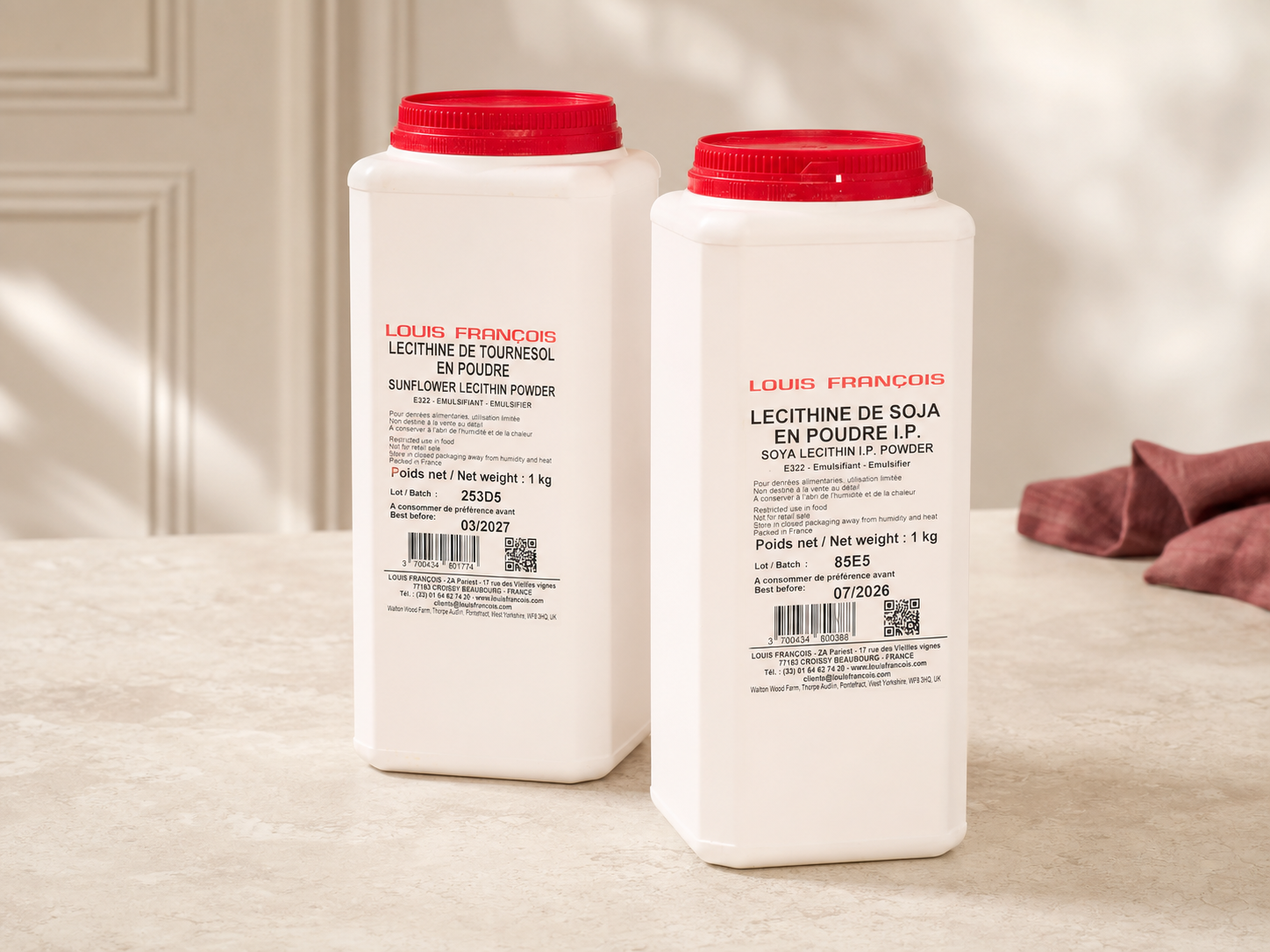
| Soy Lecithin | Sunflower Lecithin | |
|---|---|---|
| Source | Soybean oil | Sunflower oil |
| Color | Yellow to light brown | Light yellow |
| Flavor | Neutral to mildly nutty | Neutral |
| Price | 15–30 €/kg | 25–40 €/kg |
| Allergen | YES (soy) | No |
| Organic available | Yes | Yes |
| Emulsifying performance | Excellent | Slightly superior |
The choice depends on your situation:
- Tight budget, no soy allergy: soy lecithin
- Organic, allergen-free, or broader consumer applications: sunflower lecithin
Both perform nearly identically in pastry applications. Sunflower lecithin has steadily gained market share in recent years, particularly in organic and mass-market products.
Available forms
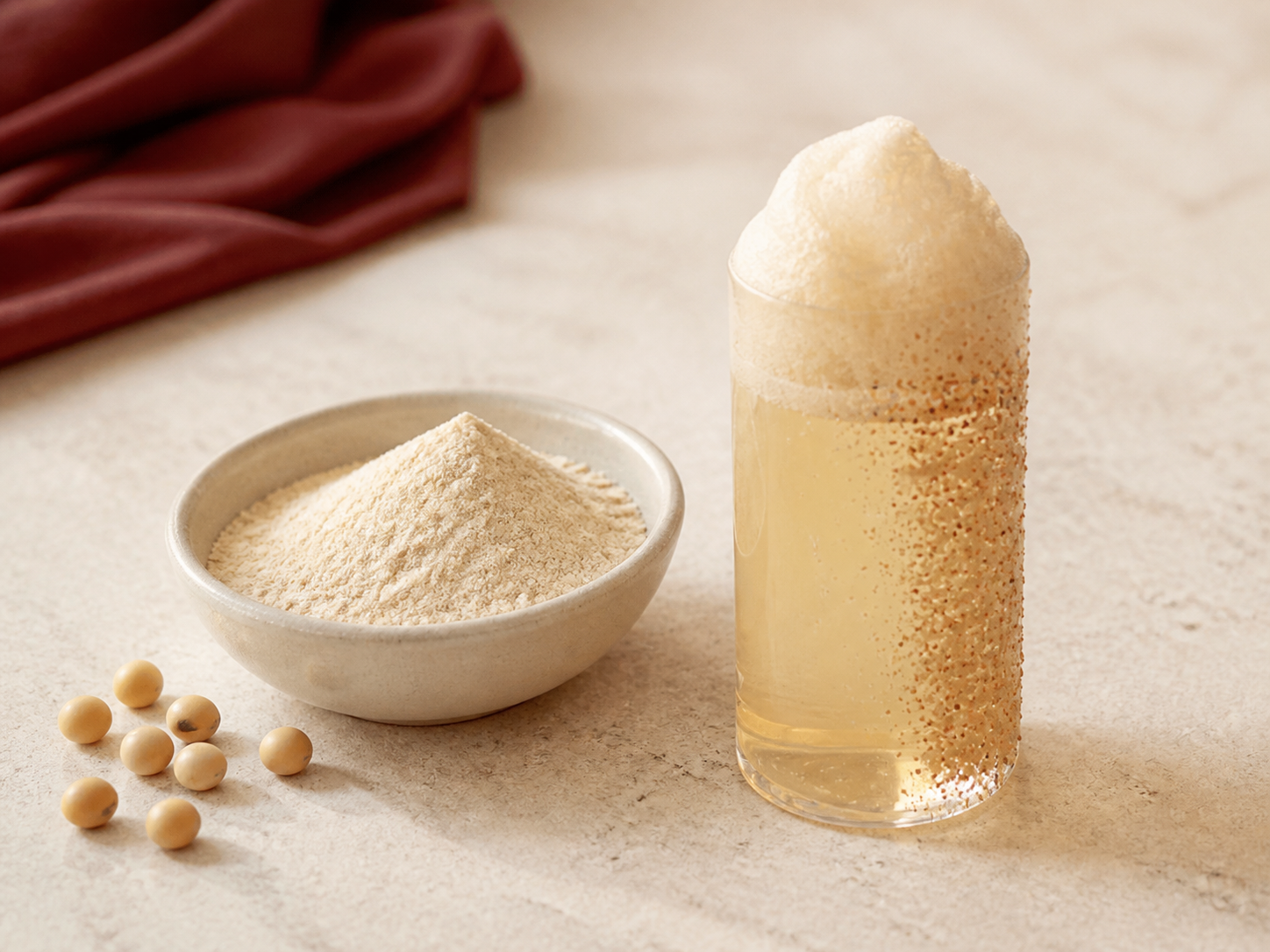
Powdered lecithin
The most common form in pastry work. A fine yellow powder that blends easily into liquids or fats. Typical dosage: 0.3 to 1% of the total weight of the preparation.
Liquid lecithin
Viscous and amber-colored, it incorporates more easily into liquid emulsions (sauces, ganaches) but is less practical in doughs. Dosage: 0.5 to 2% depending on use.
Granulated lecithin
The traditional form, which must be dissolved in a liquid before use. Primarily used as a dietary supplement; rarely used in pastry making.
The 5 main uses in pastry making
1. Stabilizing ganaches
A ganache made with very high-fat chocolate or low-fat cream can "break" — the emulsion splits and an oily layer appears on the surface. Adding 0.5% lecithin (that's 2.5 g per 500 g of ganache) stabilizes the emulsion. How to use it: stir the lecithin into the hot cream before pouring it over the chocolate.
2. Creating espumas and culinary airs (molecular cuisine)
A technique popularized by modern cuisine. A flavored liquid (fruit juice, broth, infusion) is combined with lecithin, then aerated using an immersion blender to create an ultra-light foam — almost vaporous in texture.
Basic recipe for a lemon air:
- 200 ml lemon juice
- 200 ml water
- 30 g sugar
- 2 g soy lecithin
Blend with an immersion blender for 1–2 minutes, holding the blade just below the surface to incorporate air. The foam forms on top and can be scooped with a spoon. Use as a light, airy garnish on a dessert or verrine.
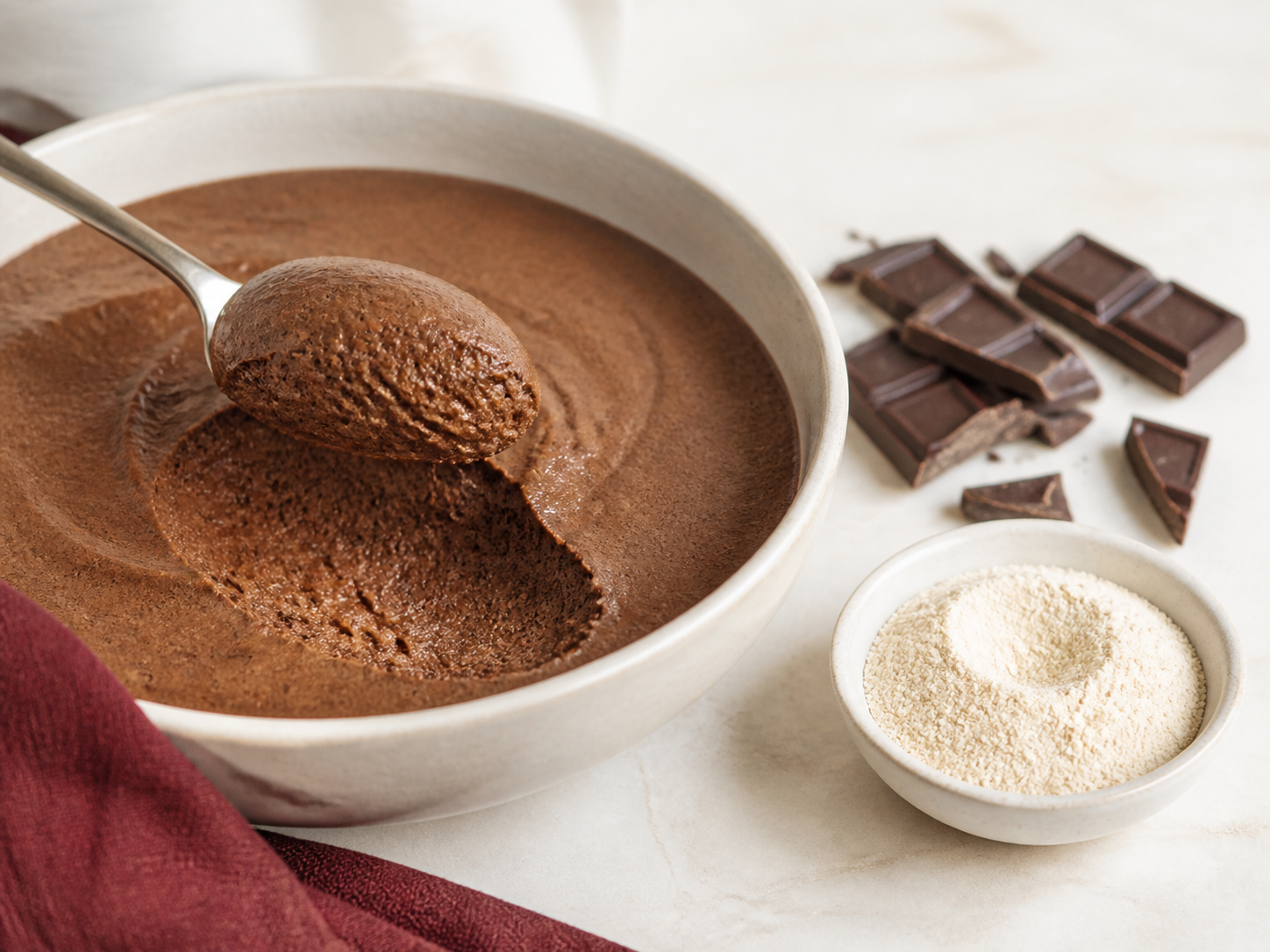
3. Improving chocolate mousses
In a classic chocolate mousse (chocolate + cream + yolks + whipped whites), a small addition of lecithin stabilizes the emulsion and prevents separation. Particularly useful when the mousse needs to hold in the refrigerator for several hours before serving. Dosage: 1 g per 500 g of mousse.
4. Enriched yeasted doughs (panettone, brioche)
Butter-rich doughs can "weep" — releasing fat during kneading or baking. Adding 0.5 to 1% powdered lecithin during kneading helps maintain the emulsion and yields a more even, homogeneous crumb. How to use it: blend into the flour before kneading.
5. Long-shelf-life ganaches (chocolate bonbons)
For chocolate bonbons intended to be kept in a box for several weeks, lecithin in the filling ganache significantly extends shelf life — from around 7 days to 2–3 weeks — by stabilizing the emulsion.
A practical example: professional-grade chocolate mousse
Here's how lecithin transforms a homemade chocolate mousse into something worthy of a restaurant dessert.
Ingredients



Method
- Heat the milk with the lecithin to 50 °C (122 °F), whisking to dissolve completely.
- Whisk the yolks and sugar together until pale and thick.
- Pour the warm lecithin-infused milk over the yolk mixture, temper, return to the saucepan, and cook to 83 °C (181 °F) to make a crème anglaise.
- Pour over the chocolate and emulsify with a spatula.
- Allow to cool to 35 °C (95 °F).
- Whip the cream to a soft, mousse-like consistency — not stiff peaks.
- Fold the whipped cream into the 35 °C chocolate base in three additions, using a gentle folding motion.
- Pour into serving vessels and refrigerate for a minimum of 6 hours.
The lecithin advantage: the mousse stays perfectly aerated for 24–36 hours, holds its structure without separating, and doesn't weep on the plate. Without lecithin, a classic mousse is best enjoyed the same day it's made.
Common mistakes to avoid
- Overdosing. Beyond 1.5%, preparations can develop an earthy or soapy taste. Stay under 1% for most applications.
- Adding to very hot liquids (>80 °C / 176 °F). Lecithin can scorch and turn bitter at high temperatures. Incorporate it into liquids between 40–60 °C (104–140 °F).
- Mixing into dry ingredients without hydration. Powdered lecithin needs to be hydrated by a liquid first. Always dissolve it in the liquid phase before adding dry or fatty ingredients.
- Using expired lecithin. Lecithin oxidizes over time and can develop a rancid flavor. Use within 6 months of opening.
Storage
Lecithin keeps well under the right conditions:
- Powdered form: 6 to 12 months in an airtight container, away from light and moisture; refrigeration is ideal but not strictly necessary.
- Liquid form: 6 months refrigerated after opening.
Signs of oxidation: a rancid smell or noticeably darker color than when first opened. Discard immediately.
What does it cost?
Lecithin is very affordable, especially in professional packaging:
- 500 g jar of soy lecithin: €8 to €15 — enough for 50 to 100 recipes depending on dosage.
- 500 g jar of sunflower lecithin: €15 to €25.
- Organic versions: €20 to €40 per 500 g.
Broken down by recipe, that works out to 1 to 5 euro cents per preparation — a minimal investment for a genuinely noticeable improvement in quality.
Where to find lecithin for pastry making
At G. Detou, 58 rue Tiquetonne, Paris 2nd arrondissement:
- Powdered soy lecithin in 250 g and 500 g jars
- Powdered sunflower lecithin for soy-free applications
- Organic soy lecithin in professional packaging
Specialist pastry supply websites also carry these products.
A word of caution about pharmacy-grade lecithin: sold as a dietary supplement, these products often contain added vitamins and other compounds that are unsuitable for pastry use.
G. Detou's advice
Most home bakers have no idea that lecithin is the secret behind stable whipped ganaches and ice creams that don't turn icy in the freezer. A dosage of 0.5 to 1% is all it takes to turn a potential mishap into a clean success. In the shop, we carry Louis François lecithin in 100 g jars — enough for roughly 18 months of regular baking for the enthusiastic amateur. We also stock the sunflower version for those avoiding soy; it's harder to find elsewhere but we get asked for it regularly.
FAQ — Lecithin in pastry making
At the correct dosage (<1%), no. Sunflower lecithin is completely flavor-neutral. Soy lecithin has a very faint nutty note at higher concentrations, but it's imperceptible at standard pastry dosages.
Egg yolk naturally contains lecithin (around 10%), which is precisely where its emulsifying power comes from. Isolated lecithin enables vegan emulsions, precise dosing (an egg yolk brings a host of other compounds alongside the lecithin), longer-lasting stability, and no eggy flavor in neutral preparations.
No. Lecithin is most useful in preparations where the emulsion is at risk of breaking, or when you want to achieve a specific effect (an airy mousse, a molecular foam). For classic recipes — pastry cream, a simple ganache — it's unnecessary.
Yes, whether soy-based or sunflower-based. Both are extracted from plant seeds. That said, always check the label for any additives that may be present in certain industrial formulations.
Soy lecithin: the risk is very low for most people with a soy allergy, as the allergenic protein is largely removed during extraction. However, a "may contain traces of soy" label is often required.
Sunflower lecithin: no known allergen concerns — the preferred choice for soy-free diets.
Yes, naturally gluten-free. However, if you require certified gluten-free status, always check the product labeling.
For a first use, start at 0.5% of the total weight of the preparation (5 g per kilogram). This is a safe, reliable dosage that delivers a noticeable effect without any risk of off-flavors.
Lecithin is considered safe at culinary dosages. It is even sold as a dietary supplement for its purported benefits on liver health and memory — the choline it contains is a precursor to certain neurotransmitters. No adverse effects have been associated with the amounts typically used in pastry making.
Lecithin is one of those ingredients that never appears in home baking recipes yet quietly underpins the quality of professional pastry work. Aerating mousses, stabilizing ganaches, creating modern culinary foams — the applications are broad and genuinely impactful. A small 500 g jar will last you months and open up an entirely new dimension of pastry technique.
Retrouvez également notre pectin guide et notre comparatif gélatine vs agar-agar.
At G. Detou, we stock professional-grade texturing agents in sizes suited to serious home bakers — no need to buy 5 kg just to experiment.
To go further: browse our full Emulsifiers, Texturizers & Acids selection.